Archives for category: Ireland

Few people outside Ireland know of Mary Raftery, but they should.

To appreciate the kind of person she was, you need to appreciate what Irish society was like just a few decades ago. Most things of importance in Ireland were controlled by the Catholic Church. Because of their power and influence, nothing happened in the country without the imprimatur of the bishops. They had ways of making their views known. What displeased them quickly came to an end. Priests were seen as minor nobility: to be revered, not to be crossed, no matter what their personal qualities and vices. The Church had their backs. So long as you followed the system, you could get on with your life.

And what of those who didn’t fit? The Church had solutions for them, too. They ran Industrial Schools to deal with poor and unruly children. They ran slave laundries to deal with unmarried mothers. Within these walls, they beat troublemakers into submission. For others, they had more effective means of gaining the upper hand, practically guaranteeing that they would never speak up for the shame of it.

Much of this took place behind closed gates and closed doors. Most people never heard of it. If you heard something, you were far better off staying quiet. Life would be easier for you. From the highest statesmen to the keenest of media investigators, the monster that lay at the heart of the Catholic Church in Ireland lay hidden for decades; all the while growing, gathering tentacles, feeding off its most vulnerable, corrupting those who came in contact with it.

This was the country in which Mary Raftery began her career in investigative journalism. Things weren’t right. A heroin epidemic was raging in Dublin. Mary began to inquire into its causes. Her inquiries lead to broken people, their dreams destroyed long before they ever took drugs. Ireland had a horrible secret, and it was behind a lock that would require several years of dogged determination to open. Mary helped to unpick that lock.

The 1990’s were not great years for the Catholic Church in Ireland. Bishops and priests were discovered to have had children in secret. Damaging books were being written. Pederasts in clerical garb were being exposed. It was possible to look upon these incidents as aberrations and the protagonists as bad apples. Easily excused and dismissed. It would take something much bigger to rock the sensibilities of official Ireland.

In 1999, Mary Raftery’s RTE documentary series, “States of Fear”, did just that. It exposed a widespread system of institutional abuse, through which thousands of children were processed, for over half a century. The system functioned through deprivation, starvation, overwork and violence: both physical and sexual. What this documentary had in abundance was evidence. After her programme, it wasn’t so easy to make excuses.

Mary went on to produce more documentaries that set out the scale of the problem. “Cardinal Secrets” (2002) showed how senior bishops “managed” the crisis, often compounding the horror and injury for victims. More recently, “Behind the Walls” (2011) shone a light into the Government run psychiatric hospitals. At one time, Ireland lead the world in terms of the number of people detained in mental institutions.

For those still in denial, the subsequent years have been torrid indeed. The scale of the problem has been revealed to be enormous and manifest. A succession of official reports have backed up, with compound interest, the original allegations. The rot within the Catholic Church has been laid bare. We now live in an Ireland that looks at the past and our past masters, and says “never again”.

We knew Mary Raftery from her regular media appearances and for her great faculty to put words to the intense anger we all felt when the latest stories came to light. She was not someone to be trifled with in a debate, as apologists found quickly to their cost. She came across as brave and ruthless in the face of grave injustice. Mary epitomised a new type of morality, based on compassion, truth and justice. She was a role model for a new, more secular generation. Mary Raftery was a sceptic, a rationalist and a humanist. Her name and her work deserves widespread recognition.

Mary Raftery died last week at the age of 54, after a battle with ovarian cancer.

Photo by hugovk. CC Licensed.

A service station was prosecuted yesterday for “under-measuring” the amount of petrol and diesel going into cars. It was the first ever successful prosecution for this behaviour. The punishment? A fine of 14,000 euro.

For a long time, I have wondered if the amount of petrol going into my car was really the quantity represented in those rapidly whizzing numbers on the pump’s display. The answer, in many cases, may well be “probably not”.

Why wouldn’t petrol station owners mess around with their pumps if the fines are so trivial? Why wouldn’t this be a major problem in the state if yesterday saw the first ever successful prosecution? The message seems to have been to do whatever you like – you will get away with it.

The National Standards Agency inspected 8,000 petrol stations last year, giving out over 2,000 warnings to owners who had their pumps calibrated incorrectly. Two thousand warnings! Just how much money did this translate to? Did the errors go both ways, or just one way? I would love to see the results of a statistical analysis checking if the errors are random, or if they are biased in any way. Such a study would clearly indicate if widespread fraud was taking place.

If I were to walk into a shop and accidentally walk out of it carrying an ice-cream I had not bought, I might well end up in court. Upon conviction I would have a criminal record. It’s a crime to defraud people out of money. The same standard should apply to business owners.

Owners of petrol stations should be criminally liable for the accuracy of their petrol pumps. If their equipment is not working correctly, it should be their primary concern to fix it immediately. If, following a first inspection, favourable errors are discovered, fines should follow, relating directly to the amount of money the pumps may have taken from customers. Subsequent favourable discoveries should be referred to the DPP. Anything else is a travesty.

(Photo “Competing” by hugovk / Flickr / CC Licensed)

Are you interested in unsolved mysteries?

This very short video clip shows a rock feature that I came across some time ago while walking the Cork coast. It’s a vertical rock face about 3 metres high and 10 metres across. Dotted across its surface are large holes, so that it resembles a gigantic block of Swiss cheese.

I have no idea how these holes were formed. It is likely that this rock face was a horizontal sea bed some 350 million years ago and that it was impacted somehow by many pillow sized boulders. Evidence of these boulders is everywhere in this particular area. Was it a volcano? A tsunami? Or something far more mundane? Your guess is as good as mine.

I’m happy to show you this place, if you have a head for heights.

I love playing around with Google Trends. You can see when particular search terms:”recession”, say, or “bailout”, hit the headlines and world consciousness and how they have fared since then. Here’s a fascinating one, though. I typed “Irish” into Google Trends and I got this profile.

No huge surprise here. Each year, there is a big spike around March 17th for some reason. The bottom graph tells the story of the Irish financial meltdown from 2008 onwards. Curiously, the St. Patrick’s spikes seem to be declining in magnitude each year. Something to worry about, perhaps?

Then I typed in the keyword “Ireland“.

A similar pattern can be seen on the bottom graph, but what is happening in the top graph? St. Patrick’s Day is almost invisible amidst the noise and yet, each year around Christmas, the frequency of “Ireland” as a search term takes a precipitous dip.  I wonder what that is all about?

Incidentally, I can’t quite figure out what the spike in late 2007 was either. Both “Irish” and “Ireland” show a similar increase, and Google isn’t helping me to locate it.

via NASA Earth Observatory

One of the things about living in Ireland is that we rarely get that much snow. In most areas it usually arrives in the depths of winter – January or February maybe – stays for about a day and then disappears again. Apart from one day last year, my kids have never woken up to snow outside their home. It’s curious because Ireland has a very high latitude on this planet. We share the same distance from the equator as Moscow, Edmonton, Gander and other bitterly cold and ice-bound places on the planet. The reason, of course, is the North Atlantic Drift: a current of warm oceanic water originating off the coast of Florida. The warm waters off our coast and prevailing northwesterly winds normally keep temperatures well above zero for most of the year.

Not so this year. A high pressure area over the North Atlantic has served us with frosty Arctic air for the best part of two weeks now. Snow, almost unheard of in November, covered most of the island with the east of the country getting a particularly thorough battering. My mother in Kilkenny is housebound and my sister in Wales was unable to come home for a wedding this weekend because of near blizzard conditions in Waterford.

Much to the disappointment of my children, Cork was spared from the snow. Snow was threatened yesterday morning but instead we got drenched by icy rain. It froze instantly to the roads, briefly turning the whole city into a massive skating rink.

NASA’s Aqua satellite took this wonderful photo of Ireland on Thursday. You can clearly see the snow clouds pasting the east coast of Ireland before venturing out into the Celtic Sea. The mid-West of Ireland, from Clare to Cork, remained relatively unscathed, while seven-foot deep snow was reported in the Wicklow mountains.

A winter to remember, for sure.

A few years ago, the Irish National Archives digitised  the census documents of 1911 and put them all on the Internet for us to see. Long-forgotten grandparents and great-grandparents were suddenly transformed into young fathers and mothers, small children and teenagers. New names were introduced to us. We were given a feeling for their occupations, their family circumstances and their positions in society. Limited though the census documents were, these people who lived a hundred years ago came to life in front of our eyes. This was the Internet at its best, providing us with a window into history.

I’m reminded of this because Google Inc. recently opened Street View to the country of Ireland. Almost every road and boreen has been mapped and it all now comes to us in full 360 degree panoramas, each image no more than 10 metres apart, covering 80,000 kilometres of roadway; terabytes upon terabytes of information freezing the Ireland of 2009 and 2010 in perpetuity.

What a treasure trove of information for the future historian. It is now possible for our children’s children to see Ireland exactly as it was during this time. They will see our dress, our cars, our gardens, our farms and our workplaces. They will witness history in the making as the Irish boom economy shuddered to a dramatic halt: the newly constructed motorways and bridges alongside the empty buildings and ghost estates; the Polish and Lithuanian shops that signified a new era of multiculturalism and the wind turbines making their appearance over the landscape as we began the painful process of weaning ourselves off the seductions of fossil fuel.

Presumably these Street View images will be updated regularly, so not only will it be possible to see Ireland as it once was, but also how our country changes gradually throughout the century. I’m assuming, of course, that all these records will not be erased; a reasonable assumption should Moore’s Law continue to hold sway over the coming years.

If there is a snag, it is that all this data is the property of a successful private company whose primary interests do not necessarily coincide with those of the citizens of a sovereign state. Although there is no sign that Google are carrying out this mapping effort with anything other than the best of motives, whether they will continue to act benevolently and responsibility with such information is a difficult question to answer. A hundred years is a long time – long enough for industries to grow and disappear and for companies to change utterly from what they once were, if they exist at all. Public information – photos of many the roadways throughout the world – has been privatised. Governments should now be thinking about how that information should be placed, eventually, back into public hands.

With Street View, Google have created a resource of unimaginable value for future historians. Here’s hoping it’s there for all to see in the years to come.

I think I was around fifteen years old. The elderly Christian Brother teaching us Religious Studies brought us all downstairs to the video room. The lesson for the day would be a documentary on Our Lady of Garabandal, a supposed “apparition” of Mary somewhere in Spain. The key message from the programme was the Blessed Virgin’s unhappiness with the world. Unless we started saying the Rosary pretty darn quick, terrible unspecified things would happen. No discussion, no criticism. We were expected to accept all of the programme’s premises at face value.

This was a major downside of an Irish Catholic education in the 1980’s. Alongside fairly solid subjects such as maths, science and the foreign languages, we were schooled in rank superstition. This was not educational, it was anti-educational. We left school in possession of a rather toxic mindset: that if a person was wearing the right clothes or had the right prefix before his name, or the right suffix after his name, then you were expected to accept that he was telling the truth, no matter what rubbish he was uttering from his mouth.

I was reminded of this a few days ago when friends of mine were discussing alternative medicine cures for various ailments. There was no analysis, no criticism. The proof was in the anecdote and the anecdote was the gold-standard.

Then there was the hubbub at Knock a few months ago, attracting thousands to witness Joe Coleman muttering nonsense into the middle distance. Many of us might laugh, but it served as a reminder that the Ireland of the moving statues hadn’t gone away, you know.

Pick up any local paper and you will find ads for peddlers of the most outrageous woo, from Chinese medicine to homeopathic treatments to new age crystal remedies. And how could we forget the pyramid schemes and the property bubbles that hit the country over the past few years? It all points a vulnerability common to us all. You might not beat the Irish, but fool us you can, and fool us you do. Every single day.

It’s all quite depressing stuff. If you want to make make a fast buck using nothing but smoke and mirrors, Ireland is as good a place as any to try your hand.

Now, I know that belief in the miraculous, the supernatural and the magical is a worldwide phenomenon. Most societies are steeped in it and it will be with us as long as our species breathe on this planet. Nevertheless, wouldn’t it be good for all of us if our kids were better prepared to accept things more on evidence than on hearsay? Wouldn’t it be better if we were taught how our brains can play tricks on us and how to avoid the more common mistakes? Wouldn’t it benefit us to quickly recognise manipulation by others? Our education system somehow avoided this aspect of our schooling and the results are everywhere to be seen.

The Irish education system, or should I say, the Catholic education system of Ireland (sadly these expressions are synonymous), didn’t dwell too much on such questions, lest we peered too closely at the shaky foundations of Catholicism’s own dogmas and diktats. We were, of course, taught to think critically, but critical thinking had its limits.

I would love to say that the system has improved greatly since I left school and that we are turning out school-leavers who have a much better handle on reality, but I fear that change has been glacially slow. I stand to be corrected in this regard.

It’s another reason why a Catholic education is not necessarily the best education for our schoolchildren. We deserve better. It’s time we got better.

The latest report on child abuse in the Dublin Archdiocese does not fail to shock. The abuse itself is chilling, depressing and appalling, but compounding it is the behaviour of senior bishops and cardinals as they conspired – over a 40 year period – to cover up the scale of the scandal throughout the Dublin area. A new word has been added to the common lexicon – “mental reservation“: where bishops could freely excuse themselves from telling the truth when under pressure to do so. The welfare of children was of little importance to these men, and the resultant suffering is incalculable.

Mary Raftery neatly sums up the gravity of this report and it’s implications for the Catholic Church in Ireland. One passage in particular stands out:

What emerges most clearly from the report is that priests, bishops, archbishops and cardinals had the greatest difficulty in telling right from wrong, and crucially that their determination of what constituted wrongdoing was vastly different from that of the population at large.

Let’s think about that, for a second. The Catholic Church, like most religions, believes that the greatest value it confers to society is its ability to guide people in distinguishing right from wrong. And yet, it’s most eminent leaders and scholars behaved – and still behave – in a way that would lead you to the firm conclusion that, despite their years of learning, refinement and experience, they have no clue as to what is commonly accepted as morally acceptable or morally abhorrent behaviour. If the very leaders of this church can’t distinguish between right and wrong, what use is Catholicism at all? Why should any sane society uncritically accept the teachings of the Roman Catholic Church in our schools? What real benefit does it offer our children?

The implications of the report are clear: The Church badly needs to be removed from the affairs of the Irish State. Let the parents and teachers teach our children right from wrong – they will do a better job. The churchmen had their chance for long time and they blew it. Enough is enough.

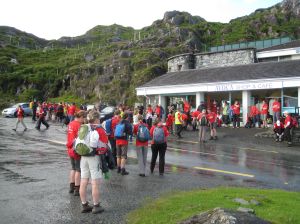
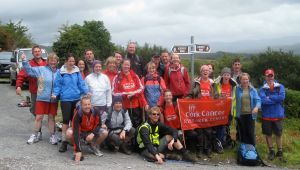
I’m back from a three day sojourn in south Kerry, walking 71 km in aid of cancer research. The format of the event this year was different from previous years, in that we were based in the same location for the whole weekend, with all walks terminating in Kenmare. We were brought to our starting point by bus from Kenmare each morning. (Kenmare is a smashing little town in south Kerry, a short distance from some of the most superb scenery in the country. If you are thinking about a trip to Ireland, it is an absolute must-see).

Moll's Gap

Moll's Gap

On Friday we travelled from Moll’s Gap to Kenmare. It was a relatively easy road walk, with the final few kilometers trudging through the hills above Kenmare. The distance was 17km, so it wasn’t too difficult. Conditions on the hills were very wet (no surprise given the rain of the last few weeks).

Lauragh to Kenmare

Lauragh to Kenmare

Saturday was the most challenging walk. We started out from Lauragh in the Beara Peninsula, and we had to overcome two hills and a long road-walk before we arrived, exhausted and footsore, into Kenmare about 8 hours later. The conditions were quite challenging, in that the ground underneath was either rocky, or very loose or sodden wet. Nevertheless the scenery was spectacular, the temperature was just right and the rain stayed away.

IMG_3322 - Old Road 1

Old Kenmare Road

Sunday was the last of the walks, from Torc Waterfall outside Killarney to Kenmare along the Old Road. This is an absolutely fantastic walk, although not for the faint-hearted. It’s a trek of about 21 km, but at times the scenery looks like something out of Disneyland. The most challenging part of the route was the end – a steep incline then decline on hard road, when my feet were shouting at me “no more”! Sunday was our wettest day. In Kerry they don’t get the kind of rain we are used to. They don’t do drizzle, or moist weather, or soft days. No, in Kerry it’s the Real Thing. From dry to drenched in 0.6 milliseconds.

IMG_3328 - Silver Bullets

All in all, a fantastic three days. I feel great from the walk, the company was great and I have to say that the organisation was fantastic throughout. I’ve had enough bananas and flapjacks to last me a lifetime.

If you would like to do something big for charity in 2010, or you just want a weekend to remember, this is the thing to do!

stoning

DERMOT AHERN: Tommy Tiernan, son of Deuteronomy of Gath.

TOMMY TIERNAN: Do I say ‘yes’?

SEAN ARDAGH, BOBBY AYLWARD, THOMAS BYRNE, SEAN CONNICK, BRENDAN KENNEALLY, DARRAGH O’BRIEN, NOEL TREACY : Yes.

TOMMY: Yes.

DERMOT: You have been found guilty by the elders of the town of uttering the name of our Lord, and so, as a blasphemer,…

CROWD: Ooooh!

DERMOT: …you are to be stoned to death.

CROWD: Ahh!

TOMMY: Look. I– I’d had a lovely gig, and all I said to my audience was, ‘That piece of legislation would make Jehovah piss himself laughing.’

CROWD: Oooooh!

DERMOT: Blasphemy! He’s said it again!

CROWD: Yes! Yes, he did! He did!…

DERMOT: Did you hear him?!

CROWD: Yes! Yes, we did! We did!…

WOMAN #1: Really!

[silence]

DERMOT: Are there any women here today?

CROWD: No. No. No. No…

DERMOT: Very well. By virtue of the authority vested in me under the 2009 Defamation Act

[NUN stones TOMMY]

TOMMY: Oww! Lay off! We haven’t started yet!

DERMOT: Come on! Who threw that? Who threw that stone? Was it you Senator Norris? Come on.

CROWD: She did! She did! He did! He! He. He. Him. Him. Him. Him. He did.

NUN: Sorry. I thought we’d started.

DERMOT: Go to the back.

NUN: Oh, dear.

DERMOT: Always one, isn’t there? Now, where were we?

TOMMY: Look. I don’t think it ought to be blasphemy, just saying ‘Jehovah’.

CROWD: Oooh! He said it again! Oooh!…

DERMOT: You’re only making it worse for yourself!

TOMMMY: Making it worse?! How could it be worse?! Jehovah! Jehovah! Jehovah!

CROWD: Oooooh!…

DERMOT: I’m warning you. If you say ‘Jehovah’ once more– [MR. A MATTHEWS stones DERMOT]

DERMOT: Right. Who threw that?

[silence]

DERMOT: Come on. Who threw that?

CROWD: She did! It was her! He! He. Him. Him. Him. Him. Him. Him.

DERMOT: Was it you?

MR A. MATTHEWS (wearing a false beard): Yes.

DERMOT: Right!

MR. A. MATTHEWS: Well, you did say ‘Jehovah’.

CROWD: Ah! Ooooh!…

[CROWD stones MR. A. MATTHEWS]

DERMOT: Stop! Stop, will you?! Stop that! Stop it! Now, look! No one is to stone anyone until I blow this whistle! Do you understand?! Even, and I want to make this absolutely clear, even if they do say ‘Jehovah’.

CROWD: Ooooooh!…

[CROWD stones DERMOT]

WOMAN #1: Good shot!

[clap clap clap]

(via Monty Python’s Life of Brian)