Our prime minister has his own special place on the bookshelves…
Our prime minister has his own special place on the bookshelves…
This is a video from an incredible day on the Skellig Islands two weeks ago. These rock stacks off the coast of Kerry are home to huge numbers of sea birds including gannets, puffins and razorbills. Skellig Michael hosts a small monastery built in the 700’s, while Little Skellig is the world’s second largest colony of Northern Gannets. Both islands are astounding in their beauty.
If you are ever in that part of the country I would urge you to check it out. Trips are arranged over the phone by contacting the operators in advance. The boat trips are weather dependent.
And now, the weather forecast…

Don’t you just love it?

For me, one of the most memorable moments in the movie “Schindler’s List” is when well dressed officials began to set up tables, open up their journals, prepare their inkwells and process the lives of human beings as if they were just commodities to be dispensed with like jam, cake and toilet rolls. All that mattered was the system. Everyone involved was a cog, with a defined role, and dare you not deviate from the actions assigned to you.
This image has come into my mind as we in Ireland learn about the atrocities committed on children by members of the Catholic Church during the 1930’s, 40’s, 50’s, 60’s, 70’s, and 80’s inside “Industrial Schools” – special institutions set up to deal with poor children. And “deal with them” they did, through a regime of mental, physical, emotional and sexual abuse.
We have been hearing about clerical child abuse for nearly two decades now in Ireland, but what is truly shocking from the Ryan report is the sheer scale of the problem. It’s a cast of thousands, if not tens of thousands. At the core were the abusers, running into the hundreds. But it didn’t stop there. Many people in high places kept quiet while these thugs did whatever they wished. What were the colleagues, the managers, the principals, the school inspectors, the civil servants, the police, the priests, the judges, the bishops and the politicians doing during this time? What did they know? What did they try to hide? This is the scandal.
There was a system in place. Clinical, effective, and unconscionably evil. This system sought to protect its own integrity above everything else, with little thought to those in its charge. This system resolutely defended the very antithesis of what it set itself up to achieve. They talked about love, but they dealt in cruelty. They talked about hope, but they only brought despair. They talked about caring, but they left a trail of broken people in their wake.
In the case of the Christian Brothers or the Sisters of Mercy, although the time for real accountability has long gone, it’s time they sold all their properties to the state to compensate the abuse victims and got off the stage. They leave behind a shameful legacy and thousands of damaged lives. They should forego their role in the education of the young, or the treatment of the sick. That’s the state’s job, not the job of the religious, who preach love and caring while keeping their dark criminal secrets under lock and key. It’s sickening that any institution, having committed so much evil during their tenure, could have any remaining authority in Irish public life.
But by and large, it’s all a footnote. These orders started hemorrhaging staff forty years ago. Even when I was in school, you would have been considered half-mad to even contemplate joining the Christian Brothers or the nuns. What remains, by and large, is a handful of septuagenarians and octogenarians in retirement homes. Most of the real criminals are long dead – saved from the debt they clearly should have repaid in their lifetimes. The bigger issue is the degree to which the authorities collaborated together, and how such collaborations should be identified, exposed and struck down whenever they occur.
For markets to work, there are strict anti-collaboration laws between suppliers, enforceable by harsh penalties. A similar situation applies to the management of the vulnerable. The managers and the regulators must never collaborate. They must never make allowances for each other. Where power rests with just one group, abuses will happen.We need to ensure that all systems of for managing the young, the sick, the elderly and the disabled are more transparent and accountable. We need systems whereby wrongdoing can be corrected quickly for the sake of those who depend on the services of that system. Bad teachers can still get protection from management and from Trade Unions, and from lax inspection regimes. So too can bad nurses, bad doctors, bad police, bad managers and bad civil servants. Even when you take the Catholic Church out of the equation, there is plenty of reason to believe that this generational disease in Irish public life will go on and on.
This link on Paddy Doyle’s website will tell you all you need to know about how much the Church and the State colluded together. It’s shameful and disgusting.
Over the weekend, I went on a trip to the Aran Islands off the coast of Co. Clare. The trip back was quite an experience.. As the video below shows, the ocean was a tad rough and the boat trip turned into a festival of international vomiting. All continents were represented, I am sure.
For those of a sensitive disposition, there is NO vomiting in the attached video, just enormous waves crashing off very high cliffs. Pretty darn impressive, if I say so myself..
As if the situation in Ireland wasn’t bad enough, we are also now a global laughing stock. Thanks a lot, Dermot Ahern.
The idea of a blasphemy law is mindboggling in this day and age. Who decides what is “grossly abusive or insulting”? A simple drawing of a man’s face is enough to cause major offence in some sections of society, particularly if the two words “Prophet Mohammed” are written underneath it, so if this is the case, ANYTHING is fair game for a law outlawing blasphemy.
What might be art or fair comment to one person might be grossly insulting to another. If the offendee gets to decide, then all free expression is in danger. Let’s remember that some people find a woman’s bare legs an offense against their religious morality.
Because the law makes it an offence to disparage any religion we could be back to book banning in this country again very soon. Up to the 1960’s, the government of Ireland zealously prohibited a wide range of publications in order to protect Catholic Ireland from mortal sin. This new bill is potentially more wide-ranging as it applies to every religion, and it impinges on all forms of expression: film, podcast, music, canvas, you name it.
Any group, including the Raelians and the Church of Scientology will be entitled to call in the lawyers if this bill is passed. Think about it: we are at risk of being sued if we were to scoff at the idea that humans are descended from inhabitants of the planet Venus..
Most religious beliefs come from a time when we knew much less about the world than we do now. Religious beliefs are often highly discriminatory, they are sometimes dangerous and they present a distorted view of reality that often contradicts the available scientific evidence. To my mind, the most serious claim against religions is that they block critical thinking, which is the main purpose of a good education. Our government seriously wants to protect this state of affairs?
So, in the spirit of Mr Ahern’s bill, I would like to propose 3 things to be outlawed forthwith.
1) Father Ted. Did Fr. Dougal not say some awful things about God? In fact, wasn’t the whole series not a piss-take on Catholic Ireland?
2) The Life of Brian. Worshipping sandals, singing while crucified, saying “Jehovah”. We’ve been there before, I seem to remember. It wasn’t very bright then, and it isn’t very bright now either.
3) Tommy Tiernan has been saying awful things about religion for years. Actually, while you are at it, lock all of those bloody comedians up. They are always making jokes about religion…
Ahern and his cabal would do well to realise that this is 2009, not 1979. If this is the standard of thinking in operation by the government, they need to leave office forthwith, lest they embarrass themselves even more.
This is the last of my 2019 time capsule postings, where I look at how the stories of 2009 might pan out in the next decade. This entry looks at two successful companies, and asks if they will still be around in 10 years time.
 From out of nowhere, Google became one of the great corporate success stories of the noughties. Originating as the first search engine that actually worked properly, it went on to corner internet advertising and to deliver such gems as YouTube and GMail free of charge to the rest of us. In the process it became a very rich company indeed. The first of it’s kind to profit hugely from the new economics of the Internet. The word “google” is even a verb, for heaven’s sake! But will they be so powerful ten years from now? Will they end up fighting endless court battles over privacy or copyright or abuse of a dominant position like Microsoft? Or might new technology from left-field beat them at their own game? It’s really hard at this remove to see any threats to their reign, but monopolies (even the good ones) rarely live forever.
Ryanair
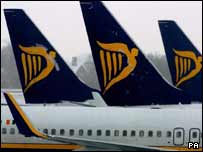 Ryanair is the airline we Europeans all love to hate, and yet despite it all, we keep flying with them. Originating in Ireland in the 1980’s it has since gone on to become one of the biggest airlines in the world by passenger numbers. The secret? An obsessive attention to low airfares resulting in full flights all the time. To their credit, they shook up a stagnant airline industry and brought huge efficiencies into air travel. More people than ever are flying routinely thanks to the likes of Ryanair. However the branding and advertising stinks of the brash Celtic Tiger “up yours” mentality, and customer service is a joke. And it’s not such a cheap way to travel anymore, with extra costs being charged for everything except breathing and going to the bathroom (no, wait)… So what is the prognosis? Will they go from strength to strength, or is there a possibility that passengers will abandon them en-masse should a half-decent alternative jump onto the stage? Well, it hasn’t happened yet despite numerous predictions to the contrary. One thing is for sure: Ryanair is lead by some very clever people and they will not give up their position readily.
On Sunday I participated in an annual charity walk from Ballycotton to Ballinrostig in Co. Cork. It’s a pretty special occasion because it is the only time in the year that walkers are permitted by the local land-owners to hike the route. As the video below will testify, the scenery is quite stunning. It’s not the easiest of walks – you have to negotiate quite a few barbed-wire fences – but the end is definitely worth the effort. The weather on Sunday was unseasonably good, which helped greatly.
So here is the video. Enjoy!

When you are admitted into hospital in Ireland, one of the first questions you are asked is your religion. The main reason, apparently, is because if you don’t manage to clock out when your stay is over, they want to be able to contact the right cleric to look after your affairs.
This bothers me. First of all, it is assumed that all residents of Ireland must have a religion. The mere idea of people walking around with no religious belief whatsoever seems to be anathema to our public services. It’s as if we ,who profess no religion, are somehow lying and that deep down we believe in a god, but that we are suppressing it. This is not a good assumption. We do not believe because there is no evidence, and plenty of contradictory evidence, despite what some people would have would have us believe. We liken belief in God with belief in Santa Claus, the Tooth Fairy and the Easter Bunny. Nobody would ever be accused of living their lives in secret denial of the Tooth Fairy, would they?
Second of all, for many non-religious people in Ireland, religion is something that we have struggled for many years to free ourselves from. Some people have painful memories from the past, others wish to undo the indoctrination of our early youth, and many of us shake our heads at the great reverence and respect shown in our society to what we see as gross irrationality. Why then are we expected to give in to religion when the final paragraphs of our lives are being written? Surely hypocrisy has no part to play in the most serious and honest moment in a person’s life?
Finally, it presents an unfortunate challenge at an unfortunate time for many non-religious people. A purely secular sending off is not open to us, as it is with people who subscribe to a particular creed. If we want to express our dissent from the consensus, then we are obliged to organize these affairs ourselves. Given the fact that there are so many of us nowadays, this is a situation that needs changing.
Organisations such as the Humanist Association of Ireland exist to provide assistance to people during major life occasions. They officiate at births and weddings and other secular ceremonies. They counsel people in their last moments and work with families and friends prior to, during and after death. However, humanist counsellors and chaplains are few and far between, particularly in the city where I live. The only non-religious funeral I have ever attended was a lonely, amateurish and sad affair that cannot have been easy on the spouse of the man who had passed away. Surely singing and poetry and prose; the hug, the handshake and the kind word, is not the sole preserve of the priest and pastor?
Irish society is growing up, so there should be more humanist options available to us to help us celebrate the major stages of our lives. It should be possible to celebrate the big moments properly – the joys, the hopes and the sadness – without the mumbo-jumbo. The non religious – the agnostics, the atheists, the secularists and free-thinkers amongst us – are as entitled to our public moments of elation, contemplation and bitter grief as anyone else. These moments should be facilitated by trained men or women who can ease the pain, organise the occasion and add to the memories.
It is something I would like to explore further.
Over the last few weeks I have been reflecting on the dramatic end to the Irish boom years. The papers and radio programs can talk about little else these days. It seemed to me that we Irish lost control of ourselves, embarking on a no-holds barred journey of utter hedonism and a devil-may-care financial splurge of epic proportions.
And yes, there were excesses. I remember once meeting the wife of a builder in Co. Clare, who told me that she changed houses every 2 years. At the time, they were both living in a 4,000 square-foot pad, and they would probably build a bigger one as soon as she got bored with it.
In a more general vein, there was the epic investment in foreign properties and towering office blocks; the multiple holidays per year to far flung locations such as Mauritius and the Seychelles; the arms races between neighbours and the ubiquity of stretch limos ferrying debutantes and first holy communicants to their dates with destiny.
But despite all this, the boom years were good years: a chance to forget the day to day struggles and to approach that stage of self actualisation heralded by Maslow. Many people were permitted to set up new businesses in a wide variety of fields, from coffee shops to tree surgery to exotic footwear. The quality of everything – food, clothes, furnishings – jumped dramatically. People were better able to provide for their families and to enjoy meals and outings with their friends. Services were set up to help people to improve the quality of their lives. People could indulge themselves in their hobbies and interests. Many people worked harder than they had ever worked in their lives, fanning the flames of an entrepreneurial ethic within Irish society. For a short few years, the wolf was no longer at the door, and it felt good.
So screw it. Let’s not regret the boom years. Let’s figure out how to get ourselves back to such times as quickly as possible so that we, our families and the less fortunate in society can benefit from a bit more cash in our pockets.
As Spike Milligan once said, “money can’t buy you happiness, but it does bring you a more pleasent form of misery”.
 Passive Impressions