Archives for posts with tag: astronomy

It’s a common story with astronomy enthusiasts. You are at a party or with friends when a friend introduces you as a person having an interest in astrology. You smile politely and gently correct them, but in the back of your mind you realise that they didn’t really get it. After all your explaining, you still expect to be called “the horoscope guy” later on. To many people, astrology and astronomy are different sides of the same coin.

Indeed, on a very superficial level, astronomy and astrology are quite similar. They are both concerned with the stars and planets, they both have very ancient pedigrees and are accompanied by a vast body of literature. Both astrology and astronomy are highly prominent in modern culture as any newspaper or magazine will attest. They both deal with future predictions and people involved in a professional level take their expertise very seriously.

However the astronomical and astrological camps are very, very different, and it is very rare to find an astronomer who has any regard for astrology whatsoever. (The opposie is probably not the case, but astrologers don’t particularly like astronomers so much). So what is wrong? Is it a case of snobbishness from the astronomical community? Professional rivalry perhaps? Or a conspiracy theory against the hard-working astrologers?

The answer is somewhat different. Fundamentally, astronomy and astrology are quite different philosophically.

Astronomy is a scientific philosophy. Astronomy is based primarily on the evidence, the facts. Beliefs about what these facts mean come second. All beliefs are tested and if they fail the tests, they are rejected. If they pass all the tests they are accepted as true, or at least provisionally true until new evidence becomes available. In this way, astronomy has been very successful in changing what were once strongly cherished beliefs – the belief that the sun and the planets revolved around the Earth, for instance, or the belief that the universe was timeless, even that time itself was somehow outside of the universe; all these ideas have perished as better data and better knowledge came on the scene.

Not so with astrology. With astrology, the beliefs themselves come first, with facts and evidence coming a poor second place. One of the strongest beliefs in astrology is that the stars and planets affect us in all sorts of ways. They guide our personalities, our moods and our fortunes in life. Now, this is a testable proposition and yet no evidence has ever been found to back up these claims. Furthermore, it is not a particularly plausible proposition given the enormous distances between astronomical bodies and ourselves on Earth and the lack of any coherent mechanism that would link the position and movement of the planets with the human psyche. The basic beliefs behind astrology therefore are magical, miraculous – somehow outside the realm of normal experience and scientific understanding.

Yet the beliefs persist. Plenty of people will tell you that astrology works. As proof they will often claim direct personal experience. The charts indicated that something would happen, and it did – exactly as described. The horoscopes gave a reading of their personalities with breathtaking accuracy. How could this happen?

The answer lies, not so much with the effectiveness of astrology, but with how our brains work. Most of us realise our brains are not perfect, but far less people understand how deep those imperfections extend. We are subject to all sorts of biases. We tend to assign undue significance to ideas we agree with while ignoring contrary ideas. We seek purpose and causality where it does not exist. We forget quickly and what we remember may often be very different from what actually happened. We are highly prone to suggestion. Professional magicians use such weaknesses against us to good (and profitable) use.

It’s not just astrology that is subject to such biases. Bias is commonplace throughout all human experience – politics, business, management, relationships, you name it. Science too. What makes the sciences different however are the extensive set of techniques that are used to eliminate bias. Controls, randomisation, blinding, sampling and peer review are examples. Such techniques, while seemingly arcane, are quite rational and logical in reality. They tend to make the process less subjective and any results tend to have greater weight, particularly if they can be repeated in a number of different settings.

The difference between astronomy and astrology highlights an important difference between science and pseudoscience. One area is founded on facts and evidence, the other is founded on beliefs. There are many fields of endeavour that are based on a set of implausible or untestable beliefs. Homeopathy, for instance, uses a belief that a tiny amount of material can cure chronic complaints and that the more dilute you make the solution, the more powerful the remedy will be. It’s over 200 years since Homeopathy originated, yet homeopaths have never properly challenged these founding beliefs. They assume them to be true and move on from there. In any field of study, when the founding beliefs are deemed to be too precious to be properly challenged, you should be very wary indeed.
My first ever podcast, “A series of spectacular events” has been posted on the 365 Days of Astronomy blog today. It recounts a number of memorable experiences that I had while looking upwards at the skies over the past few years: a meteor storm, an aurora and a space shuttle launch. Hopefully it will convey the power of astronomy to recreate that sense of wonder that we had in abundance as children.

I’d love to hear your feedback on this. It was a lot of fun to put together and I have a few other ideas in the pipe-works that I would love to turn into finished podcasts some time in the future.

Over the weekend, SpaceX managed to make history by being the first commercial company to put a payload into orbit around Earth. 

The Falcon 1 lifted off the Kwajalein Atoll in the Pacific on Sunday, lifting a 165 km dummy payload into an elliptical orbit around the planet. This is the fourth attempt after a number of high-profile failed launches. 

Although putting an object in space is no big deal nowadays, it’s still a big milestone because it heralds in a much more competitive, cheaper, efficient and fast-moving era in space exploitation.

The possibilities? Space tourism, space mining, zero-g manufacturing, and faster travel from one location to another on Earth. The downsides? More space junk and advertising.  When will the McDonald’s Golden Arches or a big Coke bottle grace our evening and morning skies, I wonder? Sooner than we might think, I expect. The day when billions of LEDs are implanted on the Moon, creating the largest dynamic TV display in history is on it’s way..

The Phoenix lander alighting on the surface of Mars

Later today (or early tomorrow morning depending on your current time zone), the Phoenix probe lands on Mars to investigate if life, or traces of ancient life, exists in Mars’ polar wastes. There is a fascinating video on APOD today showing the probe entering Mars’ atmosphere and unfurling its instruments.

It is possible that today may mark one of the greatest discoveries in human history – finding life on another planet. But what are the repercussions, really?

From a religious perspective, there appears to be two possibilities: many of the moderate religions would be relatively open to the idea that the universe is teeming with life, a view bolstered by the Vatican astronomer recently. The fundamentalist religions would appear to have a problem, having accepted that the Earth is the ultimate focus of God’s work. It’s unlikely though that any of them will collapse, inoculated as they are against logic and evidence-based thinking. A bit of word-smithing will usually suffice for most of their congregations and to hell with those throwing stones from the outside. In other words: business as usual.

From a scientific perspective, the discovery on life should not come as a surprise. Over the last 400 years, a stong body of evidence has been built up that we are not so important, or unique, in the greater scheme of things. Given the vastness of the universe, and the ability of life forms to survive even in the most inhospitable of conditions on Earth, the discovery of extraterrestrial life would only bolster this viewpoint. Philosophically, the existence of life would be uncontroversial enough. What’s far more interesting would be the questions that this discovery would pose. What is the composition of the DNA? Would the chemical composition be different? What are the origins of life on Mars? Where else might we look for life? What would the implications be were we to bring samples back to earth? What would this tell us about the creation of artificial life in the lab? To put it mildly, the discovery would have the effect of reshaping and redirecting the research agenda in the 21st Century.

From a man-in-the-street perspective, it would be enlightening, a topic of conversation. I’m not sure if it would change anyone’s life irreperably, as we have now become so used to the announcement of impressive scientific discoveries in our lives. It would be a flitting moment of celebrity, until the media find something else to absorb their attention.

Maybe I’m wrong. Maybe this is moot and the more probable event of life not being found will be the result. In any case I’d welcome any views you might have.


Comet 17P/Holmes

A new “star” has appeared in the night sky. Well, sort of. A few days ago, a relatively insignificant comet called Comet 17P/ Holmes suddenly erupted, creating the above eerie looking object in the sky, just beside the northern constellation of Perseus.

I saw the object through my small telescope a few nights ago, and it was truly unmissable. This comet “haz flavur” as they say ’round here.

To find it, try to locate the big irregular “W” in the northern sky (the constellation Cassiopeia). Then, try to find a very bright star relatively close-by (Capella). The object is about half-way between these two positions. You should be able to pick it up easily with a pair of binoculars, although, according to NASA, no equipment at all is needed: it’s clearly visible with the naked eye.

Carina Nebula

The wonderful image above was the Astronomy Picture of the Day on Google today. It’s a picture taken by the Hubble Space Telescope of the Carina Nebula, an emission nebula 7,500 light-years away.

After downloading the full image, I spent a few moments peering over the details when I found this:

Backatcha Hubble

Ah yes. Says it all really.

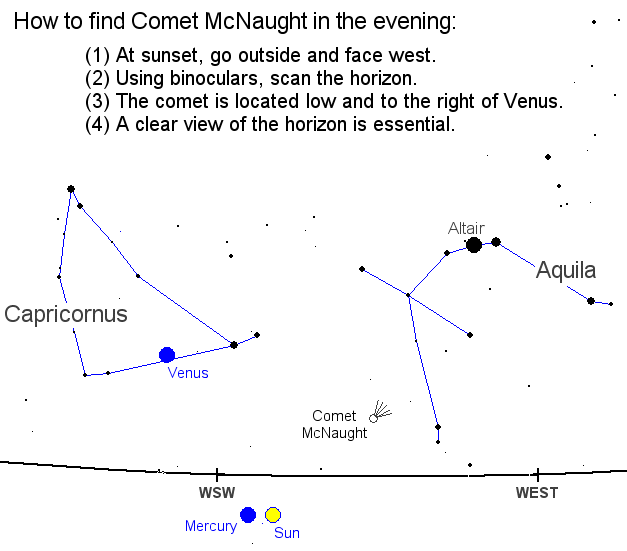
Apparently one of the brightest comets in 30 years is in the sky at the moment! You can see it just after sunset, so if the evening sky is clear, make your excuses and see if you can find it. It’s close to the sun, so look to the west. No binoculars or telescopes needed.

It’s beginning to cloud over here in preparation for yet another Atlantic storm, so I’m not sure if I’ll catch it myself. If you see it, let me know.

Here’s how to find it.

I saw a vivid fireball in the sky last night, and friends of mine are reporting the same – the Geminids are here, so be sure to pay attention to the skies over the next few days (if you are lucky enough to have clear skies). The meteor display should be greatest on Wednesday night and Thursday morning. You could possibly expect one every minute or so.

Wrap up warm, and good sightseeing!

An update: According to Spaceweather.com, a huge solar flare has erupted on the Sun, ejecting a lot of material “in our general direction”. So, not only might there be bright meteors tonight, but there is a small chance we might see auroras too. The Northern Lights are something that should not be missed. I saw them once here in Ireland, and it’s a memory I cherish – it was just magnificent. So, look for an eerie green glow in the sky tonight. You just never know..

Mars Rover (Courtesy NASA/JPL-Caltech.)

I went to a very interesting lecture last night presented by Leo Enright, the Irish broadcaster and science journalist. He talked to us about the two NASA robot probes, Spirit and Opportunity, that are currently making their way across Mars. Spirit is currently holed up in the Columbia Hills in Gusev Crater, while Opportunity has come up to the edge of the impressive Victoria Crater on the Meridiani Planum.

They both landed there in January 2004, and were originally expected to work for around 3 months. Nearly 3 years later, they are still operational, sending back pictures almost every day. Spirit celebrates its 1,000’th “sol” on Mars today. To celebrate the occasion, a panoramic 360 degree view of the Columbia Hills has been released on the internet.

McMurdo panorama from Spirit Rover (Courtesy NASA/JPL-Caltech.)

The view from the Victoria Crater is, if anything, even more stunning. The crater is about a kilometre wide, and in a few week’s time Opportunity will descend into it. (How it gets itself out is another question entirely).

Opportunity on rim of Victoria Crater (Courtesy NASA/JPL-Caltech.)

Leo demoed a free application known as “Midnight Mars” that downloads the latest photos from the rovers onto your PC each night. Because the rover cameras are about the same height as an adult human, you get the distinct impression you are standing there yourself.

The probes have bolstered the case that Mars was once covered in water and they have provided an insight into the geology and stratigraphy of the planet. Looking at the photographs from Mars, I got the distinct feeling that we know very little about the place. There is a treasure trove of information waiting to be discovered by future robot probes, and maybe some time in the distant future, people themselves.

Update: My question about how Opportunity gets out of Victoria Crater has been answered: it doesn’t. It’s fate is being decided as we speak.