Archives for category: worth a look

Oh my.

A big breakthrough was announced last month by researchers in MIT that may dramatically increase the importance of solar cells as a major source of energy. Up to now, there has been no easy way to store solar energy. The immediate availability of sunlight pretty much dictates how much power you have at any time. As soon as the sun goes down your immersion heater starts to cool down and your solar powered car grinds to a halt.

Meanwhile, nature has been busy mocking us. All around, efficient natural solar factories are at work converting the sun’s heat into chemical energy and storing this energy away for use at a later time. These conversion factories are known to the rest of us as leaves.

Taking a leaf (ouch) from nature, the MIT researchers have discovered a chemical mechanism (a catalyst) that can be used to extract oxygen from water at room temperature. Another catalyst is then used to extract hydrogen from water. All you need to trigger the reactions is electricity (from a solar cell for example). Both gases can then be safely stored away for later use. To create usable energy later on, you recombine the two gasses in a device known as a fuel cell.

Cheap, reliable, clean solar energy generated from within your home. Your house as a power station and as a refueling station. No need to wire your house to a power station. According to the scientists, we might see changes happening in as little as 10 years time. It will be interesting to see how it works out. 

Then again, this is Ireland. Now, if you could extract energy from rainclouds you might get somewhere..

It’s been some time since I’ve written about particularly good books for small kids, and I must apologise (especially to Kim) for being somewhat remiss in this area during the last few months.

For me, there is something very gratifying about sharing a compelling book with my kids. It quickly brings me back to my own childhood years by helping me relate to my children on their level. This book ticks all these boxes.

There’s No Such Thing as a Ghostie (Cressida Cowell and Holly Swain)

“But when they turned round… THERE WAS NOBODY THERE”

In this book, a young queen and her best friend do battle with the arrogant Sergeant Rock-Hard of Her Majesty’s Guard as he leads them through the castle in an effort to convince them that there’s no such thing as a ghostie. Little does he know… It’s full of delightfully poetic snippets: a Prime Minister that bears more than a passing resemblance to a certain 1980’s British PM; regular alliteration – “ghostly, ghastly feet”, “creepy, creaky staircase”, very accessible colourful drawings, and (of course) plenty of ghosties hanging around in the background. Near the end of the book, the reader is enjoined to open a trunk bearing an alarming secret. It’s one of those books in which you and your kids discover something new every time you re-read it for them.

If you know of other children’s books that really deserve a read, please let me know.

A small drawback of WordPress is it’s inability to accept posts via email.

Well, if this works, maybe it’s not so much of a drawback any more..

I’ve just set up an account on Posterous.com to do just this..


Posted by email from woodpigeon01’s posterous

Ok, so while I get my videos together on the Kerry Way walk (I’m nearly done, and I’m happy with the result – it’s just that I’m having major problems sourcing music for it), I thought I would post up a TED video that knocked me for six.

Larry Brilliant is a guy who more than lives up to the idea that we should leave the world in a better state than how we found it. Eradicating smallpox has to be one of the greatest achievements that mankind has ever put its collective mind to. Now polio and blindness are on the radar for elimination from the planet. What other scourges might scientists of the 21st Century eradicate given the collective will and sufficient resources?

The presentation contains so much: horror and fear, but also a copious dose of hope and inspiration for humanity. It finishes up with a call to action that was compelling enough to win Larry the $100,000 TED Prize in 2006. 

Just a warning: this presentation contains some harrowing images that are extremely difficult to watch. Try to bear it out. This talk is simply amazing.

The Phoenix lander alighting on the surface of Mars

Later today (or early tomorrow morning depending on your current time zone), the Phoenix probe lands on Mars to investigate if life, or traces of ancient life, exists in Mars’ polar wastes. There is a fascinating video on APOD today showing the probe entering Mars’ atmosphere and unfurling its instruments.

It is possible that today may mark one of the greatest discoveries in human history – finding life on another planet. But what are the repercussions, really?

From a religious perspective, there appears to be two possibilities: many of the moderate religions would be relatively open to the idea that the universe is teeming with life, a view bolstered by the Vatican astronomer recently. The fundamentalist religions would appear to have a problem, having accepted that the Earth is the ultimate focus of God’s work. It’s unlikely though that any of them will collapse, inoculated as they are against logic and evidence-based thinking. A bit of word-smithing will usually suffice for most of their congregations and to hell with those throwing stones from the outside. In other words: business as usual.

From a scientific perspective, the discovery on life should not come as a surprise. Over the last 400 years, a stong body of evidence has been built up that we are not so important, or unique, in the greater scheme of things. Given the vastness of the universe, and the ability of life forms to survive even in the most inhospitable of conditions on Earth, the discovery of extraterrestrial life would only bolster this viewpoint. Philosophically, the existence of life would be uncontroversial enough. What’s far more interesting would be the questions that this discovery would pose. What is the composition of the DNA? Would the chemical composition be different? What are the origins of life on Mars? Where else might we look for life? What would the implications be were we to bring samples back to earth? What would this tell us about the creation of artificial life in the lab? To put it mildly, the discovery would have the effect of reshaping and redirecting the research agenda in the 21st Century.

From a man-in-the-street perspective, it would be enlightening, a topic of conversation. I’m not sure if it would change anyone’s life irreperably, as we have now become so used to the announcement of impressive scientific discoveries in our lives. It would be a flitting moment of celebrity, until the media find something else to absorb their attention.

Maybe I’m wrong. Maybe this is moot and the more probable event of life not being found will be the result. In any case I’d welcome any views you might have.

I was lucky to attend a talk by a man called Mark Pollock today in Dublin. Mark is completely blind, having lost his eyesight 10 years ago while he was a student in Trinity College.

This event would be traumatic for anyone, but Mark rebounded. In the intervening years, he has completed a Masters Degree in Business, ran six marathons in one week in the Gobi Desert, and has successfully endured a marathon run around the North Pole. He makes his living today as a professional speaker.

That’s guts for you.

Mark had three messages for us:

1) Accept as quickly as you can what you cannot do.

There’s no point looking backwards and pretending that you are still able for something when all the evidence suggests otherwise. Mark spent some time after going blind believing that he would soon get his sight back. Accepting that this would never happen was the key to him getting on with life.

2) Figure out what you can do and go and then do it.

Mark focused on the excuses people come up with that prevents them from making the key steps to improving their lives. All they see are the problems and not ways to get around these difficulties. In his case, the targets he set built on each other over time. By starting with relatively straightforward goals, he gained the confidence and ability he needed to work on more challenging objectives.

3) Don’t go it alone. Seek help.

Mark was explicit in identifying and utilising informal networks in order to get things done. For him, the really big achievements are rarely the work of a single individual. Trying to do everything by oneself is a recipe for failure. Others, who have been there before and who know the pitfalls and mistakes can be of immense value.

Mark’s message has really hit home for me. I would recommend Mark to anyone in a business or organisation who would like to learn from a truly inspirational speaker.

Even though the multi-touch interface is now a reality in the market (what with the iPhone etc.), nevertheless I’ve been wanting to post this particular demo to my blog for some time. It took my breath away when I saw it.

It’s the future, and it’s comin’ at ya.

Vodpod videos no longer available. from www.ted.com posted with vodpod

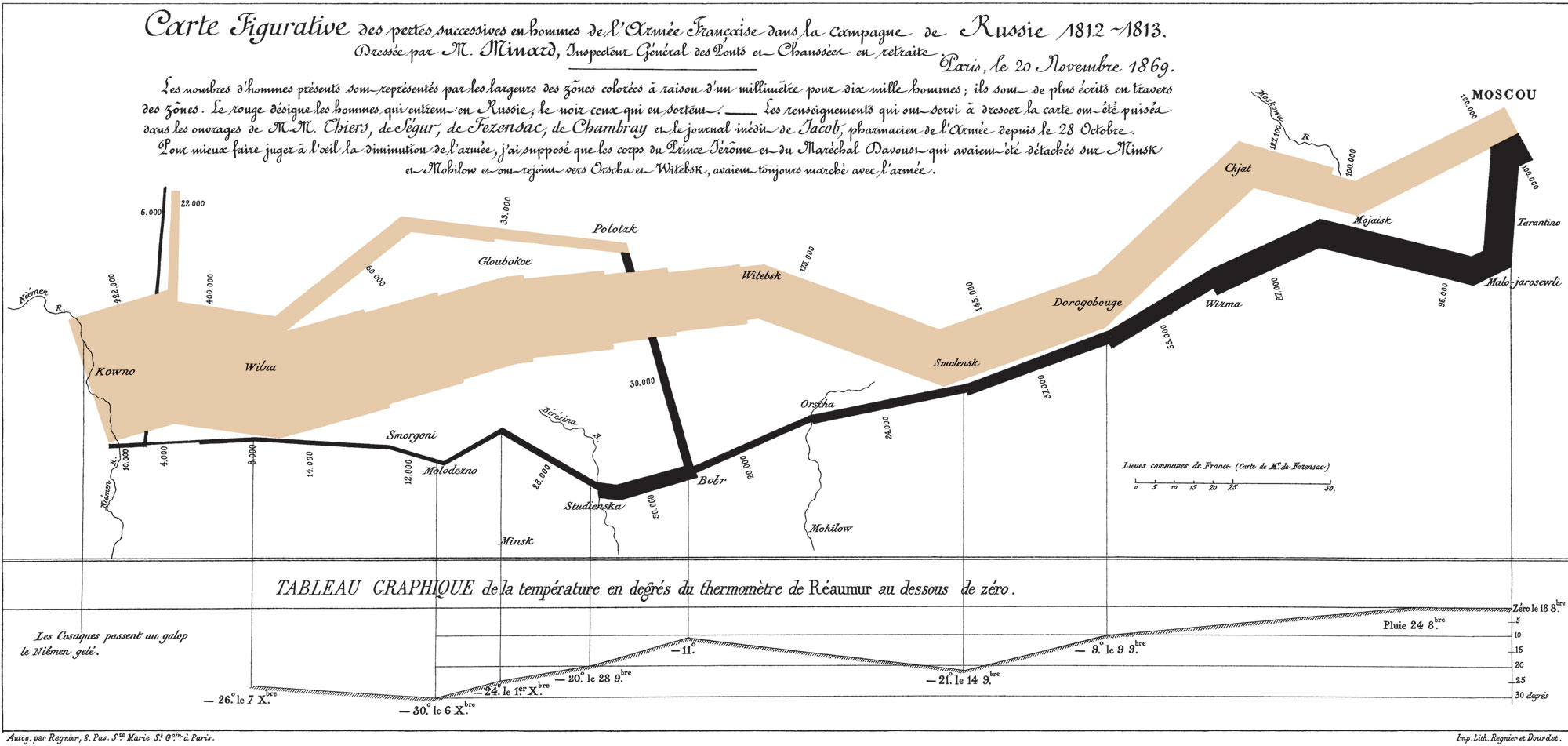
Losses of the French Army during the 1812-1813 Russian Campaign

I’ve always been a sucker for maps, so it’s no surprise that a diagram in a recent issue of the Economist got my mind-juices flowing. It shows in graphic detail Napoleon’s disastrous campaign into Russia: how an initial army of over 400,000 men got whittled down to a mere 10,000 desperate men over the course of the savage winter of 1812. This map is regarded by Edward Tufte as “the best statistical graphic ever drawn”.

In looking for more details about this graphic I came across an article about it on the Strange Maps blog, and I was hooked immediately. Recent entries contain gems such as Papua New Guinea as linguistic superpower, a caricature of Europe in 1870, and a Blonde map of Europe.

Also, as an aside, Truce mentioned an Edward Tufte book “Envisioning Information” to me some while back, that she recommended I read. What with this map and the Hans Rosling presentation capturing my imagination so recently, I’ve decided to buy the book on Amazon today.

I discovered this web-comic on WordPress some time back and I have been following it eagerly. It tells the story of Ness, a young warrior with the Fianna who sets out on a mission of vengeance within Iron Age Ireland. It’s a fascinating story, very well told. I’m looking forward to more installments from Patrick Brown in the near future.

This presentation is from Prof. Hans Rosling where he comprehensively debunks the myth of there being two worlds on this planet – a “developed world” and “the Third World”. It’s a most informative presentation! He uses the most amazing graphical techniques to do it, and delivers the content in a charismatic, engaging style. As far as presentational public speaking goes, this is the gold standard.

Vodpod videos no longer available. from www.ted.com posted with vodpod

Many thanks to my friend Brendan for the link.