Archives for category: Uncategorized

Today I managed to get to see much more of the city, taking in Chinatown, the Harbour Front Centre and the Singapore River as part of an evening on the town. 

Chinatown left an impression. It’s a large district of the town, with a diverse food market in the centre. The sights and smells make it a must see. Talking of smells, I got to whiff the delightful odours of the Durian Fruit today (they make pancakes from it). It’s pretty overwhelming. The fruit is not permitted aboard local trains and busses because of its pungency. We also passed by the Sri Mariamman temple – an amazing building in the centre of Chinatown. Close by is the Buddha Tooth Relic, which contains pretty much what it says on the tin.

Image

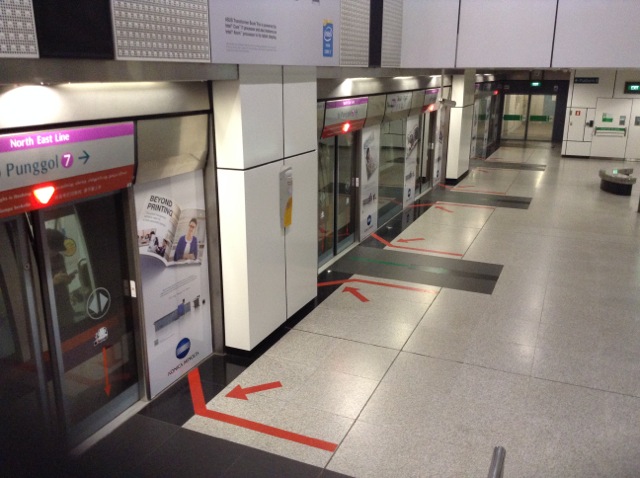
Speaking of trains, the Singapore MRT (Mass Rail Transit) system is pretty amazing. Hyper-clean, efficient and railed off by screens to avoid anyone getting too close to the tracks. There are signs on the floor telling people where to stand when alighting the train. The toll gates instantaneously calculate your fare based on the distance travelled – it’s completely cashless and based on a card top-up process. It’s also one big public service announcement, with signs telling people the fines for bringing food and drink onto the trains, or asking people to give up their seat for people in need. 

Image

It must be one of the only cities in the world where you don’t see people begging. Maybe I was in the wrong places, but I didn’t come across any vagrancy at all – not even packs of teenagers parading their boredom and weltschmertz for all to see. Everyone seems polite, well dressed and civic minded, even the kids. Added to that I saw no stray cats or dogs. Even mosquitos are a rarity in a country that’s only a few miles from the equator.

Image

We went to the Harbour Front shopping centre for the evening. Across the strait was Sentosa Island, a theme-park / leisure area for the city. It’s connected by cable car and sky-train monorail. The shops are already bedecked with Christmas decorations. I have to say it’s an incongruous and strange sight when the temperature outside is a muggy 30 degrees. From our vantage point in the Queen and Mangosteen pub, we were treated to a wonderful lightning show – no sounds, just regular darts of electricity illuminating the sky.

Image

It was also the first time I was able to appreciate the Singaporean accent. To my untrained ear, it sounds a little like the Mauritian accent – a mixture of English and other regional accents. 

Finally, we ended up in a bar on Boat Quay just across the river from the Asian Civilisations Museum. We were all quite tired then, so we quickly made our move back to the hotel – the conclusion of our last night in Singapore.

Still no sign of the phone. I’ve no idea where it might have gone. The hotel are doing an investigation, but I am now doubtful anything will turn up. 

All the pity, because we ended up in downtown Singapore last night but I have no photos to post up. We were in a bar / restaurant called La Terrazo, near Chinatown. The area is full of bars and clubs and there was a buzz to the place. It reminded me somewhat of Chicago. Apart from the low houses in this area itself, it’s all modern skyscrapers. Singapore is a high-rise society. Almost everyone lives in a government funded apartment, the cost of which, even subsidised, can be enormous.

Everyone talks about the government here too. The taxi-driver yesterday morning couldn’t stop talking about the government all the way to our destination. According to the BBC, Singapore tops the tables for so many important things: low crime rate, education, health, low corruption – yet has some of the unhappiest people in the world.

Singapore also is one of the biggest cities for gambling in the world, surprisingly close in annual revenues to Las Vegas. Singaporeans themselves are discouraged from gambling and have to pay 100 dollars per night for the privilege of attending a casino.

Many of the expats I have spoken to here love the place. The reason they commonly cite is its centrality. It’s only a short plane ride from Bali, Vietnam, Indonesia and Thailand. Kuala Lumpur is only a few hours up the road. It’s terrific for those of a certain age who want to see the world. 

Tomorrow is my last day here. How time flies.

Oh Christ. No photos tonight. I’ve lost my phone. I’m not sure if I misplaced it in the taxi on the way to work or in the hotel somewhere. It might even be at work, but so far no sign of it anywhere. I’m experiencing withdrawal systems.

Other than this, today went ok. Lots of work again, but a nice meal in the evening in the centre of Singapore. This time we ate at the Crystal Jade Korean Ginseng restaurant in the plush Ngee Ann City shopping centre. I have a love of Asian dumpling soup, so I was in seventh heaven.

What is it about Singaporean taxi drivers? Last night, we were just a little tardy getting into our taxi and before we knew it the car had driven away – a cloud of black smoke in its wake.  The driver was clearly annoyed that we had tried his patience so much. Today we took a cab with a driver who clearly preferred the delights of Siberia to the humidity of Singapore. The cab was absolutely freezing inside. We were delighted to get back to the hotel, so we could start to get circulation back into our hands and feet.

I can’t get over the friendliness of the people here. Everyone I have met is so willing to help. Their attention to detail is impressive too. When I was asking about my iPhone, the receptionist I had given my details to needed to server another customer, whereupon the other receptionist got involved seamlessly, as if they had both communicated telepathically.

Jetlag is having its effect tonight. I’m wrecked now. I’ll be up early tomorrow to put the finishing touches to my presentation tomorrow. Hopefully I’ll hear some good news about my phone.

ImageI’m staying in a posh hotel near the city centre, and as might be expected, the breakfast was out of this world. Every possible breakfast dish from every possible corner of the world seemed to be on offer. I so wanted to stay and eat and get fat and eat more and get fatter.

The traffic was quite light, even at rush hour. Apparently there is a strict limit on the number of cars in the city, and in any case, you pay through the nose for the privilege of owning one. 

Housing is also highly regulated. Even the ethnic composition of each apartment is monitored, in order to avoid ghettoisation. It’s a curious place. 

Image

Not a huge amount to report for most of today, as I was stuck in a windowless room for most of the working day. It passed by quickly though, and we ended up eating at Mellben seafood restaurant, not too far from the office. The food was delicious. Crabs and prawns and noodles and scallops and more crabs and more noodles. Scrumptious. You would not want to be on a diet. A sign inside the restaurant told us we needed to keep quiet after 10 am, as the noise was problematic for the neighbours. That was us told. 

I noticed a thread on Reddit last night that discussed the great mistake ever in history. Everything from NASA accidentally taping over some of the original moon-landing tapes and Russia selling Alaska was mentioned. It makes fascinating reading.

For me, Hitler’s invasion of Russia stands out as the greatest mistake ever made.

It’s not as if he had to do it. By early 1941, Germany had achieved a stranglehold over Western Europe. Apart from the UK,  most of the major threats had been eliminated. With most of Central Europe under Nazi control, there was now a large buffer zone between Germany and any potential invaders from the East. To the West, only the UK stood in defiance of Nazi rule. With America not yet at war, it was isolated; still reeling from Dunkirk. German bombers were wreaking havoc across the UK from London, to Belfast, to Plymouth. Money, stolen valuables and great quantities of food were flowing into Germany from France and its neighbours, all now solidly under the German jackboot.

It wasn’t enough for Hitler. Instead he eyed the great country to the east with avarice, imagining a vast living space for the German population. Here was a region awash with copious quantities of food, oil, slaves and other key mineral resources. Given how quickly Germany had conquered most of Western Europe, the pervasive view was that Russia was merely a rotten door, just begging to be kicked in.

And for a time, this seemed to be the case. Between June and October 1941, the Wehrmacht inflicted over a million Red Army casualties, snatched the Baltic states, surrounded Leningrad, conquered Kiev, and was coming within firing range of Moscow itself. 

Then nature took over. The German advance slowed to a halt as the Rasputisa – the season of mud – heralded the beginning of the Russian winter. With Moscow and the key oilfields of the south still under Soviet control, the Germans found themselves inadequately prepared for the freezing temperatures and relentless blizzards. The slowing advance gave the Russians time to call in massive reinforcements and by early December they inflicted their first major defeat of German forces. 

1942 marked a turning point in German fortunes. While they gained more ground in the summer months, they failed to take the southern oilfields, nor any other key strategic targets. German supply lines were stretched, progress was slower and casualties kept on building by the thousands. With America now in the war and Russia developing huge stockpiles of weaponry further east, it was only a matter of time before their advance would be halted completely.

The reversal began in 1943, with the meat-grinder that was the Battle of Stalingrad. Using the bitter weather and a seemingly endless supply of manpower and armaments, Russian generals overpowered General Paulus’s 6th Army. From then on, Russia had the upper hand, despite losing more soldiers in almost every encounter with German forces. Even the great tank battle of Kursk failed to stop Red Army advances.

Ultimately, Russia reclaimed every inch of territory seized by the Germans, and more. They seized large areas of Germany itself exacting a terrible price from its civilian population. The “total war” in the East made their Western front vulnerable, and in 1944, Allied forces, under US leadership, invaded France. Deprived of air support, the cities of Germany were smashed to smithereens by Allied bombers. By the time peace was declared in 1945, this once-great nation, along with many countries around it, was on its knees.

Hitler’s decision to invade Russia ultimately destroyed everything he envisioned for his country. It was a decision made from a position of hubris, a belief that war was a boon to the young men of Germany, a belief in racial superiority above all the peoples of the Earth. Overconfidently, he believed he could demolish the Red Army in a matter of weeks, long before the Russian Winter arrived. Despite the formidable strengths of the Wehrmacht, he got it badly wrong. In the following years, relentless Russian aggression whittled his army down to size, making it a manageable target for all its enemies. 

We look at Germany today, and once again it is a great nation. As a modern, liberal, democratic republic, it’s a country very different to that envisioned by the Nazis. None of its success can be attributed to Hitler and his cohorts. The rebuilding fell to the surviving children and grandchildren, along with great help from the outside. Everywhere in Germany, as in Russia, as all across Europe, are the family memories; the lost uncles and aunts, fathers and mothers, friends and loved ones. Destruction and death on a vast scale were the only legacies of Operation Barbarossa. It was one heck of a mistake.

We could ask, what if Hitler had not invaded Russia? What then? It’s certainly possible that Nazi Germany would have lasted longer. Long enough, perhaps, to develop missile-borne nuclear weapons; thus making it almost impossible to attack from any angle without enormous reciprocal casualties. The UK, even with America on its side, would have been hugely vulnerable. Wave upon wave of German bombardment, along with a robust blockade of British and Irish ports, would have made everyday life very difficult indeed. The Nazis would possibly have had time to complete, then cover up, their policy of genocide on the Jews and all unfortunate people they perceived to be less than human. A hopeless detente between America, Russia and Germany, somewhat akin to the Cold War, might have transpired; with proxy wars in Africa, the Middle East, India, South America and anywhere mischief could be made.

Decades hence, perhaps, it might have been a different story. The viciousness, violence and corruption of the Nazi regime would surely have given way to saner minds once Hitler was out of the way. Maybe a collapse, akin to the Soviet Union in the 1990’s, would have been on the cards, given enough time.

It’s purely speculation, of course. Hitler’s great mistake resulted in the deaths of millions. Had he not made it, perhaps even more would have died through the cruelty of his policies, just stretched over a longer period of time.
Last week, the Sunday Independent published a curious article about a new water technology that purported to be the “greatest breakthrough in agriculture since the plough”. This alone set my baloney detector into overdrive, and I quickly tweeted about it on our Cork Skeptics account. The story quickly went viral, catching the attention of the sceptical community in the UK and Ireland, appearing on various blogs, forums and news aggregators and getting some media attention too.

The article outlines a “groundbreaking technology” that, when applied to plants, increases their size and output, making them largely disease resistant too. What is this technology, you might ask? Water. Or more specifically, water energised by radio waves. Like, who’d have thought of that?

The article fails to convince on a number of levels. First of all, there are the exaggerated claims. Not only does the writer refer to the technology as the greatest thing since the plough, but he mentions huge savings in fertilisers, believes it can combat global warming and alludes to gigantic chickens and sheep. Then, there are the swipes at the standard bête noirs of the alternative community: pesticides and GM foods. Then there’s the muddled science that adds radio waves to water to create a miracle substance: as if nobody has tried that one before. In addition, there were the appeals to authority – the “foremost agricultural specialist”, the Kew references, the University of Limerick and Indian Government associations.

Overall, it was a badly written article that read like a rushed press-release.  It all sounded too good, too amazing, too miraculous, to be true.

I took a quick look at Vi-Aqua’s website and immediately I came across another red-flag: its lack of any side-effects. Vi-Aqua was quickly looking more like the agricultural equivalent of Homeopathy, the long discredited alternative medical treatment that has no side effects precisely because it doesn’t actually do anything. And what did I find in the “Full Scientific Proof” Report on Page 8? Yep. “Magnetic Water Memory”. In other words, Homeopathy.

Then, on Page 8: “To date no supporting scientific papers have been published”. Then why make such outlandish claims in the national newspapers? It seemed to me that we were seeing another Steorn, another Cold Fusion, another Arsenic Life, where the normal peer review process was being bypassed in order to generate media interest.

Andrew Jackson of TCD got on the case. He had a few commentaries to add: the paper cast a wide net in order to identify apparent statistical correlations, it referred to pig studies that were unblinded and inadequately controlled. None of the studies adequately supported the wild claims the article was making.

Broadsheet.ie picked it up. In the comments there was a link to a “Gallery of Water Related Pseudo-science”, in which Vi-Aqua got a mention. We also learned that the technology had been around since 2004. There was also a Reddit link with a commenter claiming that they had tested this stuff in 2007 with no discernible effect.

Then there was the Kew connection. The Sunday Independent article said the following:

In recognition of the groundbreaking technology, the Royal Botanical Gardens at Kew, London, recently took the hitherto unheard-of step of granting Professor Austin Darragh and his team the right to use their official centuries-old coat of arms on the new technology – the first time ever that Kew Gardens has afforded anyone such an honour.

A friend contacted Kew Gardens, and although initially the response was that they endorsed Vi-Aqua, I received a tweet later which said “Thank you your interest. Kew has not endorsed these products since 2006. The article in the Irish Independent was inaccurate.”

Screen Shot 2013-08-31 at 01.28.57

This pretty much brings us up to date. It would be good to hear more from Kew Gardens and from the Warrenstown people, with a review of their controls from a scientific perspective. It would also be interesting how comfortable the University of Limerick is about this, given that they appear to be associated with these claims.

Many thanks to Donncha (for alerting me to the story in the first place) and Andrew, John & Christian for the further insights.

Also worth a read is my previous blog entry on Austin Darragh, where, on national radio, he associated Chronic Fatigue Syndrome to antibiotics.

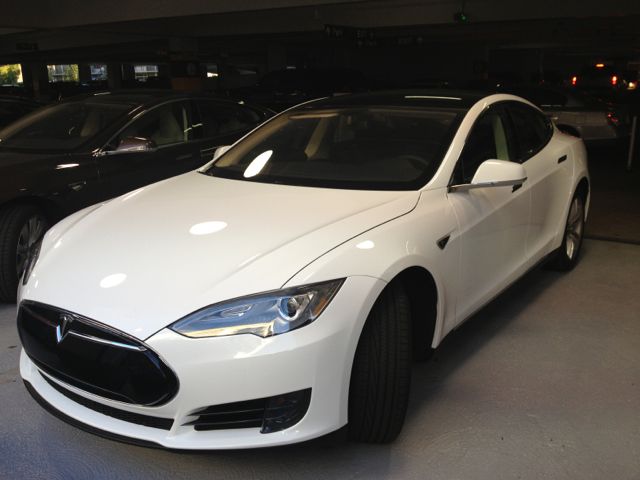
It’s been 3 years since I last went to California and one of the big changes I’ve noticed in that time is the increase in electric cars there. It’s still a tiny minority of cars on the road and most electric cars are selling at a loss, but it’s now beginning to become a realistic option.

Electric car charging stations are being set up in many big workplaces, an early sign that the era of petrol stations may be coming to an end.

Electric Cars

The car making the most waves is the Tesla Model S, a smashing looking vehicle retailing for over 60,000 dollars. I saw quite a few of them on the road when I was there.

Tesla1


It’s odd to see a gaping void where the engine is supposed to be.

Tesla2

Ireland is a long way behind with electrics. They are invisible on Irish roads, although I am reliably informed that there are  already quite a few charging points around the country. We’re still a few years from a tipping point.

Apparently, Google self-drive cars are frequently seen around Silicon Valley. Who knows what we might see in 3 years time?


Last weekend, I returned to Manchester to attend QED Con 2013. This is the biggest event in the UK and Ireland for folks interested in skepticism. It didn’t disappoint. The talks and discussions were superb.

QED: Audience at the Robin Ince / Brendan O'Neill debate

QED: Audience at the Robin Ince / Brendan O’Neill debate

First up was Stevyn Colgan, who gave a great talk about questioning assumptions in urban policing. Stevyn talked about how crime prevention needed to focus on more than just the perpetrator: the victim and the environment need to be considered too. Innovative solutions such as fake vomit, pink lighting and dog shows have their place in preventing anti-social behaviour, it seems. His talk was a discussion of how lateral thinking had produced measurable, sustainable results in preventing crime and reducing antisocial behaviour.

Next up was Helen Czerski, who struggled for the first part of her talk to get the presentation software to behave. Her talk focused on how interesting physics is all around us in everyday life and how science is for everyone, not just scientists. The talk was packed with fascinating anecdotes about bumblebees, eggs and coccolithospores (i.e. chalk).

Brooke Maganti spoke about sex, dodgy statistics and challenging assumptions about male and female inclinations in society. Her work has revealed big problems in claims of newspapers and advocacy organisations. Oh, and we’re all sex addicts.

I then attended the Skeptics in the Pub forum. As an SITP organiser in Cork, I’m scratching my head for new ideas as I look to change the format of our meetings and events. The ideas were there in abundance – storytelling events, science walks, topical subjects, civility policies, and engagement with the press and radio.

QED: Is Science the New Religion

Robin Ince lays into Brendan O’Neill during the “Is Science a New Religion?” debate.

The next meeting was “Is Science a New Religion?”, featuring Robin Ince, Brendan O’Neill and Helen Czerski. Brendan O’Neill took the view that scientists had far too much influence in the political process and that they were assuming the mantle of high priest within the power structures of society. The perspective from many there was that the reverse was the case: politics was all the poorer because of inadequate attention to evidence, except when it suited the politicians. Parliament and Government is also vastly under-represented by scientists. O’Neill got a hard time at the meeting, but I will say that differing views are important at gatherings like this. Challenging assumptions is what scepticism is about, after all.

Dr. Rachel Dunlop then spoke about the anti-vaccination movement in Australia. It’s quite a case study. The anti-vaxxers, who disingenuously call themselves the “Australian Vaccination Network” are good examples of unsinkable rubber ducks – no matter how hard you prove them wrong and challenge them in the media, they keep coming back for more. The Australian skeptics have been effective in countering false balance in their media organisations, with some measurable success.

Richard Dawkins then did an interview with Robin Ince, talking mainly about his books and ideas over the last 40 years of writing. He spoke of how Newton managed a far greater feat of understanding compared to Darwin, and yet preceded Darwin by 200 years, and how talking about Santa can be a teaching moment for kids when they eventually begin to question his existence. He had no easy answer for the human propensity for self-deception, but he did point to innovations such as the double-blind trial as tools to help people move away from dodgy thinking and poor conclusions. He also made the point that religion is not necessarily the enemy – that dogma is. Dogmas do not have to be religious to be enormously destructive.

That night we were treated to an awards ceremony and the enormous comic talents of Chris Cochrane, Michael Legge and Mitch Benn. It was hugely enjoyable.

On day 2, Carrie Poppy started proceedings by talking about how skeptics should engage more with proponents of woo by eating their dog-food, as it were. She has spent the last few years going on cleansing diets, attending a UFO cult, becoming a Mormon and submitting to acupuncture so that we don’t have to. She encourages us to try it ourselves, so we can understand more where the other side is coming from and so we can better use our anecdotes as a means of public communication.

QED: The God Panel

Mitch Benn, Laurence Krauss, Richard Dawkins and Carrie Poppy talk about God.

We then had a “God Panel” featuring Richard Dawkins, Mitch Benn, Carrie Poppie, Mike Hall and Laurence Krauss. Dawkins said that it was understandable that kids believe in God given that it is so beautiful, complicated and apparently ordered. Laurence Krauss says its more amazing that we have outgrown this simplest belief. Mitch Benn challenged Atheism Plus as people trying to turn “not a thing” into “a thing”, thereby giving critics ammunition to throw in our direction. It was an energetic and fast paced discussion all round.

There was a discussion on legal issues and defamation, appropriate in the light of the defamation bill in the UK. Ian Rushton, a member of the Crown Prosecution Service was there as were Simon Singh and Helen Dale, a solicitor based in Scotland. They talked about social media and how even retweets could be seen as libellous in certain jurisdictions.

QED: The Tree of Life

You Are Here in the Tree of Life.

Up next was Adam Rutherford, who gave a very good, accessible talk about the origins of life. Starting with the Hapsburgs and their weird family tree, he brought us through the many ideas throughout history, from creation myths to primeval soup. The second bit of his talk, on genetic modification, was just as interesting.

Finally we had Laurence Krauss, who gave a fascinating talk about the origin of the universe and how it’s stranger than we can possibly imagine. It was a great talk that brought in dark matter, dark energy and the disappearance of all the galaxies in the sky, many billions years in the distant future. “You are far more insignificant than you could ever imagine”. Don’t we know, Laurence. Don’t we know.

All in all a terrific bunch of speakers and entertainers. The pity is that I missed out on so many other great talks, such as Richard Saunders, Natalie Haynes, Mark Lynas and Rose Shapiro. Maybe next year.

In a few days, America goes to the polls to elect the person who will run the country over the next four years. The choice is between Barack Obama, the incumbent, and Mitt Romney, the Republican challenger.

If the people of Ireland were allowed a vote in the Election, we would vote overwhelmingly for Obama. This has raised a few eyebrows across the pond, but in Ireland it’s pretty clear why this is the case: the modern Republican party has an outlook that is totally alien to most Irish people. It’s an extremist dominated party characterised by a slash-and-burn approach to social welfare, touting an aggressive military policy towards foreign states, all the while attempting to row back decades of progress on womens’ rights, gay rights and worker’s rights and softening the boundaries between church and state.

A case in point: the Republican case for small government and laissez-faire economics calls to mind the Great Famine in Ireland. After successive failures of the potato crop, you would have thought that Britain would have done everything it could to prevent a catastrophe. Instead, they rationalised themselves with mantras such as “let the market decide”, and “God’s providence” to make a bad situation much, much worse. Over a million people died. It was left to charitable organisations such as the Quakers to pick up the pieces.

Having visited America many times, I have always been impressed by the friendly, hard-working nature of its people. It’s a place where friendships are made easily. People are caring, thoughtful and considerate. Normal, in other words. So why are so many people – almost 50% of the population – in thrall to the destructive policies of the American Right Wing?

Anger must play a factor. I remember many years ago, talking to an elderly American couple that I knew well. It was a polite, warm conversation until I mentioned Bill Clinton. The man’s face crumpled up and he quickly launched into a diatribe of how the man was the greatest liar the country had ever seen. If anything, this sentiment has increased, both in scope and intensity. The economy has been doing badly. Government debt is measured in the trillions. Unemployment is at record highs. It seems that everyone is looking for a scapegoat. For many, Obama is that scapegoat.

Coupled with anger is fear: the worry that left to his own devices, Obama will increase taxes on the rich and elderly, socialise the economy and punish small businesses. They worry that he will open the borders to unconstrained immigration from Latin America and make America’s borders defenceless against perceived and real enemies from outside the country. Despite four years in power, where none of these supposed inevitabilities have come to pass, these fears have not abated.

The media must take a large slice of the blame for this climate of fear. A propagandist media, the likes of which does not exist in Europe, dominates the airwaves. Theirs is a message of doom, anger, and dare-I-say-it: hatred. The word “liberal” is spat out with venom from right-wing pundits the length and breath of the country.

All one can hope for is that the demographics in the US are slowly changing. The country is transitioning from a WASP dominated culture to a more diverse, internationalised one. The Internet gives people more links to the outside world and younger people are itching to rid themselves of the Generation X and Y burdens.

The USA is a wonderful country, and one I’m in thrall to. Its ethics of hard work, freedom of speech and opportunity are ones worth aspiring to. Hopefully one day we can look back on this time and reflect on the damage that ideology can do.

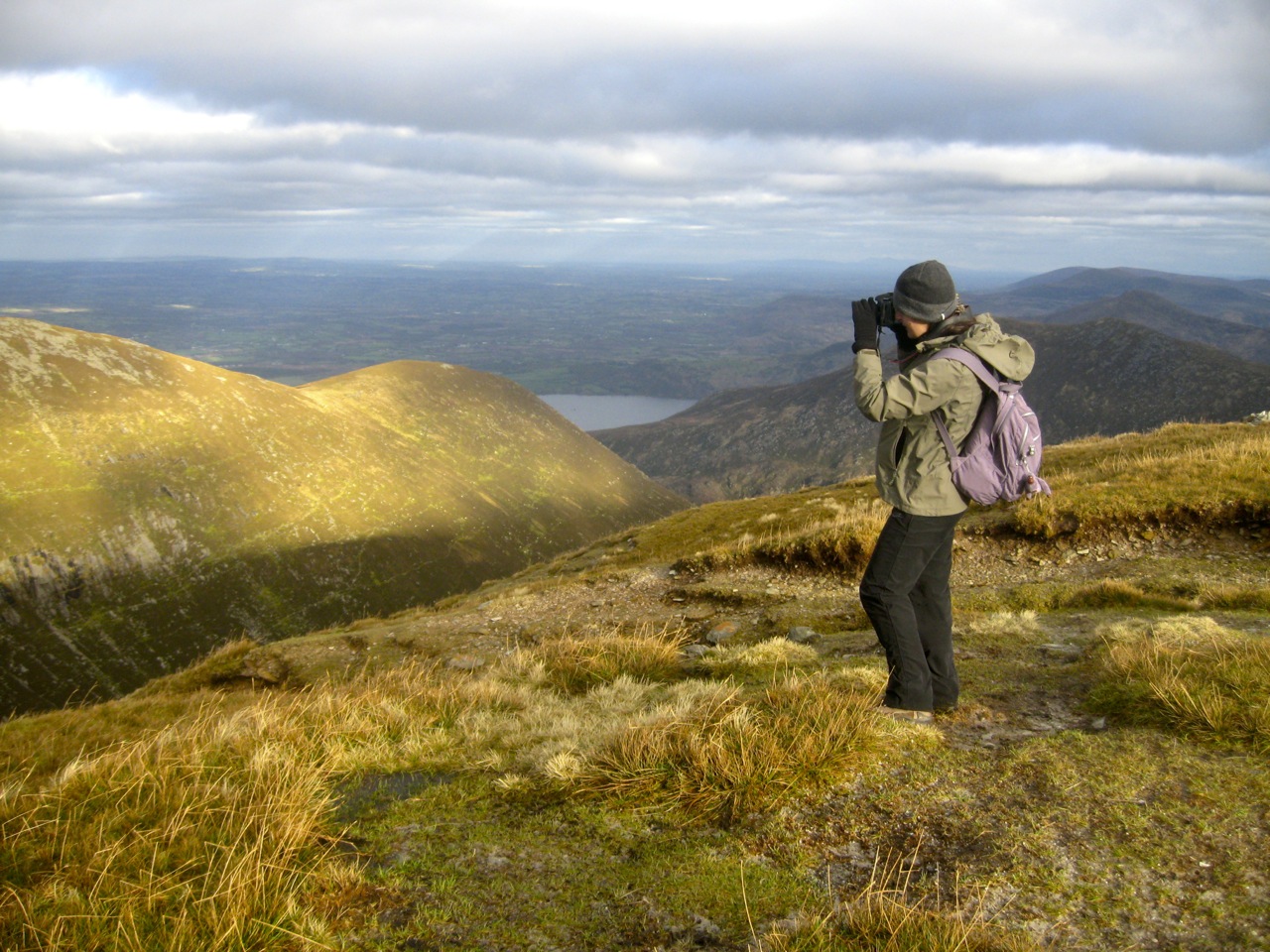
Over the weekend, Deirdre, Mark, Brendan and I took a walk in the Comeraghs: starting in the Nire Valley, crossing over to the Gap, making our way around to the Western Lakes, then climbing up to a small cairn on the plateau.

We traversed the boggy plateau, briefly encountering a “spot of bother”, when one of our group (who shall remain nameless) began to sink into the mud, saving himself using a technique with two poles that I will never forget.

After ploughing waist-deep through boggy streams and navigating through a cloudy and featureless landscape, we came to a point that we expected would lead us down the mountain. Instead of a gradual descent, however, we encountered a sheer cliff-edge. We had walked slightly further west than we had intended. We spent the next hour handrailing the cliffs until we finally discovered a safe exit from the plateau.

Just as we were going down, the cloud lifted, and we were able to make out a spectacular panorama. The walk back to the cars was almost magical, with the setting sun illuminating the valley in orange, yellow and emerald green.

It was a challenging, fun-filled, haphazard walk that we’ll remember for a long time.