Archives for posts with tag: Ireland

Here’s a nice exhibition to visit, if you are around Cork City and looking for some place to go.

The Cork Vision Centre is half way up North Main Street, close by the Gate Cinema. It’s located in what used to be St. Peter’s Church – now completely renovated. It features an impressive scale model of Cork, stretching from Blackrock Castle to the Lee Fields.

The exhibition also has paintings and sculptures by a number of local and international artists. It’s delightful stuff.

The centre is free to visit, and open from Tuesday to Saturday, 10 pm to 5 pm each day.

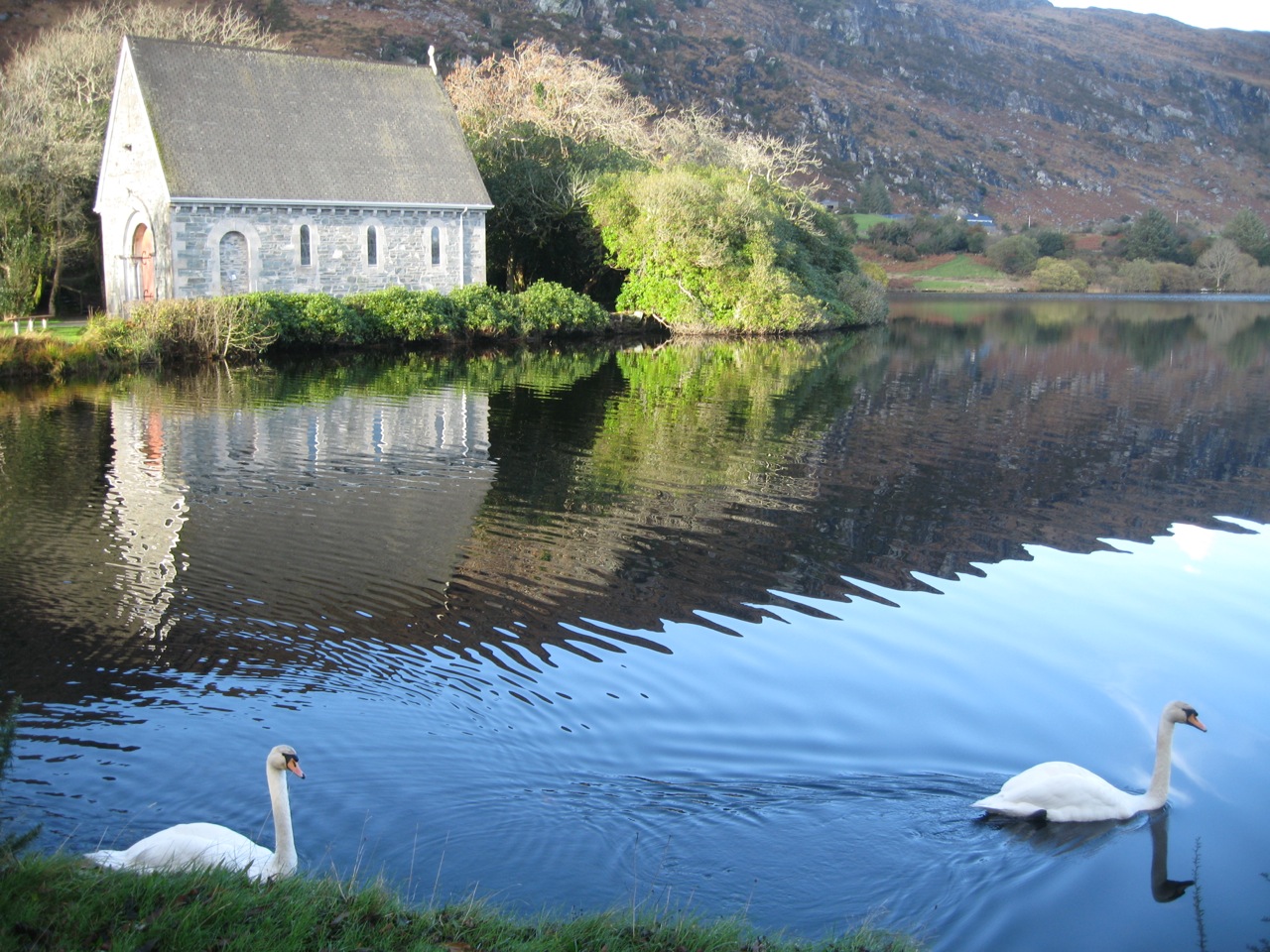
Last month, just before the sun rose in the east, I parked my car beside Loughaderra Lake, taking a moment to exit from the busy line of commuters rushing towards the city. An engaging mist was rising slowly off the water and swans lazily paddled through the ripples. It was a gentleness quite in contrast to the busy N25 road alongside it that streaks its way through East Cork.

ImageSay we didn’t split from the UK in 1922. Say a Home Rule formula was worked out, and instead Ireland became a semi-autonomous region within the British state. Our history would have turned out very differently. The question is: would we have been better off?

We have some insight into how our country might have turned out, because part of our island is still part of the UK. There are some differences between Northern Ireland and the Republic, so the analogy only goes so far. For example, the Republic is bigger; it’s had a more homogenous population, a strongly Catholic identity, and it’s been more rural and less developed for most of its recent history. Comparing the Republic to the North is instructive, but it only tells us so much.

Ireland’s post-independence history can be summarised into two main phases:  Isolation and Integration. During our period of isolation, Ireland effectively removed itself from world affairs, preferring an “ourselves alone” strategy that sought to forge its destiny utterly separate from Britain. Under isolationist politicians such as Eamonn De Valera, the economy was consigned to the margins: a rural backwater, totally in thrall to the Catholic Church. Poverty was endemic and emigration was the norm. Ireland stayed out of World War II, and effectively missed out on the industrialisation and social changes that accompanied and followed this period. People left in their droves. By 1961, its population, at 2.8 million, was 200,000 people lower than it was when it seceded from Britain in 1922.

Had we remained under British rule, it’s probable that Ireland would have industrialised and developed faster during this period. We would have been part of the war effort. This would have meant greater numbers of Irishmen enlisting with the British armed forces, greater involvement by Irish women in war-time production and significant occupation by Allied forces in the run up to D-Day. Ireland would possibly have benefitted from the Britain’s post-war recovery. It is likely that Ireland might have been better off remaining within Britain between the 1920s and 1960s.

From the 1960’s onwards, Ireland opened its door to the world. It sought out foreign investment, entered the European Community, and forged links with US multinationals in specific high-growth sectors such as pharmaceuticals and computers. Domestic businesses became internationally competitive and the population decline was soon arrested. In the last 50 years, Ireland has liberalised, secularised, industrialised and urbanised. It hasn’t all been plain sailing and despite deep recessions in the 1980’s and 2010’s, the trajectory has been broadly upwards.

It’s not easy to see how Ireland would have benefited in the same way under Britain as we have done as an independent state. Britain would have controlled our corporate tax rate, thereby hampering our attractiveness towards foreign investors. Much funding and investment would likely have been diverted towards London and the major population centres of England than elsewhere. Although Britain has many agencies promoting rural development, none have matched IDA Ireland in terms of the successful relationships it has forged and its capacity to attract inward investment.

A key consideration would be the extent to which low-level guerrilla warfare, the likes of which occurred in Northern Ireland, might have damaged Ireland’s prospects within a British state. Given our long history, animosity between Britain and Ireland would have continued and occasionally deepened, particularly during recessions and times of social change. It’s very probable, therefore, that Ireland’s fate as an economic region within the UK might have been badly affected by paramilitary operations both in Ireland and in Great Britain, even if they were eventually to be resolved by new forms of governance.

Finally, there is Britain’s rocky relationship with the EU. While we have delegated much of our economic sovereignty to Brussels and are under the watchful eye of the Troika, Ireland has largely benefitted as a member of the EU and the Eurozone, through regional subsidies, a seat at the table, the lifting of trade barriers or access to new markets. Britain’s relationship remains lukewarm, and there have been suggestions of late that it might leave the EU altogether. For a small, sparsely populated island on the western edge of Britain, this would bode badly for our long-term economic prospects.

The economy aside, it is less clear how Ireland would have developed socially and culturally under British rule. Differences between ourselves and people from Northern Ireland or most other regions of Britain are marginal at best. Ireland’s cultural life is similar in many ways to Britain: we follow similar music, watch the similar TV shows, follow similar celebrities and read similar newspapers and magazines. Our high street shops are broadly the same, so fashion trends tend to match our counterparts across the sea. We have our national sports of Hurling and Gaelic Football, but these games (particularly the latter) are followed on both parts of the island with equal devotion and fanaticism. Neither should we forget that UK soccer teams enjoy far more support here than do teams in our local football leagues. Religion is possibly a wash either way also. While religion can hugely important in terms of ethnic and cultural identity – it unquestionably played a role in Northern Ireland during the Troubles – extreme devotion to Catholicism was the norm in Ireland for long periods of independence. It’s current decline is more likely due to self-inflicted wounds and increasing levels of secularism than anything else.

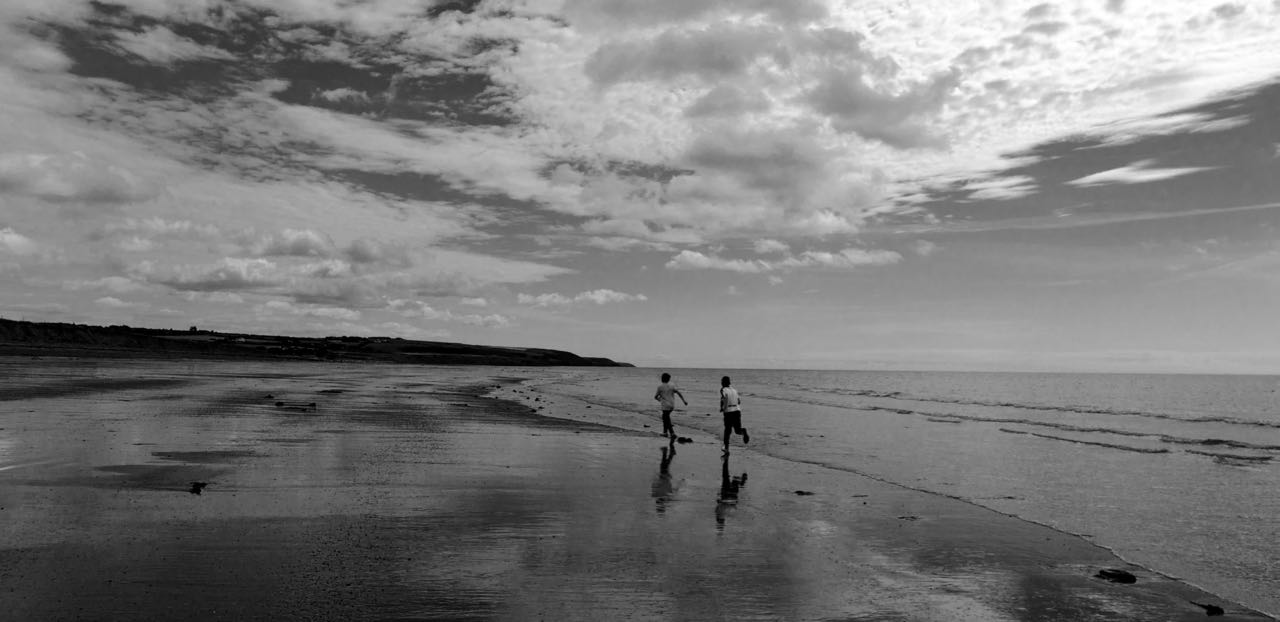
I took a short walk down to Garryvoe beach today. It was a calm, cold October day with plenty of sunlight bouncing off the sea and the shoreline.

The red and white stones, sandstone and limestone, make Garryvoe a favourite of Cork daytrippers.

We had to walk quickly as the approaching clouds heralded a big change in the weather. As I am posting this entry it is raining furiously outside.

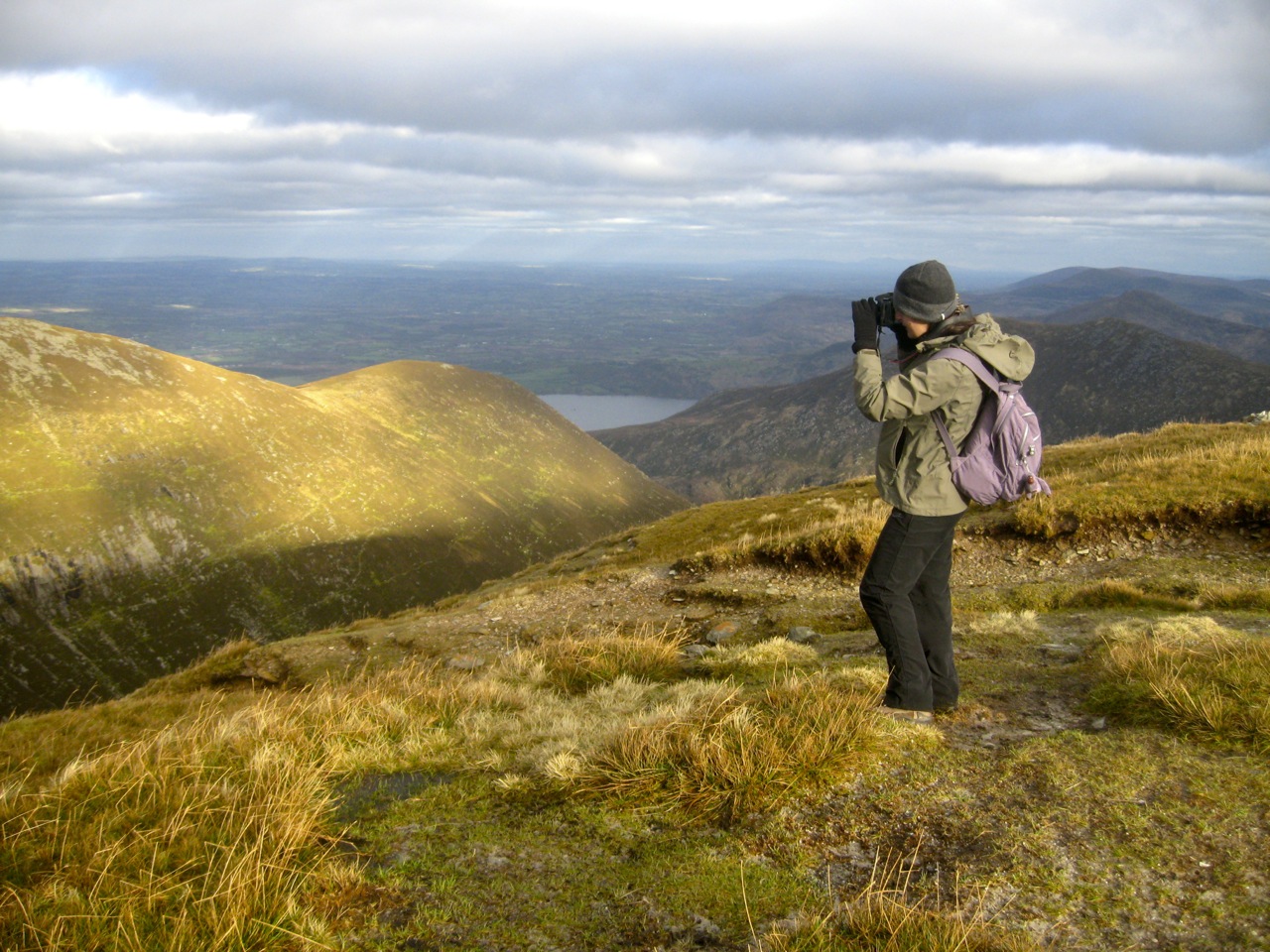
Over the weekend, Deirdre, Mark, Brendan and I took a walk in the Comeraghs: starting in the Nire Valley, crossing over to the Gap, making our way around to the Western Lakes, then climbing up to a small cairn on the plateau.

We traversed the boggy plateau, briefly encountering a “spot of bother”, when one of our group (who shall remain nameless) began to sink into the mud, saving himself using a technique with two poles that I will never forget.

After ploughing waist-deep through boggy streams and navigating through a cloudy and featureless landscape, we came to a point that we expected would lead us down the mountain. Instead of a gradual descent, however, we encountered a sheer cliff-edge. We had walked slightly further west than we had intended. We spent the next hour handrailing the cliffs until we finally discovered a safe exit from the plateau.

Just as we were going down, the cloud lifted, and we were able to make out a spectacular panorama. The walk back to the cars was almost magical, with the setting sun illuminating the valley in orange, yellow and emerald green.

It was a challenging, fun-filled, haphazard walk that we’ll remember for a long time.

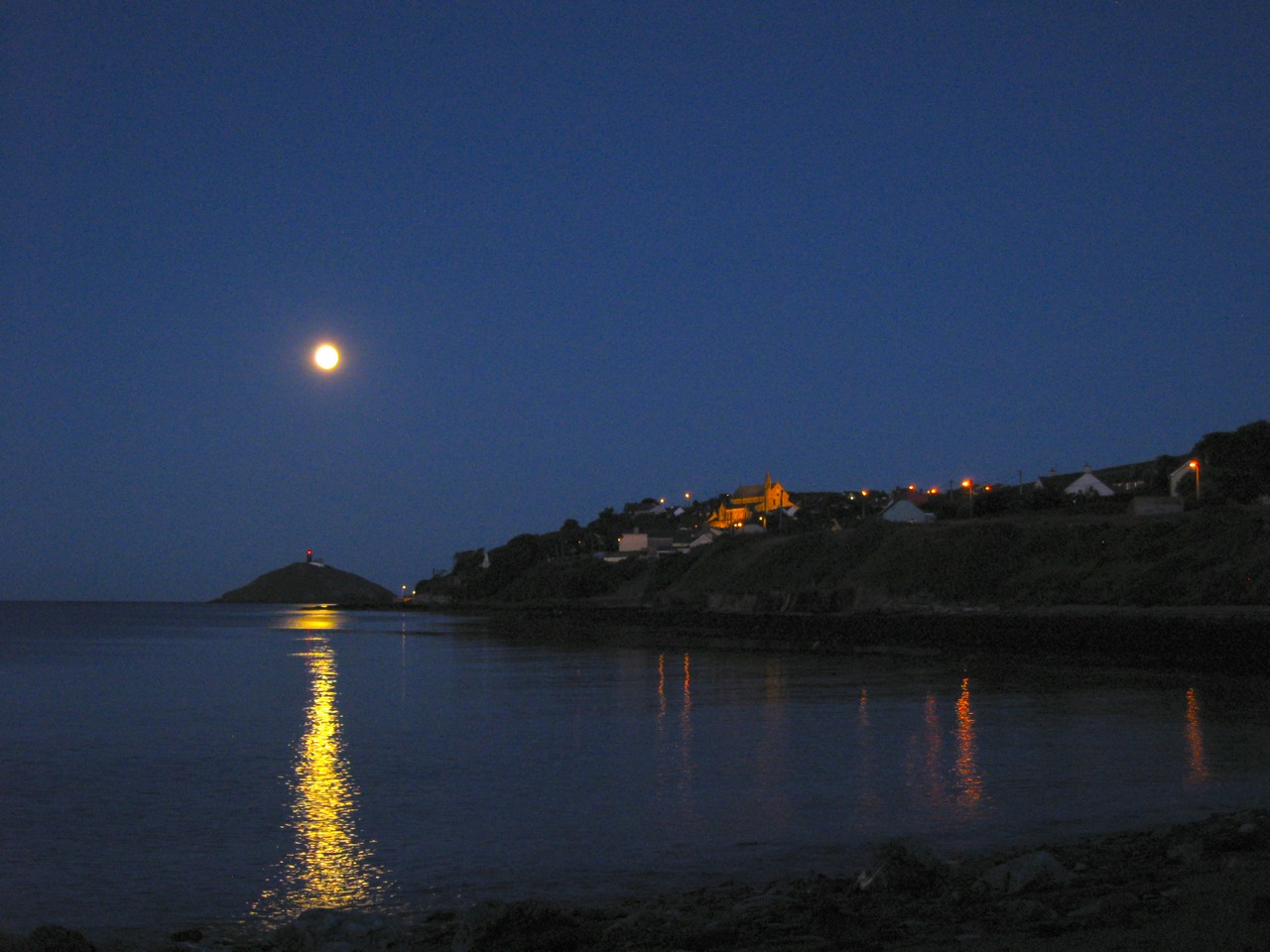
As you might have noticed from the background image, we’ve recently moved home, to a beautiful house, close to the sea by East Cork.

I was raised in the countryside, but after 20 years living in towns and cities, I had completely forgotten what it was like to live in a rural environment. The silence: interrupted only by the cooing of woodpigeons and crows. The stars: the Milky Way glistening, in all its brilliance, from horizon to horizon. Most of all, the beautiful, ever-changing views: from sunrise to sunset, the changes of colour from dull viridian to brilliant emerald; rain showers signalling their arrival as they float like wayward ghosts over distant ridges.

I’m looking forward now to winter, when the seas boil over and mighty winds assault our house, torrents of rain dashing like arrows off the windows. Inside, a fire burning brightly, king of its tiny domain, keeping us all cozily warm.  And the clear nights, dominated by Sirius and Orion to the south – the brilliant, endless scattering of stars. Endless fascinations.

There’s a feeling of freedom here. We’re minutes away from beaches, cliffs and a quiet fishing harbour. We have a choice of walks we can take, along quiet winding boreens. Although the rapidly approaching autumn darkness will hamper our evening forays, it’s a treasure to be enjoyed at the weekends.

So, hopefully, many long and happy years ahead.

I have finally yielded to the hype and I’ve downloaded Instagram. Instagram is a photo sharing app for smartphones which allows photos to be uploaded and shared. Mood filters can then be added to enhance the original.

At this time the pictures are only available on the web via services such as Webstagram.

Here are some photos from my walking trip through the Gap of Dunloe in County Kerry today.

I applied a Valencia filter to this one, creating a 1950’s effect. The old bridges in the Gap made it easy to re-create a “Quiet Man” look and feel.

We’re not sure if this boy is a pony or some sort of cross-breed. He was a great subject, though, staying bolt-still during the photo-take. The filter here was “X-Pro 11”.

This photo used a “1977” filter. From what I can remember, photos back in 1977 were pretty much like photos nowadays. The washed out look from many of these photographs is more due to the breaking down of the photographic chemicals over the intervening decades.

Finally, some lenticular clouds over the Gap, looking for all the world like UFO’s. I don’t think I used any filters at all here.

In an article in the Sunday Times today, a number of retired members of the Irish police force (Gardaí) expressed their dissatisfaction with psychics who claim to have information on the whereabouts of missing persons. On numerous occasions, Gardaí have been forced to conduct searches based purely on tip-offs from psychics and clairvoyants. No bodies have ever been found as a result of these types of searches.

“They always say a body is buried near a tree, or in water, or sometimes on a stretch of coast”, said retired assistant commissioner Martin Donnellan. “When nothing is found they’ll say the spirits are sending them the wrong signals”.

“I have never seen one of them provide any information that was worthwhile”, said retired cold-case detective Alan Bailey. “They usually claim the victim came to them in a dream, and asked them to convey a message”.

According to these sources, psychic meddling has become a big problem. Gardaí often waste precious time and resources to conduct searches they know will have no useful outcome. Psychics make contact with families, who in turn put pressure on the police to conduct a search. “In truth”, says Donnellan, “such searches are being conducted to appease families”.

The involvement of one British psychic, Diane Lazarus, was described as “unhelpful and distracting” after she claimed to provide information concerning the murderer of teenager Raonaid Murray in Dublin in 1999.

Psychics have offered their “services” in the cases of Annie McCarrick, Amy Fitzgerald, Mary Boyle, Jo Jo Dullard and Deirdre Jacob, among others. In each case the information provided has lead nowhere, instead creating false hope for the families of the victims. 

If psychics were effective, we would have heard of it by now. Psychic policing would be an active part of crime research and every police force in the world would have a psi-division. There would be abundant, successful peer-reviewed studies available and a history of solved disappearances. Instead, this field of inquiry remains where it’s always been: mired in the realm of science fiction.

Psychic investigators are engaged in a process of deception, always of others and quite often themselves. They waste police time and police resources. They provide false hope. They reopen old wounds, forcing families to re-live the terrible times of the disappearance. Their currency is delusion and the effect, almost always, is misery.

Ideally, psychics should be held financially and legally responsible for every claim they make regarding disappearances or unsolved murders. Like cigarette manufacturers, they should be forced to provide an explicit, official warning in all cases where they provide an input into a crime case, if the only information they have is from a dream, a vision or a claimed supernatural source. All cases where psychics fail to provide useful information needs to be publically registered, so that families can review for themselves how utterly useless their services are.

Until proper evidence is provided to the contrary, it is about time we allowed police to fully engage themselves in modern policing, keeping the delusional practices of psychic investigators where they should remain: in the movie theatre. 

Image by Jerry ツ

Yesterday, a man called around to the door to do a job. As soon as he had set foot inside the doorway, he started talking. And talking. And talking. He spoke about the government, the police, the criminals, the immigrants, the travellers. He gave us his views on how the law should be changed to benefit the victims and not the criminals. If we thought things were bad now, he said, just wait. They were going to get a lot worse.

It must have gone on for ten minutes. With him just inside the door. No pause in conversation. No chance for us to get a word in edgeways. No realisation that, instead of looking at him, we were staring on the middle distance.

By the time he had finished his work, the world had been set to rights. This would probably have involved the incarceration and expulsion of large sections of the Irish, and non-Irish, population.

Do these people realise they boring the pants off other people? Do they realise how offensive they are being? Do they not pick up on the hints? The lack of feedback, the glazed eyes, the silences that follow their diatribes? Don’t they realise that, if nobody seems interested in what they are talking about, that the correct course of action is to stop? Just to take a breath and listen to what others have to say?

May all of you have a bore free day today.

(Image “Boring” by Jerry ツ Flickr / CC Licensed)

I had the privilege of speaking at the First Friday’s at the Castle in CIT Blackrock Castle this weekend. My talk was “Hoaxes and Hysteria in Astronomy”, where I took a sceptical look at Astrology, UFO’s and the Moon Landing “Hoax” conspiracy theory.

I first spoke about astrology. To understand why astrology is wrong, you need to understand how it originated, and how astronomical discoveries since the 1500’s have completely overturned the basis of the belief system. It also gave me the opportunity to present Phil Plait’s frequently posted diagram:

Then I gave a potted history of UFO’s and our culture’s fascination with all things extraterrestrial. Part of it featured Orson Welles’ infamous radio broadcast that panicked half of America in 1938. Here is the first piece of the radio show. Even now, over 70 years later, it still works as a monumental piece of broadcasting.

Orson Welles later described why he did it:


While a great many people claim to have seen UFO’s, there has never been any hard evidence provided. UFO reports have been plagued by problems of mistaken identity, delusion and hoaxes. One of the best hoaxes was crop circles: initiated by two drinking buddies in the south of England.

I then spoke about the widespread perception that the moon landings of the late 1960’s and early 1970’s were a hoax and that NASA staged a cover-up of monumental proportions. There have been many rebuttals, most comprehensively done by the Mythbusters team.

Personally, I love Michell and Webb’s take on it.

At the end of the talk, I got around to my Baloney Detector Kit:

That last one, the “lone mavericks” suffering for their ideas, is particularly true. There have been far, far more wrong-headed lone mavericks” in history than the tiny number of people who have eventually been proven right.

Finally, if you have managed to read through to the end, here are some useful links should you wish to know more.

  1. BadAstronomy.com : Phil Plait waxes lyrical about his wonderment of the universe, while regularly debunking the widespread misinformation.
  2. Snopes.com : If you hear a strange tale or you get an email that sounds fishy, check this website out. It will give you some food for thought.
  3. Skepdic.com : The Skeptic’s Dictionary is a tremendous resource for people who want to understand the scientific view of modern delusions and weirdness.
  4. Randi.org : The James Randi Educational Foundation has been fighting baloney for years. There are plenty of resources there for budding sceptics.
  5. Skeptoid.com : Brian Dunning has created a comprehensive list of ten-minute podcasts debunking all sorts of strange ideas. You name it, it’s probably there.

We run regular “Skeptics in the Castle” meetings in Blackrock Castle, where experts are invited to talk about the reality behind modern misconceptions, fads and strange beliefs. Check out our website corkskeptics.org. We are also on Facebook and Twitter.