Archives for category: tours and trips

Here’s a nice exhibition to visit, if you are around Cork City and looking for some place to go.

The Cork Vision Centre is half way up North Main Street, close by the Gate Cinema. It’s located in what used to be St. Peter’s Church – now completely renovated. It features an impressive scale model of Cork, stretching from Blackrock Castle to the Lee Fields.

The exhibition also has paintings and sculptures by a number of local and international artists. It’s delightful stuff.

The centre is free to visit, and open from Tuesday to Saturday, 10 pm to 5 pm each day.

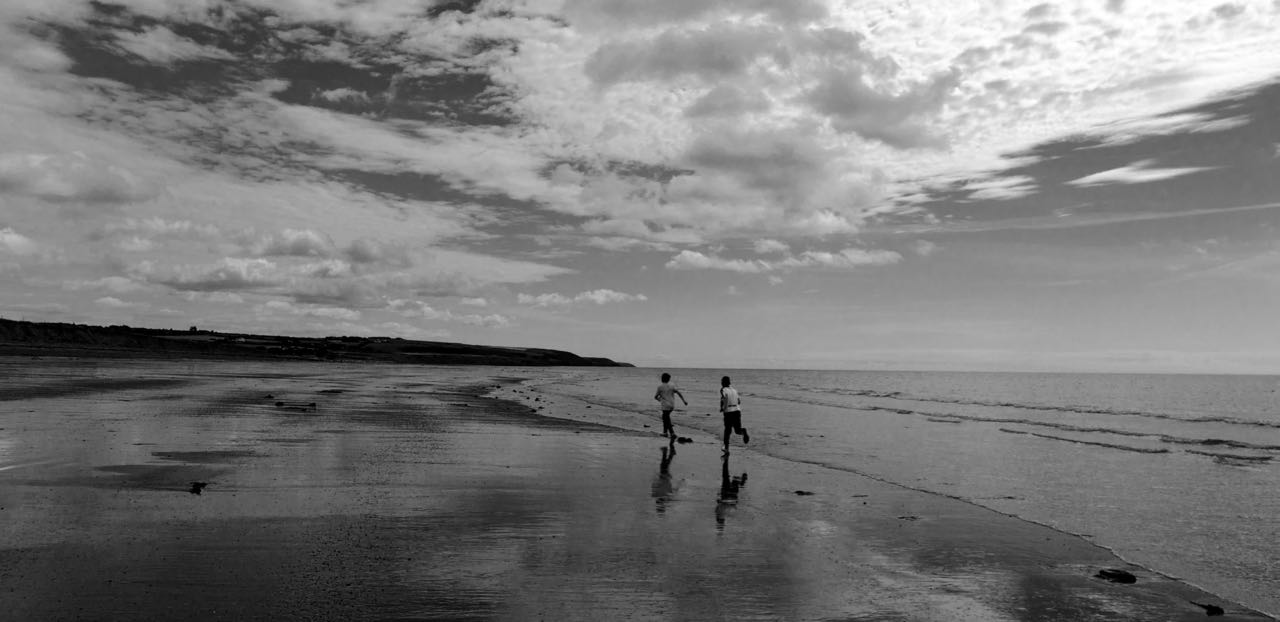
I took a short walk down to Garryvoe beach today. It was a calm, cold October day with plenty of sunlight bouncing off the sea and the shoreline.

The red and white stones, sandstone and limestone, make Garryvoe a favourite of Cork daytrippers.

We had to walk quickly as the approaching clouds heralded a big change in the weather. As I am posting this entry it is raining furiously outside.

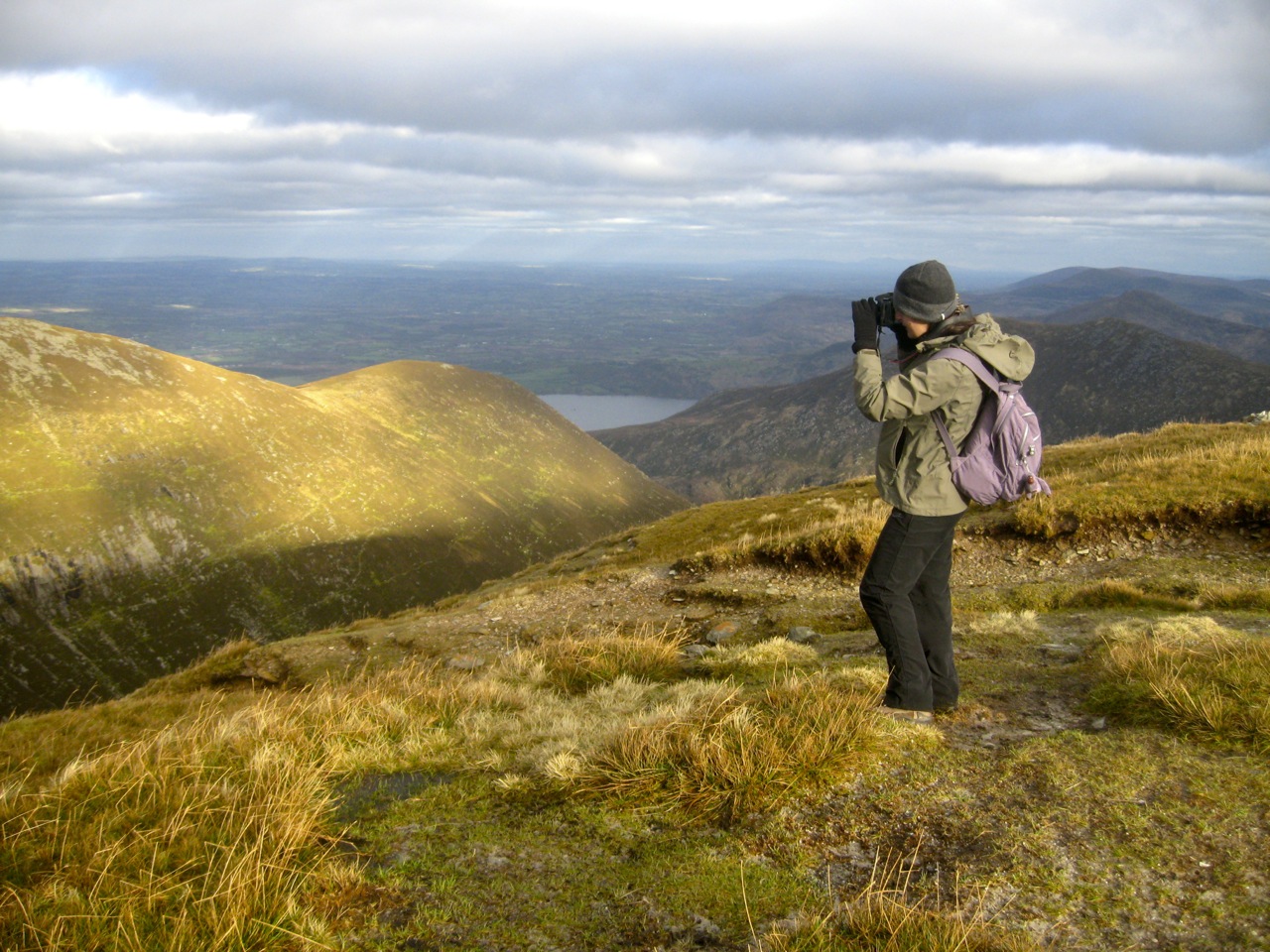
Over the weekend, Deirdre, Mark, Brendan and I took a walk in the Comeraghs: starting in the Nire Valley, crossing over to the Gap, making our way around to the Western Lakes, then climbing up to a small cairn on the plateau.

We traversed the boggy plateau, briefly encountering a “spot of bother”, when one of our group (who shall remain nameless) began to sink into the mud, saving himself using a technique with two poles that I will never forget.

After ploughing waist-deep through boggy streams and navigating through a cloudy and featureless landscape, we came to a point that we expected would lead us down the mountain. Instead of a gradual descent, however, we encountered a sheer cliff-edge. We had walked slightly further west than we had intended. We spent the next hour handrailing the cliffs until we finally discovered a safe exit from the plateau.

Just as we were going down, the cloud lifted, and we were able to make out a spectacular panorama. The walk back to the cars was almost magical, with the setting sun illuminating the valley in orange, yellow and emerald green.

It was a challenging, fun-filled, haphazard walk that we’ll remember for a long time.

I have finally yielded to the hype and I’ve downloaded Instagram. Instagram is a photo sharing app for smartphones which allows photos to be uploaded and shared. Mood filters can then be added to enhance the original.

At this time the pictures are only available on the web via services such as Webstagram.

Here are some photos from my walking trip through the Gap of Dunloe in County Kerry today.

I applied a Valencia filter to this one, creating a 1950’s effect. The old bridges in the Gap made it easy to re-create a “Quiet Man” look and feel.

We’re not sure if this boy is a pony or some sort of cross-breed. He was a great subject, though, staying bolt-still during the photo-take. The filter here was “X-Pro 11”.

This photo used a “1977” filter. From what I can remember, photos back in 1977 were pretty much like photos nowadays. The washed out look from many of these photographs is more due to the breaking down of the photographic chemicals over the intervening decades.

Finally, some lenticular clouds over the Gap, looking for all the world like UFO’s. I don’t think I used any filters at all here.

Here is a short video of our road trip to Germany this year, condensed into three minutes. Just because.

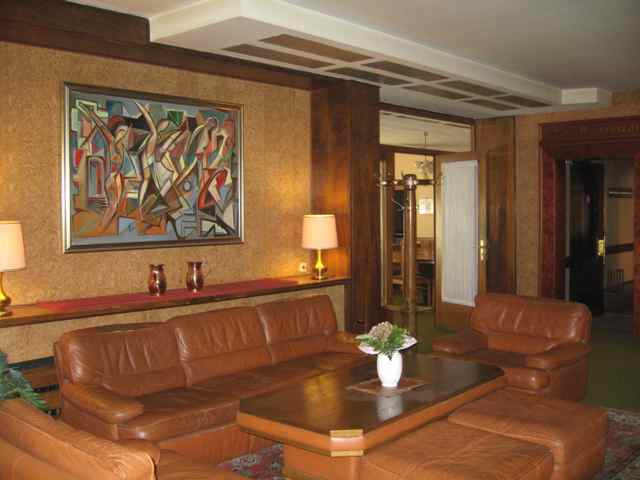
Walking into the hotel was like going backwards in time. The wood panelling, the cubist picture on the wall, the brown leather sofas. All perfect. All preserved like an ancient fly in amber. Here, the 1970’s were still alive. Little consideration was given to the peculiarities of our present age.

We had not expected to stay here. We were in this hotel because our car was undergoing emergency surgery. While driving through the Palatinate forests east of Pirmasens, we heard a bang from the engine. A battery light appeared on the dashboard and I lost power steering. We ended up in a petrol station waiting for the German AA man to arrive. He quickly diagnosed the problem. The alternator V-belt had broken. This was not something he would be able to fix by the side of the road. A trip to the garage was called for. The repair would be neither fast nor cheap. Our plans had changed.

An elderly man was waiting for us when we went downstairs for breakfast the following morning. He was dressed in an impeccable but dated waiter’s outfit. He reminded me of the butler in that perennial German favourite “Dinner for One”. The lady of the hotel, presumably the architect of this situation, was of a similar vintage. She wore a bright orange dress with her hair tied up in a beehive. Clearly, she was a beauty to behold in former years. As we were coming downstairs to check out, we could hear her tapping away at an old typewriter. I wondered to myself what had happened to cause her clock to freeze in time some forty years ago.

We took a boat trip to Spike Island in the centre of Cork Harbour last Sunday. This small, unprepossessing island has a remarkable history. It was a monastic settlement in early Christian times. A military fort was built there in the 18th Century and in the 19th Century it became a holding centre for convicts on their way to Australia. The island was occupied by British forces until 1938 and in the 1980’s it was re-opened as a prison, earning it the monicker “Ireland’s Alcatraz”. The prison has now closed, and the site is currently under the control of Cork Co. Council.

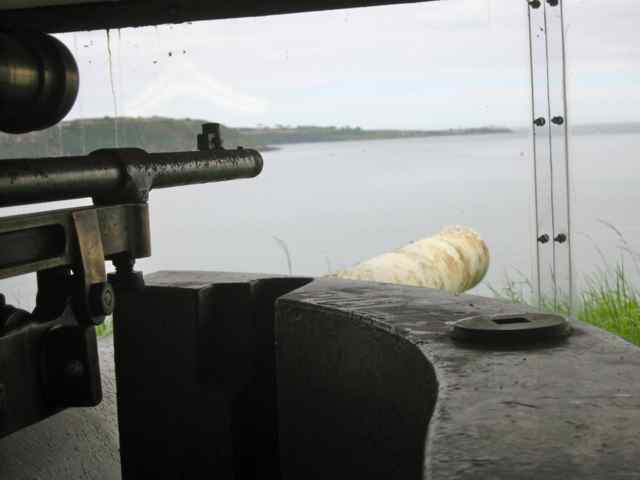
The main building on the island is a star fort, that, with Fort Carlisle and Fort Camden at the entrance to Cork Harbour, provided a strong line of defence from any possible attack from the seas. An impressive 6 inch gun is still in place there, silently directed towards the mouth of the harbour. It has never been used in anger, but plans are afoot to fire it during the Titanic centenary commemorations next year.

In 1985, the fort was used to house juvenile offenders. It was not fit for purpose and later that year, the inmates rioted. Most of the buildings within the fort were burned down. The prison was subsequently modernised but following a dispute with prison wardens, the minister for Justice summarily shut the prison down. In 2006, plans were announced to build a modern prison on the island, replacing the existing prison in Cork. These plans were abandoned after Ireland’s economic collapse. The facility is now deserted apart from the occasional guided tour.

Prisoner cell, in use up to 2004.

During the summer, visitors can go to the island by boat from Cobh. The tour itself is quite fascinating given its strategic location in the harbour and its historical significance. There are still a few issues however. It’s a pity visitors can’t stay longer on the island. There is almost no opportunity to explore it for yourself before you are called back to the boat. Most of the buildings outside the fort are in a perilous state and even some of the more recently occupied rooms could benefit from a spring-clean. Much work needs to be done to bring the history of the site more to life: signs, displays, audio-visuals etc. The narrative from the tour guide was uncritical and failed to take into account many of the complexities of our country’s past. Despite these quibbles, it’s a must see by anyone with an interest in the history of Ireland.

A map of the island is below.

We travelled once again to the Saltee Islands today, where we saw a variety of seabirds all nesting and preparing their chicks for the summer. I took this short video of the trip and I might add some photos from Claudia later. She has taken some beautiful shots today.

As for my video, well, it’s short and it has some close-up footage of a seal at the end if you manage to stay the pace. (Sorry for the wind though – will try better next time).

If anyone had asked me up to today what the Irish mainland’s most southern headland was, I would have immediately answered “Mizen Head”. I would have been wrong.

That honour goes to the much lesser known Brow Head, a few kilometres to the east of Mizen*.

Brow Head can only be visited on foot. There is a small car park near the ithmus between Crookhaven and Barley Cove. A 2km walk westwards up the Mallavogue laneway and through some fields, leads you directly to the headland. On the way, you will see the remains of some old mines, constructed in the 19th Century. There is also a signal tower on the headland, dating back to the Napoleonic times. Guglielmo Marconi built one of the first transatlantic telecommunications towers on the headland.

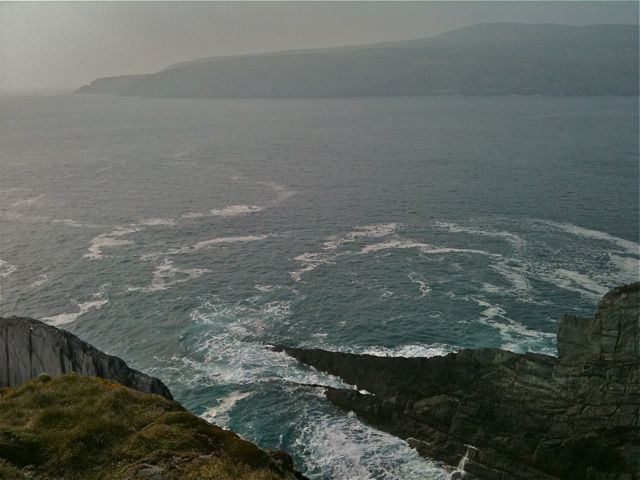
The headland itself is precarious. There are high cliffs on both sides, with sheer, vertical drops in all cases. Brow Head is undergoing active erosion and entire bedding planes are exposed in some places. The wave action is intense, to say the least. We were fortunate to come there during a large swell. The huge volumes of water crashing into and pouring off the rocks were nothing short of breathtaking.

Here’s a short video to give a flavour of the place. It’s a real gem. Hidden Ireland at its best.


* Mizen Head is actually the third most southerly point on the Irish mainland. That’s a good pub quiz question for you, right there).

The day turned out to be wet and misty, so instead of our planned hillwalk we ended up walking the Glenshelane Forest Trail near Cappoquin, Co. Waterford. “Glenshelane” translates into “Valley of the Fairies” and with its meandering streams and moss covered trees there is something magical about the place (or at least the parts that have not been the subject of recent tree-felling).

By accident, we ended up at a place called Melleray Grotto. It’s a strange place. Nestled beside a bridge across the Monavugga river, the grotto has a large shelter and car-park in addition to the usual statues of Mary and St. Theresa. According to the signs and leaflets there, three children saw multiple apparitions of the Virgin Mary there in 1985, the same year as the moving statues phenomenon in Ireland.

The children reported seeing Noah, Jesus and the Devil among other biblical characters. According to them, Mary spoke to them on a number of occasions. The free leaflet provides us with a transcript of what she said: pronouncements like “I Want Prayer” and “The World Must Improve” – not exactly the most inspirational of stuff. She even went on to predict a great cataclysm in 1995. Unless I am much mistaken, this did not happen in 1995, or am I wrong? (Ah, but of course, there was that matter of a divorce referendum…).

I was left with the distinct impression that the whole thing was a hoax or a prank that went somewhat out of control, or perhaps the exploitation of people who might have been in need of professional medical help. Over the period of the “visions”, thousands of people descended on the place, just as they were doing in similar places around the country.

On the seats nearby was a Catholic newspaper that seemed gave the distinct impression of a religion on the ropes; as if they had rounded up the wagon train and all you could see, looking from the outside, were guns pointing at you. Everyone becomes their target – atheists, secularists, liberal Christians, Muslims, anyone who does not sign up to their strict interpretation of Christianity. This is fine, I guess, for preserving intact the worldview of the faithful, but useless as a vehicle for attracting new recruits. The paper is full of anger, bitterness and despair for the future.

It’s a ramshackle place where one’s common understanding of the world takes a somersault, to be replaced by arcane stories and apparent miracles. A place where normal critical thinking takes a vacation. Not so different, I would think, to Hindu shrines half a continent away, with their votive candles, petitions and magical holy water. The pleas and prayers are sodden with desperation and agony. Rather than making people more comfortable about their troubles, I wonder if it only makes things worse by assigning an agent, a conscious cause, to their suffering. If their problems – serious illness or  a bereavement  say – were caused by a conscious agent, then you will never stop asking why and no answers will ever come. That’s not comfort in my book.

The Grottos is an odd, fascinating and somewhat sad place: a distinct throwback to the Middle Ages and an insight into the power and irrationality of human belief.