Archives for posts with tag: Ireland

Few people outside Ireland know of Mary Raftery, but they should.

To appreciate the kind of person she was, you need to appreciate what Irish society was like just a few decades ago. Most things of importance in Ireland were controlled by the Catholic Church. Because of their power and influence, nothing happened in the country without the imprimatur of the bishops. They had ways of making their views known. What displeased them quickly came to an end. Priests were seen as minor nobility: to be revered, not to be crossed, no matter what their personal qualities and vices. The Church had their backs. So long as you followed the system, you could get on with your life.

And what of those who didn’t fit? The Church had solutions for them, too. They ran Industrial Schools to deal with poor and unruly children. They ran slave laundries to deal with unmarried mothers. Within these walls, they beat troublemakers into submission. For others, they had more effective means of gaining the upper hand, practically guaranteeing that they would never speak up for the shame of it.

Much of this took place behind closed gates and closed doors. Most people never heard of it. If you heard something, you were far better off staying quiet. Life would be easier for you. From the highest statesmen to the keenest of media investigators, the monster that lay at the heart of the Catholic Church in Ireland lay hidden for decades; all the while growing, gathering tentacles, feeding off its most vulnerable, corrupting those who came in contact with it.

This was the country in which Mary Raftery began her career in investigative journalism. Things weren’t right. A heroin epidemic was raging in Dublin. Mary began to inquire into its causes. Her inquiries lead to broken people, their dreams destroyed long before they ever took drugs. Ireland had a horrible secret, and it was behind a lock that would require several years of dogged determination to open. Mary helped to unpick that lock.

The 1990’s were not great years for the Catholic Church in Ireland. Bishops and priests were discovered to have had children in secret. Damaging books were being written. Pederasts in clerical garb were being exposed. It was possible to look upon these incidents as aberrations and the protagonists as bad apples. Easily excused and dismissed. It would take something much bigger to rock the sensibilities of official Ireland.

In 1999, Mary Raftery’s RTE documentary series, “States of Fear”, did just that. It exposed a widespread system of institutional abuse, through which thousands of children were processed, for over half a century. The system functioned through deprivation, starvation, overwork and violence: both physical and sexual. What this documentary had in abundance was evidence. After her programme, it wasn’t so easy to make excuses.

Mary went on to produce more documentaries that set out the scale of the problem. “Cardinal Secrets” (2002) showed how senior bishops “managed” the crisis, often compounding the horror and injury for victims. More recently, “Behind the Walls” (2011) shone a light into the Government run psychiatric hospitals. At one time, Ireland lead the world in terms of the number of people detained in mental institutions.

For those still in denial, the subsequent years have been torrid indeed. The scale of the problem has been revealed to be enormous and manifest. A succession of official reports have backed up, with compound interest, the original allegations. The rot within the Catholic Church has been laid bare. We now live in an Ireland that looks at the past and our past masters, and says “never again”.

We knew Mary Raftery from her regular media appearances and for her great faculty to put words to the intense anger we all felt when the latest stories came to light. She was not someone to be trifled with in a debate, as apologists found quickly to their cost. She came across as brave and ruthless in the face of grave injustice. Mary epitomised a new type of morality, based on compassion, truth and justice. She was a role model for a new, more secular generation. Mary Raftery was a sceptic, a rationalist and a humanist. Her name and her work deserves widespread recognition.

Mary Raftery died last week at the age of 54, after a battle with ovarian cancer.
Here’s some delightful news to wake up to on a gloomy Monday morning.

Minister of State for Enterprise Seán Sherlock is to publish an order early in the new year that is expected to allow music publishers, film producers and other parties to go to court to prevent internet service providers from allowing their customers access to pirate websites. (Irish Times)

It’s being done because of a court case involving record company EMI, where they took out an injunction against the cable company UPC, ordering it to block access to websites that allowed illegal downloading. They failed in their injunction, and now the Irish Government is helping them push it through with supportive legislation.

Let’s think about that for a second. Along with the usual suspects, there are other companies that in their own way, “allow illegal downloading”. They go by the name of Google, Facebook, LinkedIn and Twitter. In other words, the companies that add the most value to the Internet may well be in the firing line. This legislation does not target users or accounts, it goes after whole websites. If the record companies get their way, they have carte blanche to gut the Internet to protect their failed business model.

And here’s another problem. Now, let me make this clear: I’m not into file sharing in any way. I don’t know the first thing about setting up torrents and peer-to-peer networks. It’s not that I have any sense of superiority about it, just because I’m simply not that big into music and movies. Blogs and reading seem to be more my kind of thing. In principle, I’m quite happy to pay the producers for the content that they produce. If they have gone to all that effort to create something of value, I think they should be rewarded for it. But paying companies whose sole purpose in life is to limit distribution through copyright laws? Not so much.

EMI are a dinosaur. They made money when CD’s and DVD’s were in vogue. They are suffering now, because a far more open and efficient system – the Internet – has displaced them. Gutenberg II has arrived and the likes of EMI are trying to burn the pamphlets. Unless they adapt, the EMI’s current business will be dead in ten years. The law might not be dead, though.  So, it’s quite feasible that we might have a draconian off-switch on the Internet, whose current use does not match the original intended purpose. How good is that?

Which gets me to my third problem with this. Ireland is a country whose growth prospects depend greatly on its attractiveness towards large and emerging technology companies – companies that have thrived because of Internet freedoms. We have the highest percentage of tech workers in Europe. A huge proportion of our GDP (and consequently, tax revenue) is tied up with the fortunes of the technology and Internet industry. These companies want to do business with governments that understand the dynamics of the Internet. By bowing to the dubious demands of the likes of EMI, our government will be demonstrating, in a very unambiguous way, that they don’t understand it at all. Instead of towing EMI’s line, we should be listening to what the technology companies are saying about this. They seem to be very angered about the US’s SOPA law. Why would it be different here? Do we really have such bad lawyers in this country, that they are not prepared to stand up to the record industry on such a crucial matter?

Dear Sean Sherlock TD, the proposed legislation is bad legislation. You are going to punish legitimate users of the Internet and you playing with the growth prospects of our country, all in an attempt to appease a pack of dinosaurs whose day has come.

Professor Austin Darragh spoke to Marian Finucane on the radio last Saturday. Professor Darragh, now in his eighties, is one of the most esteemed members of the medical profession in Ireland. His prolific career, spanning 6 decades, is a case study in productivity and enterprise. He has been a pioneer in both the academic world and the business world. More recently, he has devoted significant time to understanding crippling issues such as Chronic Fatigue Syndrome (CFS), and Seasonal Affective Disorder (SAD).

In a wide ranging interview, he made two claims that had me scratching my head.

He is concerned about immunisation, particularly in children. He believes that a lot more work needs to be done to understand the linkage between the whooping cough vaccine and allergic syndromes such as asthma and eczema.

He believes that antibiotics are a principal cause of CFS. The thinking goes like this: our cells contain mitochondria, which are bacterial organisms. Mitochondria generate energy that feed the cells. Antibiotics kill bacteria, and therefore, while killing “bad” bacteria, they will kill mitochondria too. Therefore the cells do not get the energy they need. Therefore people feel fatigued. Therefore, CFS.

I am not an expert in medicine, and I have not done any research into these issues, but to my mind these are pretty serious statements. If they are completely factual, backed up by proper scientific research, then these are hugely important medical breakthroughs. The CFS claim is truly revolutionary, as I have not heard anything like this from mainstream scientific commentators: in fact, I have frequently heard the opposite.

If the claims are not backed up by proper evidence, then what he is saying is enormously irresponsible. Both areas: childhood immunisation and CFS, are fraught with stratospheric levels of emotion and an almost zealous disregard for the truth. The science behind the claims of the most vocal of the advocates is either non-existent or flatly contradictory. Children throughout the developed world have fallen ill and died as a result of the questioning of immunisation. Fear mongering about the use of antibiotics, on the basis that you might get CFS, could have equally serious consequences. Making public factual claims about things that are merely hypotheses, serve as a huge distraction and may divert badly needed resources and time from more promising areas of research.

On the claim that CFS is called by the death of mitochondria, then how come we all don’t have CFS after a course of antibiotics? How come chronic users of antibiotics don’t all have CFS? How come you can safely administer antibiotics to small children and the elderly? What is the research? What alternative views exist and what research has been conducted into alternative claims? None of this was explored in the interview, but it would be interesting to know more.

I encourage you to listen to the radio programme and to draw your own conclusions. The relevant part of the interview begins at the 26:16 minute mark.

I must be the slowest person ever to join Toastmasters.

My first meeting was in 1988, when I was a student in University College, Cork. I was terribly shy, somewhat socially inept and going through a very difficult period of adjustment in my life. Why I went along, I am not quite sure. Toastmasters just seemed like something I needed to do.

Having arrived late at Moore’s hotel in the centre of Cork city, I blushed awkwardly while asking the receptionist where the meeting was. I clearly remember her gawking at me and giggling as I self-consciously made my way to the meeting room. The people there were a bit older than me, but from the first day, they made me feel welcome. I joined up soon afterwards and very quickly I set myself the task of presenting an Icebreaker speech – the first speech you will do in a Toastmasters club. It was one of the most unnerving things I have ever done. Talking to the audience was almost like an out-of-body experience. I could not believe that this was my voice and that I was commanding the attention of a roomful of people.

Over the next two years I worked through more speeches, performing different roles in the club. I barely missed one meeting during that time. Toastmasters offered me something that I was not getting from college – a chance to express myself, to follow my own interests and to interact with friendly people from all different ages. It just seemed to suit.

After leaving college, my work found me in Belfast for a few years, then Prague and finally Dublin. Five years had passed since my last Toastmasters meeting, but despite the crazy hours I was doing in work, I had a yearning to go back. I joined the Dublin Toastmasters club in Buswells Hotel and I spent 3 years there, slowly grinding my way through the remaining speeches in the manual. I completed my tenth and final speech just before I relocated back to Cork.

It was now 1997, and marriage, babies, a house and new job opportunities were to take pride of place in my life until 2003, when I joined the local club in Midleton. I’ve been there ever since, and I’ve enjoyed almost every minute of it. Despite having served in all sorts of roles in the club and entering every competition that has been going, I’ve taken the advanced manuals at my own slow pace. I’ve yet to get any Advanced Toastmaster qualification. What I have gained, however, are great friends, a good deal of self-confidence and a relative proficiency in public speaking and presentation skills. I’ve gone on to set up a skeptics club in Blackrock Castle Observatory and to dabble in podcasting in my spare time. I am currently president of two clubs: Midleton and the club at my workplace.

Toastmasters for me has been a great experience. No two meetings are ever quite the same. You never know what is going to pop up that might give you a laugh, a jolt, or a pause for thought. The people who attend the meetings, irrespective of their backgrounds, all have fascinating stories to tell. I have learned to underestimate nobody. I have also learned the secret of good presentation skills: practice. The more you present in front of people, the easier it gets and the more polished you become. Toastmasters offers nothing except an opportunity to improve your abilities in a supportive environment. It’s the best way to learn.

I have only the vaguest of ideas where I go from here. I’m hoping to complete my first advanced stage in the next few months and to complete my presidency with two reasonably strong clubs by the end of the year. Beyond that, I don’t know. Maybe a new and scary challenge will present itself. I still have lots to learn and new challenges to take on. Here’s to the next 23 years.

Find a Toastmasters club in your area. World / UK Ireland

I’m currently going through the painful process of finding a place for my eldest son in secondary school next year. Competition for places is high, so it’s not unusual to find that many schools have an enrolment policy, which helps them decide who gets an offer and who doesn’t. One consideration is whether you live near the school. Another consideration is whether you have a sibling already in the school. Performance in entrance tests and interviews may be considered. In one school we visited, a key criterion appeared to be the extent to which parents wanted their child in the school, i.e., how much they were willing to pester the school management to get their kid a place.

All well and good, but many schools have another card up their sleeve. When you have ticked the suitability boxes on almost everything, your child might still be rejected. He might simply be part of the wrong religion.

Let’s cut to the chase. Children are getting accepted into schools, not on merit, not on ability, but on the overriding need to have the right formulation of strange ideas in their head. Hell, it’s not even their head – it’s expected to be in the heads of their parents. You couldn’t think of a worse reason for a kid to be rejected if you tried.

As far as I know, there is no such thing as Catholic maths, or Protestant geography, or Buddhist science. Schooling is schooling, and, apart from religion classes themselves, your religion should bear no relationship to what is taught in the classroom.

Religion offers people an opportunity to discriminate. Imagine you had to bring your family abroad, to Pakistan, say, and the only school for your daughter was an Islamic school. Part of each day involved learning parts of the Koran off by heart. If you were not Muslim, you would probably be unhappy having her learn it, no matter how well disposed to the school you were. Yet, we don’t see anything wrong with the children of non-affiliated parents being expected to conform to a similar system right here in our own country. Even if the child is exempted from these classes, a line is being drawn quite explicitly between her and other students.

I also wonder whether the “ethos” and “values” cards are overplayed. Religion does not play a part in most workplaces and yet most people seem to be able to show respect for each other. Common humanity: courtesy, manners and compassion, is not the preserve of any one religion or philosophy, as we soon find when we meet people with vastly different upbringings.

The fact that religion can be used as grounds for selection, in such a crucial area of life as education, is a monstrous failure by the Irish State. Religion has no role in the definition of who can be an Irish citizen. Article 44 of the Irish Constitution specifically states that the State shall not discriminate on religious lines. Surely this extends to schools, paid as they are out of taxpayer money?

Here’s my suggestion. It should be made illegal for schools in receipt of public money, to discriminate against children and parents on religious grounds. Ireland urgently needs a level playing field.

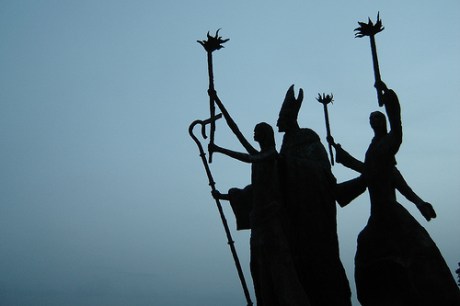
"La Rogativa" (Trevor Huxham)

Two church leaders, Archbishop Michael Neary and Bishop Patrick Rooke, strongly attacked secularism in Tuesday’s Mayo News. They called secularism a cult, and defined it as a philosophy defined by selfishness and greed. It was seen as the “common enemy” – the implication being that secularism was responsible, among other things, for the Celtic Tiger debacle.

These comments completely miss what secularism is about. The basis behind secularism is an acknowledgement that in a free society, people believe all kinds of things and are entitled to believe all kinds of things. It notes, therefore, that it is not the job of government to dictate beliefs to anyone, or to promote a particular set of beliefs above others. Public society should operate on a neutral setting with regard to belief systems, in order to provide a flat playing pitch to everyone. We expect that our schools, our hospitals, our local and national governments, and all offices underwritten by the tax payer, do not discriminate or unduly benefit people, simply on the basis of a particular belief system.

What is self-serving, greedy or cultish about that?

Core to secularism is freedom of speech, and however the churches might object, this includes the freedom to criticise religious beliefs – to expose them to public scrutiny and debate. Despite what it may seem to clerics unused to such questioning, this is the complete opposite of how a cult works – there is no control, no censure, no subjects that are out of bounds. There is no central authority figure. Secularism is called a cult by the clerical establishment because their beliefs are challenged, criticised and occasionally ridiculed.

What happened to Ireland’s economy during the 2000’s was lamentable, but I cannot see how it can be linked to secularism. It’s a safe bet that many of the property developers, regulators, speculators and bankers involved in the boom were practicing Catholics, coming, by and large, from a generation that had much a stronger Catholic influence than we do today. Implying that “they were really closet secularists” is simply a feeble attempt to redefine, for the sake of convenience, what “secularism” and “Catholicism” actually mean.

So I say to these men, grow up. You are living in a society where many different beliefs, and none, coexist. You live in a society where the entitlement and power given to you and your followers is eroding; where people are free to challenge you and to criticise your views, no matter how sacred you think they are; and where greed crosses all mindsets, all cultural boundaries, including your own, yet you see fit to conveniently blame it all on secularism, with no basis whatsoever.

Photo: “La Rogativa”, Trevor Huxham, 2007, (CC Licenced).

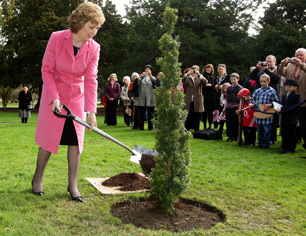
A lady who has occupied a large plot of land in one of Ireland’s most famous parks has been served notice of eviction by the Irish authorities. “I’ve been here for the past 14 years”, says Mrs. Mary “Prezzer” McAleese, “and now they want to move me and my whole family out in one go”. McAleese (60) moved into the house in 1997 after the previous occupant was called away on urgent business, leaving the lands completely deserted.

The house stands on a large plot of land in Co. Dublin, where McAleese has busied herself planting trees in every available space since she moved in. “She has a thing about trees”, says Mr B. Obama, who witnessed her plant one recently during a visit to the park. Another lady, Elizabeth W. (name withheld), noted McAleese’s propensity to plant a tree every time she met a new visitor. “It was very odd”, she said, “all I wanted was a cup of tea, but instead she had the gardening gloves on before I had a chance to say hello”.

“Now, after minding my own business, they’re kicking me out and taking me away from my trees”, mourned Mrs. McAleese yesterday. She says that she will go to jail if necessary to stop new tenants from occupying her lands. “There is such a thing as squatter’s rights, you know”.

Meanwhile, suitable candidates are being lined up to occupy the lands once Mrs. McAleese vacates them. “I have quite a lot of experience burying things”, says Mr. M. McGuinness from Derry, who has expressed a strong interest in the lands. Another candidate for the park, Mr. D. Norris, also feels qualified, albeit in a different way. “I prefer metal detection to tree planting, quite frankly”, he pronounced. “After all, people enjoy dredging up things from the distant past, don’t they”? Ms. Mary “Kelloggs” Davis, another applicant, is apparently more keen to use the lands to rehabilitate the large number of telephone poles damaged by distracted motorists crashing into them over the past few days. Other applicants for the land: Michael D. Higgins, Sean Gallagher and Dana Rosemary Scallon were unavailable for comment, while we couldn’t be bothered asking the remaining applicant, Mr. Gay Mitchell, to comment at all.

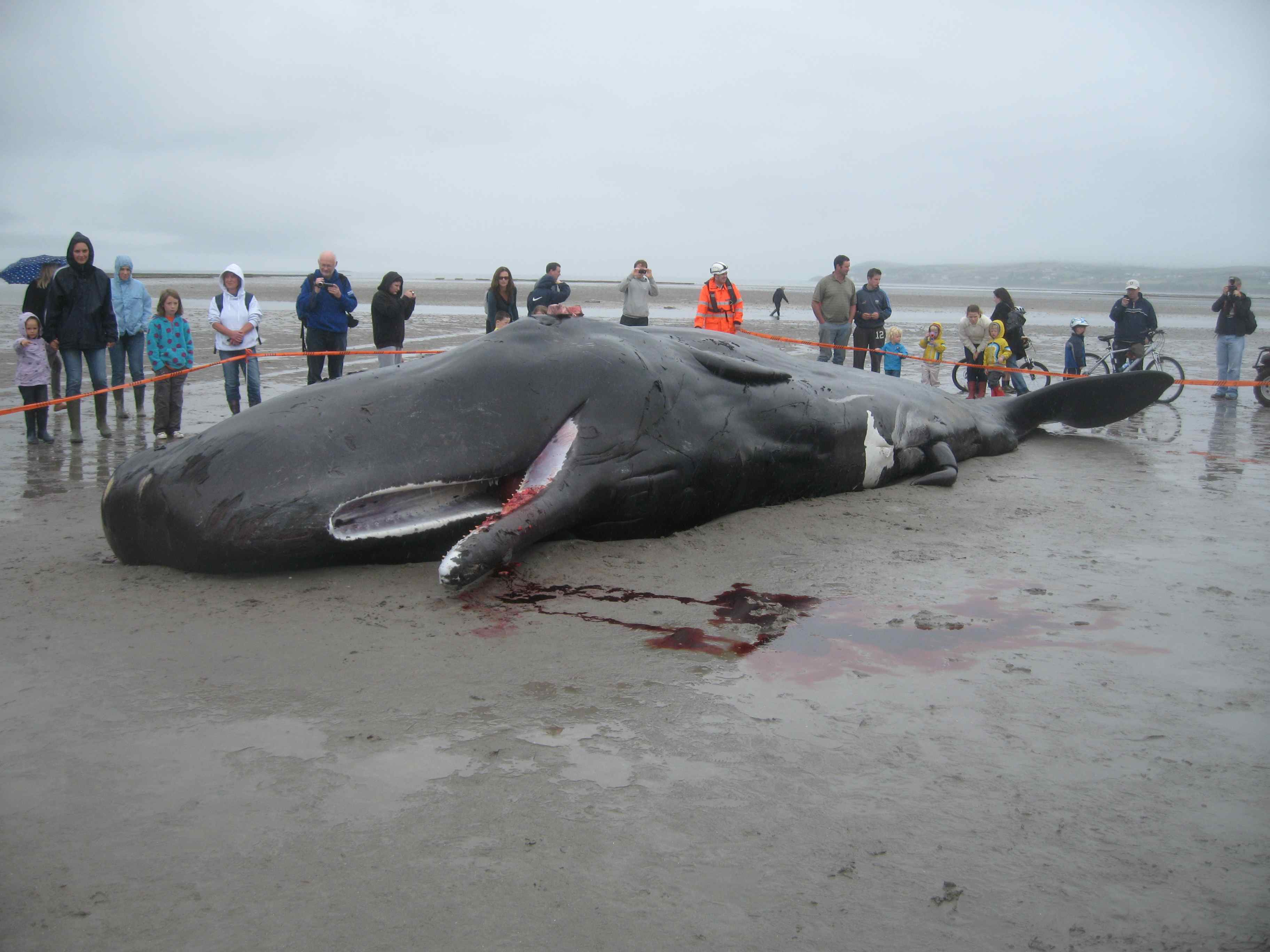
On Saturday we travelled to Ring, Co. Waterford to visit the last resting place of a juvenile sperm whale.

Sperm Whale beached off the Cunniger, Ring, Co. Waterford

The whale had been sighted off the coast of Wexford on Thursday. It was clearly in some difficulty – travelling slowly and far too close to the coast for its own good. Sperm whales spend most of the their time in deep waters off the continental shelf. It is unusual to see them so close to the coast unless there is something wrong. By Friday morning, the whale had beached itself close to the Cunniger – a long narrow spit reaching out from Ring to Dungarvan. Even though it remained alive all day Friday, long enough for the tide to come back in, it was clear to everyone that the whale was dying. Re-floating it would have been an exercise in futility.

Beached Sperm Whale, Waterford

The whale died overnight. It was not old and not even fully grown; no more than 20 years of age and measuring 10 metres from head to tail fin. It is not known why he perished. Some observers noted that he was underweight and possibly starving. A post-mortem is unlikely to be carried out, so the cause of death may never be known.

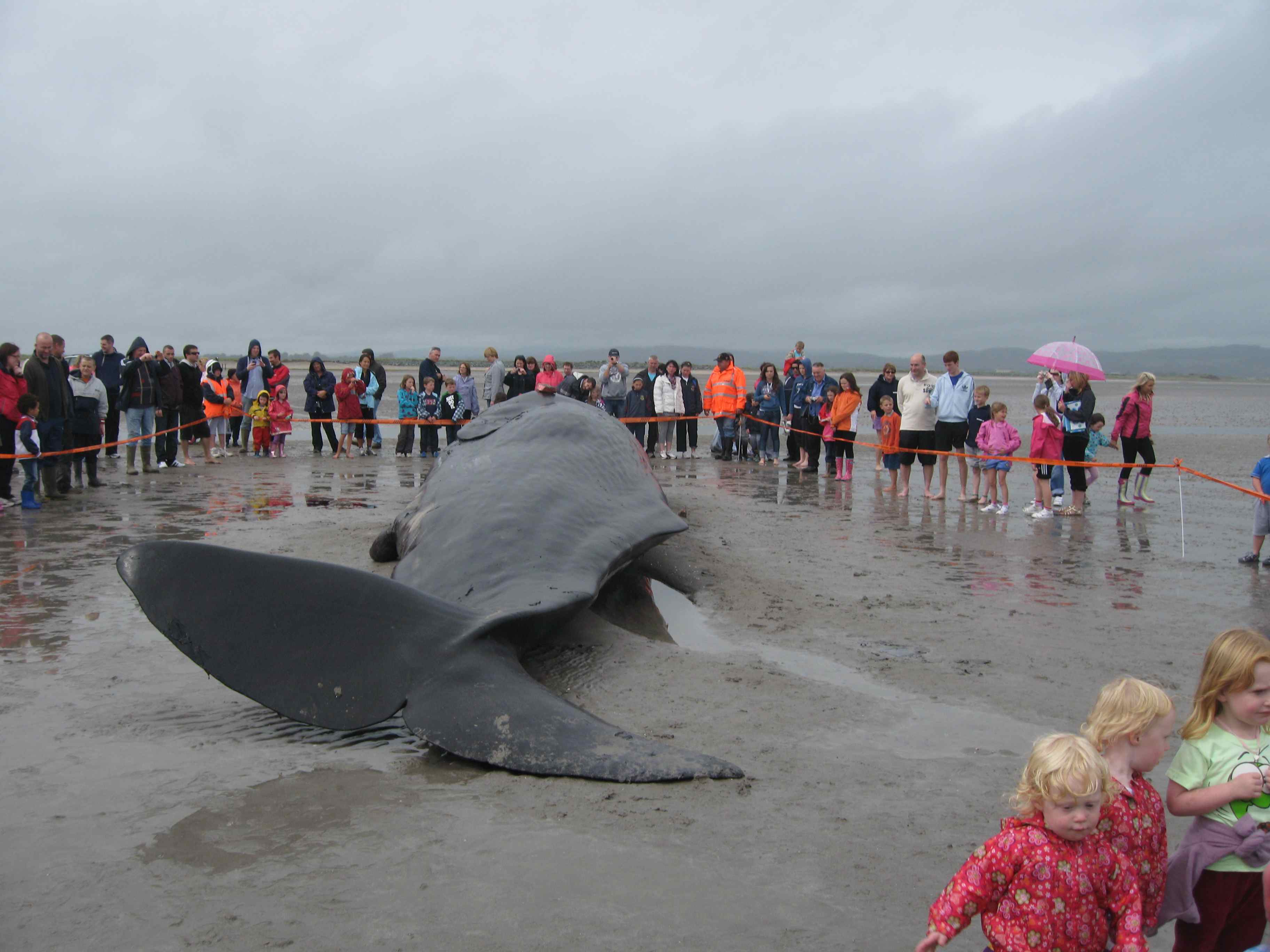
Dead sperm whale looking from tail fin

A large crowd was present by the time we arrived. Curiosity had spurred families from all around the country to see this rare, if somewhat morbid, spectacle. Scientists had taken some tissue samples earlier in the day, causing a small pool of blood to form under the whale’s mouth. For many, this would have been the largest creature they had ever seen up close. It was quite moving to see such a beautiful creature so helpless and still.

Are you interested in unsolved mysteries?

This very short video clip shows a rock feature that I came across some time ago while walking the Cork coast. It’s a vertical rock face about 3 metres high and 10 metres across. Dotted across its surface are large holes, so that it resembles a gigantic block of Swiss cheese.

I have no idea how these holes were formed. It is likely that this rock face was a horizontal sea bed some 350 million years ago and that it was impacted somehow by many pillow sized boulders. Evidence of these boulders is everywhere in this particular area. Was it a volcano? A tsunami? Or something far more mundane? Your guess is as good as mine.

I’m happy to show you this place, if you have a head for heights.

Photo via Marino González (Flickr : Merlin1487) CC Licensed

Over the weekend, Carol Hunt wrote a thought provoking piece about the prospect of the Irish Catholic Church going its own way, free from Vatican influence. Plenty of food for thought. In an article covering 1500 years of Irish history, she explains how the “Romanisation” of Irish Catholicism, with its contorted theology, unquestioned paternalism and petty proscriptions, is a relatively recent phenomenon; emerging primarily from the aftermath of the 1847 potato famine. Irish Catholicism had ploughed its own furrow for centuries, she argues. Maybe, it’s time for it to return to its roots.

Fascinating though a wholly Irish Catholic Church might be, I can’t see it happening soon. Even if the Vatican insult the lot of us when they respond to Enda Kenny’s Dáil speech, I don’t see the bulk of practicing Catholics here doing anything about it. Ultimately, it comes down to inertia. Many of those most likely to have had the energy to change the church from within have long since left the church in disgust and frustration, with no intention of ever going back. The remainder are split unequally along two lines: a core of deeply committed Catholics who prefer to believe that the whole scandal is a secular assault on their religion and a larger, more moderate group who, while affronted by the behaviour of the clergy in the past two decades, are unwilling to do anything about it.

There are likely to be a multitude of drivers motivating the second group to do nothing. For many, obedience to the Church is the respectable thing to do. Public dissent and argument have always been strongly discouraged within the Church, so why raise your head above the parapet? Some are keenly mindful of their “Catholic” identity, as opposed to a “Protestant” identity, in an island where too much blood has been spilled over these minor theological differences. In the background is the lingering fear of damnation, both in the putative next life and this one too. In the end, no matter what anachronistic pronouncements are uttered from on high; no matter what will emerge from the scandals of the future, most moderate Catholics will put up with it all for the sake of an easy life.

It’s not as if home-grown Catholicism, as opposed to Roman Catholicism, isn’t attractive to many within this second group. Most Irish Catholics would do away with the failed ban on contraception in the morning. They would welcome married clergy and women priests. They certainly wouldn’t mourn the passing of Vatican countenanced clericalism and secrecy, particularly when we have all seen its devastating effects in Ireland and around the world. It’s just that, for Irish practicing Catholics, desiring something and doing something about it are two very different things.

Protests and dissenting voices have been limited and sporadic.  Diarmuid Martin, Archbishop of Dublin, has been highly critical of the Catholic hierarchy’s behaviour and is an uncompromising advocate of reform. He has been a lone voice, however, increasingly marginalised even if he is saying what many Catholics are privately thinking.

When a few trogloditic priests around the country revealed their true colours over the past few weeks – comparing Enda Kenny to Hitler and referring to the Cloyne aftermath as being part of a secular Jewish agenda – a few brave souls walked out of Mass and there were a small number of letters to the newspapers. The vast bulk of people remained silent. It seems that the spirit is willing, but the motivation to do anything about it is about as strong as a wet straw.

So, no. I don’t expect any real changes any time soon. Irish Catholicism will continue to ally itself with Rome, despite what outrages might emerge involving the Vatican in the coming years. The prognosis for this church is a slow and steady decline into irrelevance and backwardness while old age and disillusionment steadily swabs up the remaining bulk of congregants.

* Photo “Broken Cross” by Merlin1487 (Marino González) on Flickr (CC Licensed)