Archives for posts with tag: Ireland

What if humans no longer existed? What if one day, all the animals woke up to find us no longer here? What would happen to the Earth then? Here’s an account that speculates about what might happen next.

I’m fascinated by these things ever since I read a book that associated the rise and fall of human society in Ireland with pollen samples taken from ancient soils.

We’re meant to be living in an enlightened world. We’re meant to be more educated. We are meant to be more tolerant of other cultures.

So why is it that the most common lunchtime and pub conversations still convey a desire that (travellers, criminals, immigrants, [insert minority group of choice]) be (executed / castrated / locked away and the key thrown away / [insert gruesome ending of choice])?

Seems we haven’t progressed that much after all. 😦

Blarney Castle

With St. Patrick’s Day on the way, I took a short spin over to Blarney Castle to take a few pictures.

I’ve never kissed the Blarney Stone – the idea of suspending myself under a damp rampart to press my lips against it in the hopes that I will speak more eloquently seems rather pointless, if not somewhat unhygienic. Anyway, I think I have already have the gift of the gab. You don’t want me to get super-charged on gabbing, believe you me. It’s a magical de-gabbing stone I need.

Stream in BlarneyBlarney Castle up close

Daffodils and Lookout Tower

Click on any photo above for more detail.

The grounds of Blarney Castle are delightful. Along with the impressive ruined castle, there are all sorts of structures to discover including a lookout tower, a lime-kiln and Blarney House itself. Then there is the lake, the cave and the Rock Close: a pleasant walled garden not far from the castle. Spring has come early this year, so all the trees are budding, the daffodils are everywhere and the hazel catkins are in full flower. Not a shamrock in sight.

I’ve just uploaded a selection of my favourite photos from the past few years and I’ve set up a permanent “My Photos” page on the blog for easy access.

Most of the following pictures relate to places I have visited in Ireland. Click on the thumbnails to be brought to a bigger photo. I’ll try to annotate them soon if I get a chance.

It’s just a reminder to me that I live in a beautiful country.

Panoramas

Winter scene in Kerry Evening scene near Kenmare, Co. Kerry Achill Island 2

Connemara 2004

Roundstone, Connemara, Co. Galway Connemara, Co. Galway Road to Clifden, Co. Galway

Achill Island 2005

Achill Island Deserted Village Achill Island 1 Achill Island Grainne Mhaol Tower Achill Island Keel Beach

Wexford 2005

Scene from Churchtown House, Co. Wexford Johnstown Castle, Co. Wexford Johnstown Castle, Co. Wexford

Kerry 2005

The Blasket Islands, Co. Kerry Gap of Dunloe, Co. Kerry Black Valley, Co. Kerry Sunset in Kenmare

Clare 2006

Clare Coastline - Loop Head Poulnabrone Dolmen, The Burren The Burren Co. Clare

Cork 2006

Stones in Ballybrannigan Bird feeding time, Fota Island, Co. Cork Rostellan Wood Evening scene in Midleton, Co. Cork

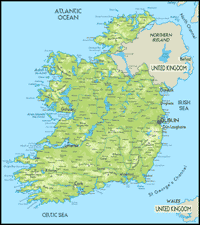
Map of Ireland

Map of Ireland by Tourizm Maps © 2006

So far, 2007 has been a momentous year in terms of the political situation in Northern Ireland. Sinn Féin, (the Irish republican party and erstwhile political wing of the IRA), has agreed to join the policing board, announcing finally that the war is over. On the other side of the political fence, the DUP (the majority Unionist party lead by the firebrand preacher Ian Paisley) has greatly lessened it’s rhetoric and looks set to enter into a power-sharing administration with Sinn Féin some time later this year.

Compared to the situation 15 years ago, the current political situation is an incredible departure from what seemed at one stage like an endless war. Even in the last 5 years, the IRA have decommissioned, abandoned criminality, stopped punishment beatings, disbanded as a military organisation, finally agreed to the rule of law and for all this they must be wholeheartedly commended. The Sinn Féin organisation seems now to have fully committed itself to a democratic political path. The ballot box has, at last, won out over the armalite.

Sinn Féin sees itself as being in government, sometime within the next 10 years, both in Northern Ireland and the Republic of Ireland. This is not a pipe-dream by any degree of imagination. (Since the 1994 ceasefire it has managed to garner over 10% of the vote in the Republic, making it the 4th biggest political party here). Their stated vision is to finally unify the island, North and South, to end all British influence there.

My question at this stage is – how? Any attempt to transfer power from Britain to the Republic of Ireland will be robustly resisted by Unionists who have not changed their stance (that Northern Ireland remain British) in the last 100 years and, after the low-intensity war of the seventies, eighties and nineties (a.k.a “the Troubles”), are probably more entrenched in their views than ever. How does a party such as Sinn Féin succeed in convincing Unionists that joining an Irish Republic would be in their best interest? The party is avowedly anti-British, working class, socialist, with paramilitary roots and structures that have created a huge degree of distrust within Unionism – an obstacle I can’t see them easily overcoming in the coming decades.

In addition, Sinn Féin have abided by a system of power-sharing in Northern Ireland which gives proportional representation to minority parties based on their share of the vote. Majority rule is clearly a non-runner in Northern Ireland when the political views and loyalties are so far apart. Sinn Féin are a minority party – the second biggest after the DUP – but the percentage differences are relatively small and it is probable that some time in the next 30 or 40 years, they may become the biggest party in Northern Ireland. The problem for them however is that, having resisted majority rule for so long, they can’t just dump power-sharing when they become the majority themselves. Whether they like it or not, they will be joined at the hip to the Unionists in Northern Ireland for the forseeable future.

Neither is it likely that Sinn Féin will ever become the dominant political player in the Republic. Politics in Ireland is based around coalitions with centre-right parties such as Fianna Fáil and Fine Gael taking much of the vote. Apart from Sinn Féin, none of these parties have much stomach for a constitutional fight with Britain or with Unionists over how they should be governed. It’s a view which would resonate also among a large proportion of Southern Irish voters who are more interested in economic prosperity than they are in some sort of political reunification of North and South.

Sinn Féin, therefore, are left with an aspiration, in much the same way as the incumbent Irish political parties “aspire” to re-unification on the island. When it becomes likely, as I think it will, that Sinn Féin will not make much headway in achieving re-unification, what happens then? Is there a possibility that the old chestnut of Irish Unity will come back to haunt this island again some time in the future, and that, yet again, war or hostilities will break out as they have done so many times in the past?

Hopefully, the answer is no. In the end, the Troubles were not so much about political re-unification as they were about civil rights and achieving political influence and justice for the Nationalist community. A well-run political system in Northern Ireland with true representation and fairness may do a lot to head off any future problems as will a Northern Irish state that works hand-in-hand both with Britain and the Republic of Ireland.

Only time will tell.

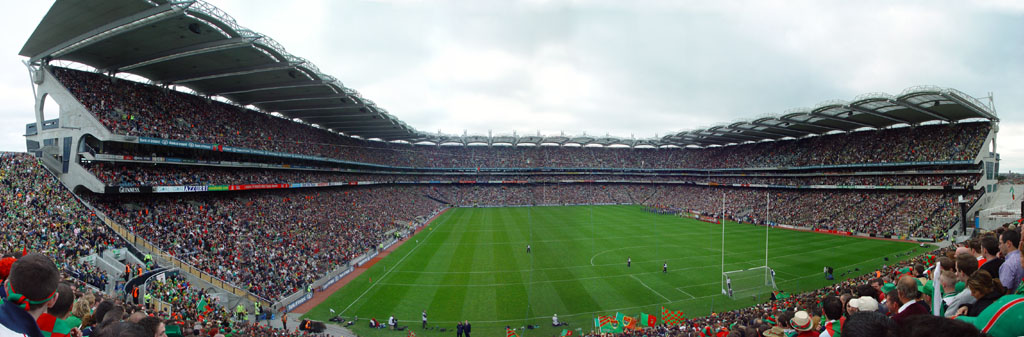
Croke Park

Some of you may know that Ireland has two unique field games – hurling and gaelic football. Both games have massive followings and they draw a fanatical attendance from all over the country during the summertime each year. The two games are by far the biggest sports in Ireland. The games are strictly amateur, and much of the attendance money gained has gone into developing the games and the sporting infrastructure around the island. The greatest achievement from decades of investment is a huge stadium in Dublin called Croke Park. It’s truly enormous. It’s the fourth largest stadium in Europe and it has a capacity of over 80,000.

For decades however, Croke Park has been strictly off-limits to the “foreign” games of rugby and soccer. No major international sporting event featuring these two games has ever happened there. The reason for this is wrapped up with the history of modern Ireland and the foundation of the Irish state.

The Gaelic Athletic Association, or GAA, is the ruling body for hurling and gaelic football. They have always been passionately devoted to promoting all things Irish (particularly Catholic Irish), and this view was hardened during the the War of Independence when in 1920, British Auxiliaries opened fire on a crowd of supporters during a match in Croke Park, killing 13 people. For a long time afterwards, no foreign games were permitted in any GAA ground in the country including, of course, Croke Park*. What’s more, members of the GAA were not even allowed to attend any games of rugby, cricket or soccer. Even though this particular restriction was repealed in the 1970’s, the ban on the use of Croke Park for “foreign games” persisted into the 21st century. Although there has always been a lingering sense of anti-Britishness within the GAA, the prevailing view among supporters of the ban was that the other sporting organisations (i.e. the FAI and the IRFU) had done nothing to deserve access to it – that they were riding on the GAA’s coat-tails, in effect.

All this changed in 2005, after a very passionate and drawn out public debate. The GAA finally agreed to open Croke Park temporarily while Landsdowne Road, the home of rugby and football on Dublin’s south-side, was being refurbished.

Tomorrow, Croke Park hosts its first ever international rugby game – Ireland versus France. It’s a sell-out (and some GAA supporters think it’s a sell-out in another way too), with an attendance that will be more than double that of any home rugby international ever played in the country.

A week or so from now, Ireland will play England in Croke Park. The Union Jack will be hoisted there, and God Save the Queen will ring out from within the stadium grounds.

It’s a bit of history alright.

* with the exception of American Football, Athletics and Australian Rules. Go figure.

Our Toastmasters club ran a poetry and prose evening tonight and for the first time ever, I recited some of my poems in public. I got a particularly good reception to my poem He lies there still. We had about 12 contributors tonight. A few guests spoke, including two visitors who have never been to a Toastmasters meeting before. One guest even told us that she wanted to join the club through the medium of poetry!

For me, the comment of the night was “I couldn’t write poetry. Poetry is far too profound. Nobody should ever underestimate the depths of my shallowness”.

The club has been thriving this year. We have signed up our 7th new member (more than the previous 3 years combined) and all our meetings have been varied and interesting. We made a key decision last year to move to a new venue. We moved from the formal surroundings of the local hotel to the more intimate setting of a pub and this has played a part in making the club more accessible to ordinary people.

I’m really enjoying it this year. Compared to this time last year, it’s like a different world.

I hate writing letters. I hate the effort involved in buying stamps and envelopes (they are never around when I need them), finding out peoples addresses, folding, licking, affixing, finding a suitable post box and dropping off the letter. When I discovered email many years ago, my heart momentarily lept with joy that all this might become a thing of the past, only to gradually realise that letters have not yet gone the way of the camera film or the black and white telly. The lead-up to Christmas does my head in for that reason alone! (Bah, humbug).

It gets worse. In the town in Ireland where I live, the local post-office opens late, closes for an hour-and-a-half at lunchtime and closes early too. Long queues are de-rigeur, with the officials hiding behind a thick barrier of bullet-proof glass. You can’t buy stamps over the counter at any shop in the town, and there is no letter box on the outside of the post-office. If you want to deliver a letter you have to find a public letter box. If it’s a parcel you have to get it weighed in a post-office first unless you have the luxury of a franking machine on your premises. It’s a crap service and we put up with it because they have a monopoly in this country. Nothing much has changed in thirty years. It’s a third-world service in a first-world country.

Why oh why do we still need to affix stamps to our letters in this day and age? Why can’t the postmen and postwomen collect letters from our houses instead of us having to traipse all the way to the bloody post-office to send them?

Here’s what I would love to see from a modern postal service. You write a letter, pop it into an envelope, write on the address or just give a name and post-code. (For familiar addressees, maybe all you need to do is to write their name). You then put this into a mailbox outside your door – the same one as where the letters are delivered – and the postal service does the rest. They stamp each envelope with an electronic barcode and then debit an account that you have set up with the post-office previously. You have many different ways of paying, from a pay-as-you-go option to a flat fee, all paid via direct debit or online or even a good old fashioned cheque, a bit like how mobile phone accounts work. The letters and parcels are delivered efficiently and quickly, and you can do all this without the need for stamps or even opening your front door. Maybe for a small extra fee, they would drop some replacement envelopes into your mailbox every so often so you don’t even have to buy these either?

Is this rocket-science? I don’t think so. Could it be done without too much effort? I think it could. Do I think An Post will do anything like this in my lifetime? Ha! Don’t make me laugh.

I originate from this part of the world. On the south side of the river is Waterford, a small Irish city with a very old and venerable history. On the north side, where I come from, is County Kilkenny. As you can see, one side of the city is relatively well developed, the other side not so much. It’s something of an urban planning nightmare – a city caught between two local authorities who, to put it mildly, are not great admirers of each other.

I was was watching a TV documentary last night that focused in on this particular issue. Waterford badly needs to expand its boundaries and as a result it would like to take over a large tract of South Kilkenny, mainly in my home parish of Slieverue.

The proposal has met with huge opposition from the residents and politicians of South Kilkenny. In 2005, about 10,000 people objected to the plans, but the pressure continues. The issue is very much one of what we Irish might call Tír Grá – love of the homeland. Kilkenny people could never see themselves as Waterford people. We support different GAA teams (hurling being something akin to a religion in Kilkenny), we have strong ties to other Kilkenny communities, and we’re even part of a different province to Waterford.

Nevertheless, there is a contradiction of sorts: Most South Kilkenny people work in Waterford, shop in Waterford and socialise in Waterford. (In truth, because the maternity hospitals are in Waterford, most South Kilkenny people were probably born in Waterford too – but let’s not go there). Waterford, in a sense, is the reason why they live in South Kilkenny in the first place. So, despite loving Kilkenny and wanting to remain part of Kilkenny, from an economic perspective Waterford is the centre of the world for most people in South Kilkenny. Kilkenny County Council has done little to develop the area of South Kilkenny, and the Dublin road is one of the worst in the state. You have to drive on it to believe how bad it is. Most South Kilkenny people owe Kilkenny County Council nothing, and despite people wanting to stay part of Kilkenny, they would be happy enough to benefit from Waterford Council services.

An Irish Solution to an Irish Problem

Isn’t the answer here obvious? Why can’t Waterford City Council accept that the ancient counties of Waterford and Kilkenny are what they are and best left alone, but that other solutions to the problem are possible? For instance, why not set up a Waterford Metropolitan Authority or some other quango to administer the entire region? Cork, for instance, has two local authorities: the City Council and the County Council – you don’t see people getting too upset when their boundaries are changed (actually Waterford south of the river has such an arrangement too). Powerful super-authorities are not new either: the National Roads Authority is one such example, and a successful one too, I might add. A super-authority would neatly bypass the issues associated with land attachment, concentrating instead on day-to-day administrative and developmental issues. All that would be required would be a bit of restructuring, a name change here, a rewriting of some documents there and a strong declaration stating that the areas of South Kilkenny under WMA control are still part of the ancient county of Kilkenny. Robert, as they say, would be your uncle. Ok, it’s probably a bit more complex than this, but you get the jist.

The remaining issue is more a legalistic one to be fought out between the two councils, and it concerns just one thing really: Moolah. Councils get revenue in the form of rates from local businesses and currently Kilkenny County Council receives income from the small number of businesses that exist in the South Kilkenny, revenue that presumably would go to Waterford once the super-authority was set up. And how do you solve issues like this? Anyone? Yes. With moolah. Find a price, negotiate, pay them off. Everyone is happy.

Similar inter-county issues exist elsewhere in the country and, I’m sure, throughout the world. Limerick City straddles the county of Clare and Athlone (in County Westmeath) abuts County Roscommon. The City of Derry is bordered on three of its four sides by the County of Donegal, which not only is another county, it’s in another state altogether! Can we not learn a bit more about how best to deal with such problems and move on?

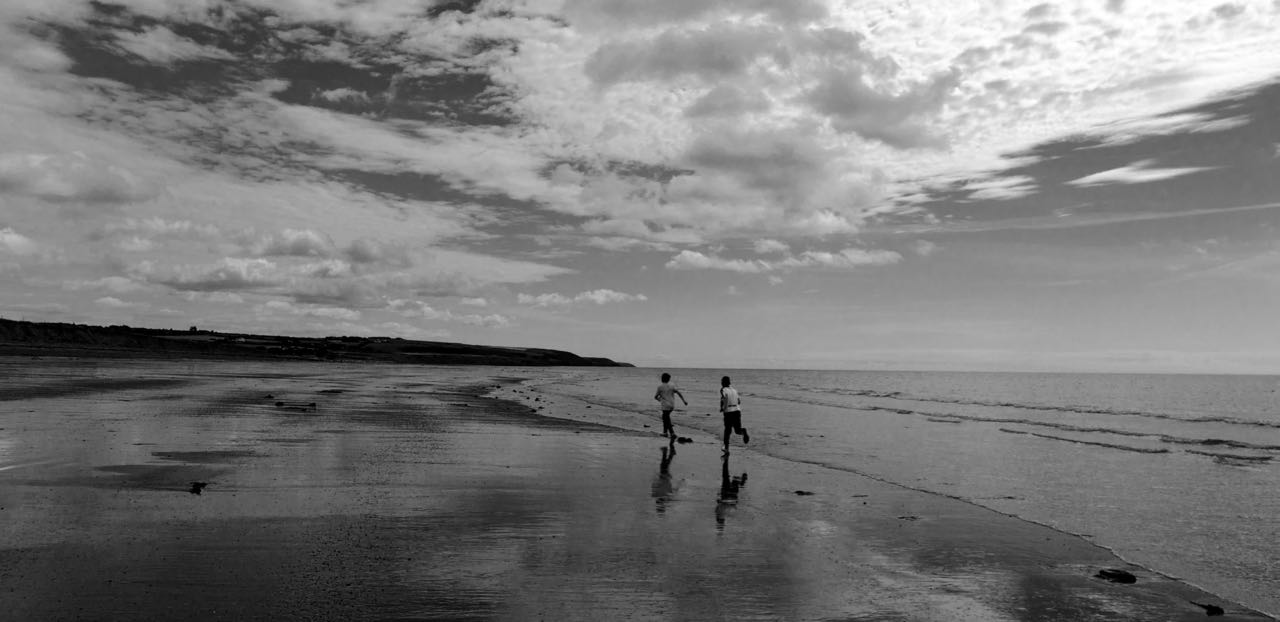
Another photograph from the weekend. This one is from Inch Beach in East Cork – one of my regular haunts.

Irish country Road by the sea