Archives for posts with tag: history

2014

Ten Years Ago (2004): Ireland bans smoking in pubs; the Beslan massacre happened; a huge tsunami hits the Indian Ocean coasts of South-east Asia, claiming 230,000 lives. New website called “Facebook” launched.

Twenty Years Ago (1994): The Rwandan genocide; an IRA ceasefire announced after 25 years of violence; Fred West is arrested, bodies discovered underneath his house on 25 Cromwell St; Nelson Mandela becomes president of South Africa.

Thirty Years Ago (1984): Announcement that HIV virus is responsible for AIDS; Ronald Reagan visits Ireland; Ethiopian famine prompts huge international reaction; Bhopal chemical disaster in India.

Forty Years Ago (1974): Dublin and Monaghan bombings; Birmingham pub bombings; Richard Nixon resigns as US President; worst tornado outbreak in US history; Rubik’s Cube invented.

Fifty Years Ago (1964): The Beatles take America by storm, Nelson Mandela sentenced to life imprisonment; Martin Luther King wins Nobel Peace Prize; Mary Poppins is released.

Sixty Years Ago (1954): First polio mass vaccinations; first kidney transplant from a live donor; Rock and Roll begins with “Rock Around The Clock”; Alan Turing commits suicide.

Seventy Years Ago (1944): Most recent eruption of Mount Vesuvius; Normandy D-Day invasions; Warsaw Uprising; Battle of the Bulge; “Doodlebug” bombs hit London; attempted assassination of Hitler; Asperger’s Syndrome first described.

Eighty Years Ago (1934): US Dust Bowl; Bonnie and Clyde killed; Night of the Long Knives; Hitler becomes “Führer” of Germany.

Ninety Years Ago (1924): Irish language made compulsory in schools; Hitler arrested for Munich Beer Hall Putsch; Vladimir Lenin dies; last vestiges of Ottoman Empire abolished.

One Hundred Years Ago (1914): Beginning of World War I; first successful blood transfusion; Irish Home Rule bill passed; electric traffic lights first introduced.

Two Hundred Years Ago (1814): Napoleon abdicates, is exiled to Elba; British forces burn down White House in Washington; end of the War of 1812.

Three Hundred Years Ago (1714): Longitude Prize announced; End of War of the Spanish Succession; King George I of Hanover takes UK throne after Queen Anne dies.

Four Hundred Years Ago (1614): Logarithms invented by John Napier; Moriscos – Muslim descendants – expelled from Spain; Juan Rodriguez becomes first European settler in what would later become New York City.

Five Hundred Years Ago (1514): Copernicus first outlines his theory of Heliocentrism.

Six Hundred Years Ago (1414): Council of Constance begins, ending the Western Schism, where rival popes contended for supreme authority of the Catholic Church.

Seven Hundred Years Ago (1314): The Scots defeat the English in the Battle of Bannockburn; Last of the Knights Templar burned at the stake.

Eight Hundred Years Ago (1214): The Mongol Army, under Ghengis Khan, lays siege to Beijing.

Nine Hundred Years Ago (1114): A crusade is launched on the Muslim held Balearic Islands.

One Thousand Years Ago (1014): Brian Boru defeats his enemies in the Battle of Clontarf. Brian is killed in during the subsequent rout.

One Thousand One Hundred Years Ago (914): Foundation of Waterford, Ireland’s oldest city.

One Thousand Two Hundred Years Ago (814): Death of Charlemagne, first Emperor of Europe since the collapse of the Roman Empire.

One Thousand Four Hundred Years Ago (614): Persians capture Jerusalem, carry off the True Cross, the Holy Lance and the Holy Sponge. Birth of Aisha, wife of Muhammad.

Two Thousand Years Ago (14): First Roman Emperor, Augustus, dies.

Two Thousand Three Hundred Years Ago (287 BC): Archimedes of Syracuse, mathematician, engineer and possible inventor of the Antikythera Mechanism, is born.

I noticed a thread on Reddit last night that discussed the great mistake ever in history. Everything from NASA accidentally taping over some of the original moon-landing tapes and Russia selling Alaska was mentioned. It makes fascinating reading.

For me, Hitler’s invasion of Russia stands out as the greatest mistake ever made.

It’s not as if he had to do it. By early 1941, Germany had achieved a stranglehold over Western Europe. Apart from the UK,  most of the major threats had been eliminated. With most of Central Europe under Nazi control, there was now a large buffer zone between Germany and any potential invaders from the East. To the West, only the UK stood in defiance of Nazi rule. With America not yet at war, it was isolated; still reeling from Dunkirk. German bombers were wreaking havoc across the UK from London, to Belfast, to Plymouth. Money, stolen valuables and great quantities of food were flowing into Germany from France and its neighbours, all now solidly under the German jackboot.

It wasn’t enough for Hitler. Instead he eyed the great country to the east with avarice, imagining a vast living space for the German population. Here was a region awash with copious quantities of food, oil, slaves and other key mineral resources. Given how quickly Germany had conquered most of Western Europe, the pervasive view was that Russia was merely a rotten door, just begging to be kicked in.

And for a time, this seemed to be the case. Between June and October 1941, the Wehrmacht inflicted over a million Red Army casualties, snatched the Baltic states, surrounded Leningrad, conquered Kiev, and was coming within firing range of Moscow itself. 

Then nature took over. The German advance slowed to a halt as the Rasputisa – the season of mud – heralded the beginning of the Russian winter. With Moscow and the key oilfields of the south still under Soviet control, the Germans found themselves inadequately prepared for the freezing temperatures and relentless blizzards. The slowing advance gave the Russians time to call in massive reinforcements and by early December they inflicted their first major defeat of German forces. 

1942 marked a turning point in German fortunes. While they gained more ground in the summer months, they failed to take the southern oilfields, nor any other key strategic targets. German supply lines were stretched, progress was slower and casualties kept on building by the thousands. With America now in the war and Russia developing huge stockpiles of weaponry further east, it was only a matter of time before their advance would be halted completely.

The reversal began in 1943, with the meat-grinder that was the Battle of Stalingrad. Using the bitter weather and a seemingly endless supply of manpower and armaments, Russian generals overpowered General Paulus’s 6th Army. From then on, Russia had the upper hand, despite losing more soldiers in almost every encounter with German forces. Even the great tank battle of Kursk failed to stop Red Army advances.

Ultimately, Russia reclaimed every inch of territory seized by the Germans, and more. They seized large areas of Germany itself exacting a terrible price from its civilian population. The “total war” in the East made their Western front vulnerable, and in 1944, Allied forces, under US leadership, invaded France. Deprived of air support, the cities of Germany were smashed to smithereens by Allied bombers. By the time peace was declared in 1945, this once-great nation, along with many countries around it, was on its knees.

Hitler’s decision to invade Russia ultimately destroyed everything he envisioned for his country. It was a decision made from a position of hubris, a belief that war was a boon to the young men of Germany, a belief in racial superiority above all the peoples of the Earth. Overconfidently, he believed he could demolish the Red Army in a matter of weeks, long before the Russian Winter arrived. Despite the formidable strengths of the Wehrmacht, he got it badly wrong. In the following years, relentless Russian aggression whittled his army down to size, making it a manageable target for all its enemies. 

We look at Germany today, and once again it is a great nation. As a modern, liberal, democratic republic, it’s a country very different to that envisioned by the Nazis. None of its success can be attributed to Hitler and his cohorts. The rebuilding fell to the surviving children and grandchildren, along with great help from the outside. Everywhere in Germany, as in Russia, as all across Europe, are the family memories; the lost uncles and aunts, fathers and mothers, friends and loved ones. Destruction and death on a vast scale were the only legacies of Operation Barbarossa. It was one heck of a mistake.

We could ask, what if Hitler had not invaded Russia? What then? It’s certainly possible that Nazi Germany would have lasted longer. Long enough, perhaps, to develop missile-borne nuclear weapons; thus making it almost impossible to attack from any angle without enormous reciprocal casualties. The UK, even with America on its side, would have been hugely vulnerable. Wave upon wave of German bombardment, along with a robust blockade of British and Irish ports, would have made everyday life very difficult indeed. The Nazis would possibly have had time to complete, then cover up, their policy of genocide on the Jews and all unfortunate people they perceived to be less than human. A hopeless detente between America, Russia and Germany, somewhat akin to the Cold War, might have transpired; with proxy wars in Africa, the Middle East, India, South America and anywhere mischief could be made.

Decades hence, perhaps, it might have been a different story. The viciousness, violence and corruption of the Nazi regime would surely have given way to saner minds once Hitler was out of the way. Maybe a collapse, akin to the Soviet Union in the 1990’s, would have been on the cards, given enough time.

It’s purely speculation, of course. Hitler’s great mistake resulted in the deaths of millions. Had he not made it, perhaps even more would have died through the cruelty of his policies, just stretched over a longer period of time.

ImageSay we didn’t split from the UK in 1922. Say a Home Rule formula was worked out, and instead Ireland became a semi-autonomous region within the British state. Our history would have turned out very differently. The question is: would we have been better off?
We have some insight into how our country might have turned out, because part of our island is still part of the UK. There are some differences between Northern Ireland and the Republic, so the analogy only goes so far. For example, the Republic is bigger; it’s had a more homogenous population, a strongly Catholic identity, and it’s been more rural and less developed for most of its recent history. Comparing the Republic to the North is instructive, but it only tells us so much.

Ireland’s post-independence history can be summarised into two main phases:  Isolation and Integration. During our period of isolation, Ireland effectively removed itself from world affairs, preferring an “ourselves alone” strategy that sought to forge its destiny utterly separate from Britain. Under isolationist politicians such as Eamonn De Valera, the economy was consigned to the margins: a rural backwater, totally in thrall to the Catholic Church. Poverty was endemic and emigration was the norm. Ireland stayed out of World War II, and effectively missed out on the industrialisation and social changes that accompanied and followed this period. People left in their droves. By 1961, its population, at 2.8 million, was 200,000 people lower than it was when it seceded from Britain in 1922.

Had we remained under British rule, it’s probable that Ireland would have industrialised and developed faster during this period. We would have been part of the war effort. This would have meant greater numbers of Irishmen enlisting with the British armed forces, greater involvement by Irish women in war-time production and significant occupation by Allied forces in the run up to D-Day. Ireland would possibly have benefitted from the Britain’s post-war recovery. It is likely that Ireland might have been better off remaining within Britain between the 1920s and 1960s.

From the 1960’s onwards, Ireland opened its door to the world. It sought out foreign investment, entered the European Community, and forged links with US multinationals in specific high-growth sectors such as pharmaceuticals and computers. Domestic businesses became internationally competitive and the population decline was soon arrested. In the last 50 years, Ireland has liberalised, secularised, industrialised and urbanised. It hasn’t all been plain sailing and despite deep recessions in the 1980’s and 2010’s, the trajectory has been broadly upwards.

It’s not easy to see how Ireland would have benefited in the same way under Britain as we have done as an independent state. Britain would have controlled our corporate tax rate, thereby hampering our attractiveness towards foreign investors. Much funding and investment would likely have been diverted towards London and the major population centres of England than elsewhere. Although Britain has many agencies promoting rural development, none have matched IDA Ireland in terms of the successful relationships it has forged and its capacity to attract inward investment.

A key consideration would be the extent to which low-level guerrilla warfare, the likes of which occurred in Northern Ireland, might have damaged Ireland’s prospects within a British state. Given our long history, animosity between Britain and Ireland would have continued and occasionally deepened, particularly during recessions and times of social change. It’s very probable, therefore, that Ireland’s fate as an economic region within the UK might have been badly affected by paramilitary operations both in Ireland and in Great Britain, even if they were eventually to be resolved by new forms of governance.

Finally, there is Britain’s rocky relationship with the EU. While we have delegated much of our economic sovereignty to Brussels and are under the watchful eye of the Troika, Ireland has largely benefitted as a member of the EU and the Eurozone, through regional subsidies, a seat at the table, the lifting of trade barriers or access to new markets. Britain’s relationship remains lukewarm, and there have been suggestions of late that it might leave the EU altogether. For a small, sparsely populated island on the western edge of Britain, this would bode badly for our long-term economic prospects.

The economy aside, it is less clear how Ireland would have developed socially and culturally under British rule. Differences between ourselves and people from Northern Ireland or most other regions of Britain are marginal at best. Ireland’s cultural life is similar in many ways to Britain: we follow similar music, watch the similar TV shows, follow similar celebrities and read similar newspapers and magazines. Our high street shops are broadly the same, so fashion trends tend to match our counterparts across the sea. We have our national sports of Hurling and Gaelic Football, but these games (particularly the latter) are followed on both parts of the island with equal devotion and fanaticism. Neither should we forget that UK soccer teams enjoy far more support here than do teams in our local football leagues. Religion is possibly a wash either way also. While religion can hugely important in terms of ethnic and cultural identity – it unquestionably played a role in Northern Ireland during the Troubles – extreme devotion to Catholicism was the norm in Ireland for long periods of independence. It’s current decline is more likely due to self-inflicted wounds and increasing levels of secularism than anything else.

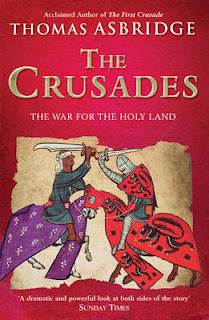
I’ve just finished reading a marvellous historical book: Thomas Asbridge’s “The Crusades – The War for the Holy Land”. There are many things to love about this work. It presents a very coherent narrative all the way through, explaining the key events and the important sequences clearly, without relying on military jargon. It brings many of the protagonists to life, giving you a sense of their inner workings, motivations and weaknesses. It also presents a picture of life through the eyes of the different combatants, providing explanations for sometimes inexplicable actions. Covering almost 200 years of history and a host of different characters, this is no easy thing. I would thoroughly recommend it.

In some ways, the book is not really about the Crusades at all. The book’s focus is the Crusader states of Edessa, Antioch, Tripoli and Jerusalem; from their establishment to their demise in the late 1200’s. Some Crusades, such as the Second and Fourth Crusades, are barely mentioned and the machinations of popes and princes in Europe take secondary place to the key events in the Levant.  A large section of the book is taken up with the events from 1100 to 1192, when crusading was a relatively minor aspect of life in the “Outremer”.

The role of religion is explored in the book. Unquestionably, religious devotion inspired legions of Crusaders to travel to the Holy Land, provoking a reciprocal commitment to jihad within the Muslim population. It was secular pragmatism, however, that sustained the Crusader states over much of their lifespans. Christian princes formed treaties and alliances with their erstwhile enemies, while cross-cultural trade and commerce flourished in the Near East during this time. Political changes were often a function of practical concerns, brought about by shifting alliances and crises of leadership. Religious idealism, as a force for change, was markedly less effective. Attempts by the clergy to organise their own expeditions usually ended in abject failure, costing the lives of many Crusaders while meriting barely a footnote in the history of the region.

Most of the people in this story lived short, brutal lives. If battle didn’t kill them, illnesses such as cholera and dysentery did the job. Irrespective of whether you were Christian or Muslim, you would have been lucky indeed to reach the age of forty. Children grew up quickly, if they made it to their teens at all. From the many massacres detailed in the book, life was cheap in the extreme. The inhabitants of a besieged city, once fallen, could expect no mercy. Even the elite did not have it easy. Kings and sultans at the height of their powers often succumbed to illnesses or murderous intrigues at a comparatively young age, prompting vicious power struggles amongst remaining family members. Slavery was rife and punishments were exceedingly cruel. How these conditions motivated people to live their lives, sacrificing all for the dreams of salvation, we can only guess.

Although Asbridge was eager not to make connections between the Islamic / Christian culture wars of today, I feel that an altogether different, more enduring parallel can be made between then and now. I was struck by a sense of familiarity reading about characters such as Baldwin I, Saladin, Richard the Lionheart and Louis IX. Despite a gap of nearly one millennium, these individuals came across as surprisingly modern to me. It struck me that they were not unlike modern businessmen, with interests to protect, opportunities to exploit and competitors to fend off. The elites operated in a relatively lawless world, similar to the modern corporate landscape, differing only in the amount of blood spilled. Their levels of strategic insight would put many an MBA to shame. These leaders benefitted greatly from advances in technology such as trebuchets, crossbows, navies and Greek Fire, while setting up information systems using messengers, homing pigeons, spies and an elaborate network of express couriers, in the case of later Malmuk rulers. I can’t help but think, were you to transport Richard Branson, Rupert Murdoch or Steve Jobs back to these times they would have readily donned a suit of armour, leading their armies into battle. When it comes to business, some things never change.

Storytelling may be the most important means of verbal communication that we have. Stories were the standard form of imparting knowledge from generation to generation for millennia. To this day, some of the best forms of entertainment: movies, novels, plays; are ones that tell a story. Children learn stories at an early age by their parents. We were born to narrate, and to be narrated to.

via youngdoo (Flickr / CC Licensed)

A key aspect of good stories is their coherence. Everything in the story contributes to the message the author wishes to impart. A case is built up, line upon line, until a solid, inevitable conclusion is reached. The aim of the storyteller is to build up evidence that convinces the reader; there should be no loose ends. Incongruence is disparaged. To tell a good story is to make it flow like water from source to sea. Coherence is the power of good storytelling.

In life, we tell stories all the time. We use the tools of the narrator to make our message heard, to compete for jobs, to seek enrichment. The best storytellers find tales that contribute to their narratives. If there is a jarring note, they try to write it out of the plot. There are many techniques to do this. Our stories create coherence, direction and conviction in a otherwise chaotic world.

Via Local Studies NSW (Flickr, CC Licensed)

Stories package life into digestible bites, but we all know that life is not so simple. Stories, by their very nature, are distortions of reality. They place greater weight on some incidents, facts, people, findings and opinions; while minimising the importance of other aspects of a situation. They gloss over complexities in the interest of maintaining attention. Two people can create totally different stories from exactly the same event. If we want to understand real events, we need to treat individual stories with great caution.

Stories are often central to the world-views of people. At the heart of all great political movements, religions, fads and management theories are narratives – ways of looking at the world that emphasise certain aspects while dismissing contradictory information. The filters are so great that people go to the grave convinced of their certainty, even when all the evidence points in the opposite direction.

We should be thankful that we possess narrative thinking, as it is our greatest communication tool. At the same time, we should mindful of its many weaknesses. There are occasions in life where simple narratives are not enough. There are situations where the distortion field erected by narration needs to be pulled down, so that we can understand reality as it is, faults, blemishes and all.

via TED.com

Fortunately, there is a mode of thinking that recognises the failures of the narrative. It accepts challenges head-on. It seeks to understand the biases that plague our patterns of thought. Through testing and experimentation, it matches our premises to reality. This type of thinking does not come naturally to us. We have only engaged with it, seriously and systematically, over the last 400 years. In that time, it has proven itself over and over again; allowing us to see things as they are, rather than how we think they should be. We have a name for this type of thinking.

We call it science.

A few years ago, the Irish National Archives digitised  the census documents of 1911 and put them all on the Internet for us to see. Long-forgotten grandparents and great-grandparents were suddenly transformed into young fathers and mothers, small children and teenagers. New names were introduced to us. We were given a feeling for their occupations, their family circumstances and their positions in society. Limited though the census documents were, these people who lived a hundred years ago came to life in front of our eyes. This was the Internet at its best, providing us with a window into history.

I’m reminded of this because Google Inc. recently opened Street View to the country of Ireland. Almost every road and boreen has been mapped and it all now comes to us in full 360 degree panoramas, each image no more than 10 metres apart, covering 80,000 kilometres of roadway; terabytes upon terabytes of information freezing the Ireland of 2009 and 2010 in perpetuity.

What a treasure trove of information for the future historian. It is now possible for our children’s children to see Ireland exactly as it was during this time. They will see our dress, our cars, our gardens, our farms and our workplaces. They will witness history in the making as the Irish boom economy shuddered to a dramatic halt: the newly constructed motorways and bridges alongside the empty buildings and ghost estates; the Polish and Lithuanian shops that signified a new era of multiculturalism and the wind turbines making their appearance over the landscape as we began the painful process of weaning ourselves off the seductions of fossil fuel.

Presumably these Street View images will be updated regularly, so not only will it be possible to see Ireland as it once was, but also how our country changes gradually throughout the century. I’m assuming, of course, that all these records will not be erased; a reasonable assumption should Moore’s Law continue to hold sway over the coming years.

If there is a snag, it is that all this data is the property of a successful private company whose primary interests do not necessarily coincide with those of the citizens of a sovereign state. Although there is no sign that Google are carrying out this mapping effort with anything other than the best of motives, whether they will continue to act benevolently and responsibility with such information is a difficult question to answer. A hundred years is a long time – long enough for industries to grow and disappear and for companies to change utterly from what they once were, if they exist at all. Public information – photos of many the roadways throughout the world – has been privatised. Governments should now be thinking about how that information should be placed, eventually, back into public hands.

With Street View, Google have created a resource of unimaginable value for future historians. Here’s hoping it’s there for all to see in the years to come.

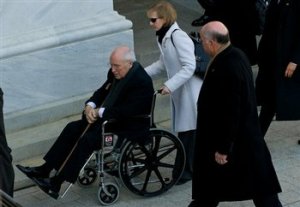
Cheney passes into history

I was originally going to post a snarky message comparing the ex-VP to Peter Seller’s comic creation, but then I saw this photo and realised that what I was trying to do wasn’t really that funny.  What I see instead is pathetic and rather sad.

Here is a man whom history has already judged. Over the coming years, as the threat of censure fades, as the files documenting the Bush Presidency get released, the judgement of future generations is destined to get much, much harsher.

For Dick Cheney, there will be no kind epitaphs. No entry into the pantheon of the American Greats. No statues or streets named after him outside of his home state. Merely whispers, rumours and that background radiation of anger that accompanies the memory of someone who did so much to spread misery and resentment during his time in the limelight.

singularity

Evidence has come to light over the past few decades that the ancestors of modern man spent, not a few years, but hundreds of millennia fashioning very primitive tools out of stone in the Olduvai Gorge in Kenya. Throughout that time almost no change in style took place. Sons and daughers simply learned the craft from their parents without, it seems, adding or enhancing the technology. Technological development had reached a plateau.

Now let’s move the clock forward to 200,000 years ago, to the beginning of anatomically modern humans. The tools had changed and social organisation had advanced to the point that humans were able to spread around the world, dominating and sometimes defeating those species that stood in our way. But nevertheless, the technologies throughout this time remained relatively primitive. For much of the last 200,000 years, people lived in small hunter-gatherer communities, surviving from day to day. No great works. No monuments. Despite our slow spread around the globe, change was severely limited by the scarcity of important resources such as food.

Then, only 10,000 years ago, at the end of the last Ice Age, we discovered agriculture. Towns, cities, kings and queens came into existence. Professions and trades were born. Laws and religions developed. Writing was discovered and men went to war in large numbers. Great monuments grew out of the deserts and the jungles. But nevertheless, there was a lot we did not understand. We didn’t have the tools or technology to allow us to fly, or understand the universe, or even to cure the simplest of diseases. It was as if again we had reached a limit in terms of our understanding of the world.

Then along came Science. In the last 400 years, human beings have begun to systematically understand ourselves and our surroundings, to put aside our magical fantasies and to discover what really works. We learned how to put things together to make better things; how to take the properties of the physical realm to beam pictures and ideas around the world; how to put people into outer space; how to cure and prevent the worst afflictions such as Typhoid and Smallpox and how to lay waste an entire nation at the press of a button.  

Even during this decade this progress has continued unabated. We have put probes on Mars, unravelled the human genome and spotted planets revolving around distant stars. You can store the entire contents of the Library of Congress in a few small boxes beside your desk. You can search for and find the information you need, from anywhere in the world, in mere seconds. Faster and faster and faster and faster. As if this progress were approaching an asymptote, a singularity.

It makes you wonder, where will all this progress lead to?

Will we reach a point where this seemingly exponential rise in technology will continue unabated, or will things level off as we reach the limits of our abilities, as yet undefined? Are we living through a short transition point between an early agricultural and an advanced technological civilisation? Will we reach a new plateau, and what might that plateau look like?

A few scenarios come to light, some bad, some good.

The gloomiest and yet more probable of scenarios suggests that our recent advances will end in tears, with humanity blowing itself apart or enacting such a huge price from the environment that the planet seeks revenge, taking us and a large section of our fellow travelling species into oblivion.

A less gloomy scenario suggests that, while not destroying our species, humanity is reset back to the dark ages, or into hunter gathering mode, perhaps to rise again in a few millennia, only to meet a similar eventual fate in due course. A periodic rise/ collapse cycle fluctuating in tune with future Ice Ages perhaps.

Or perhaps we will find some way to live sustainably, in concert with the planet, while not sacrificing our technological knowledge in the process. Could it be that we will look at technology in the same way as we look at door-knobs, napkins and salt-cellars nowadays: where there is little scope for development apart from the vagaries of modern fashions? In this scenario, generations will pass and fads will change, but the overall technology framework will remain roughly constant, just like those humanoids in the Olduvai Gorge so many years ago. 

Maybe indeed all this talk of technological progress is a mirage. Instead, the big events in human society: war, disease, over-population, ideology and catastrophe, drive technology over the longer term as opposed to the prevailing view that technology is in the driving seat.  Perhaps we are simply too close to events to note how technology will adapt to the human story over a span of thousands and hundreds of thousands of years. We think we are driven by technology, but perhaps it is only a blip in a much bigger picture in the development of our species.

In an alternative rendition of our future, we are on a course for unending techological advance. Perhaps our curiousity and propensity to keep innovating will know no bounds? Perhaps we will keep on bending, breaking and redefining the limits of the possible? Maybe, as some suggest, we will pass on our propensity for innovation into robots, nano-machines and newly created biological forms, thus maintaining the acceleration indefinitely? 

Is it not too wild to suggest that the end game in all this is a journey to the stars? It may be that we are on course to developing the capabilities needed to cross the multi-trillion kilometer gulfs between our Sun and its neighbours? So in this case, as we board the ships to the sky, the acceleration might come to a sudden halt, to be replaced thousands of years hence by a new burst of activity, followed by further intense cycles of innovation as future generations disperse, ever so steadily, across the galaxy.