Not enough red meat? Not enough guns and bar room brawls? Not enough “telling people like it is”? Not enough Page 3, dog whistles and giving them one?
Too much namby pamby “talking”? Too much pussy talk about looking out for other people? Too much acceptance of difference? Of sharing feelings? Of giving people a chance in life? Of praising facts and expert views? Of a fucking education?
This election has been the most amazing one in my lifetime. From day one, the Trump campaign has been extraordinary, with regular candidates tossed aside like bowling pegs, one after the other. I do not yet know the outcome of today’s election, but I’m hoping fervently that Hillary makes it across the finish line today – finally stopping this runaway dumpster truck from seizing the highest office in America.
Normally, the dissection of a political battle involves picking through what the winning candidate did right and what the losing candidate did wrong. Should Clinton win, the story should be about how she fought an effective media battle, how she decisively won the debates, how she courted celebrities and rock stars, fought a well-financed ground war and made effective use of analytics. It should be about the long succession of Trump scandals, fiascos and unforced errors, from the Khans to Pussygate, to his atrocious debate performances; his alienation of Latinos, African Americans, women and Muslims; his unedifying spats with his fellow Republican politicians. In ordinary times, you could write a story of these last few months in terms of what was done right by Hillary and wrong by Trump. But these are not ordinary times. The real story of this campaign is how, despite all the errors and disasters, Trump remained in contention and how seemingly smaller setbacks and mistakes sent Clinton’s campaign into a nosedive. Trump survived a video laying his misogyny bare for all to see. He survived a leak which suggested that he paid no tax for decades. He survived, despite being called out on lie, after lie, after lie. Any one of these should have been enough to put paid to his political aspirations. And yet, when Clinton suffered a bout of pneumonia, or called his supporters ‘deplorable’, or had the FBI resurrect the email investigation, she quickly found herself on the back foot, fighting a desperate battle to maintain her lead.
The story of this election was how, among a large number of supporters, Trump was treated like a demigod, while Clinton was treated with extreme scepticism, bordering on disgust. Trump effectively used hatred, anger and his charisma to marshall powerful forces in his favour, sending out a clear signal that America is extremely vulnerable to demagoguery. How the country recovers from this frightening state of affairs will be a whole other story.
This is the fifth and last part of my overview of QED 2016. To see the previous entries, please check out Part 1, Part 2, Part 3 and Part 4.
This is my final write-up from QED 2016. I know I’ve left out a ton of stuff – inevitable given that there were so many simultaneous tracks. I also realise I haven’t written much about the awards or the Saturday evening activities, but as I wasn’t taking any notes, my writings would be purely from memory, which is highly dodgy at the best of times. I will note however that the QED Award to Crispian Jago was thoroughly well deserved. Crispian has been a force of nature over the past years, bringing satire to a whole new level and crystallising how so many of us felt about pseudoscience. This has not been an easy time, as he has been afflicted by cancer in the last year. He was inundated by well-wishers throughout the conference. I wish him the very best in the months ahead.
Of Mousetraps and Men
The penultimate speaker on the main stage was broadcaster Michael Blastland, with a talk about how seemingly trivial things may form the most important part of life for all of us. We are brought up to believe in simple stories, that A causes B, and so if we implement seemingly simple solutions to complex problems, the outcome will be predictable. Of course this is not what happens. Life is more like a Heath Robinson machine with things constantly going wrong and taking different paths. Just because A happens, B might not.
We are lazy storytelling machines.
He talked about great artists and great achievers – Darwin and Lennon for example – who might not have achieved greatness were it not for serendipity. He looked at chain smokers and red meat eaters who lived to a hundred years old, despite the odds. He discussed studies where teenage delinquents from similar backgrounds had massively different life outcomes.
Science is all about the average, the aggregate, the loss of individuality. But what if it’s the particular that drive the cause?
He talked then about prescription drugs, such as statins and heartburn medications, where the lifetime benefit to people on the medications vs those not taking additional medications, while scientifically significant, is somewhat marginal. What we know at a global level may often tell us little at a local level.
Some big effects will almost certainly never affect you. But some little fuckers almost certainly will.
So what? Well, apart from some suggestions on getting into the details, adapting and experimenting, we are left with far more questions than answers. We all know that life is hugely complex and that chaos and complexity dominate our lives. We all know that we cannot predict our individual futures, but we can extrapolate some general trends, and these trends are important, no matter how chaotic the raw data. The fact that some people will beat the smoking lottery is not an argument for telling people to keep smoking. The fact that some unvaccinated kids will be mildly affected by measles if they get it, is not an argument for telling everyone not to get immunised. The fact that we can’t predict next week’s weather over Slough or Cleethorpes is not an argument against climate change. Is his argument that science is shit just because it cannot predict individual outcomes in every situation? But then again, when did science ever make such claims?
Here’s Michael Blastland talking to the RSA on a related topic.
The Deadly Dowsing Rod
If you were asked what the most dangerous pseudoscience is, the answer is unlikely to be water divining. It’s first cousin, however, is certainly way up there. When the art of water divining is extended to bomb detection the cost in human lives is enormous, as the people of Iraq unfortunately discovered.
Meirion Jones is an investigative journalist who reported this incredible story to the world. He handed us a small, cheaply made dowsing rod that looks eerily similar to a retractable antenna on old TV sets attached to a hand-grip. During the Iraq War, this device – the ADE 651 – got approved by armies around the world without a shred of evidence that it actually worked. The mastermind behind the device was Jim McCormick, a small time crook who became fabulously wealthy as the devices, costing up to 40,000 dollars each, sold in staggeringly large quantities.
It does exactly what it’s designed to do. It makes money.
Jim McCormick
Meirion asked around, and eventually found a whistleblower who was able to provide parts for the device. The device was tested by scientists and was shown to be completely inert, unable to detect anything. It turned out that the British military had a role in facilitating its distribution, so they were disinclined to help the BBC investigation.
Speaking as a professional, I would say that’s an empty plastic case.
Sydney Alford, engineer who tested the device.
McCormick and his accomplices were arrested and tried. McCormick was convicted of fraud in 2013 and is currently serving a 10 year sentence. The device has been withdrawn from most militaries, but clones and similar devices that claim to detect HIV and other diseases continue to pop up on a regular basis.
And that was it!
All that was left were the many thanks to everyone involved – the organisers, speakers, volunteers and panelists who did such a good job over the weekend. Hopefully see you all again next year.
This is the fourth part of my overview of QED 2016. To see the previous entries, please check out Part 1, Part 2 and Part 3.
The March of Unreason
Taking a break from the formal talks (and I am sorry I could not see Paul Zenon), I went to a panel discussion discussing the forthcoming British exit from the EU and the “post factual” age we are now apparently in.
“A lie can run around the world before the truth has a chance to get its boot on.”
Emma observed that on complex political issues people tend to follow the advice of friends over experts.
People are more likely to trust their friends over experts, because they think that experts don’t have their interests at heart.
Michael Dougan broke the Brexit lies down into four parts –
Telling lies about the here and now: According to the media now, the referendum was won by the working class of northern England. This is not true. The southern English middle class vote was by far the most important.
Fantasies about the future: Boris Johnson is still being dishonest about “special deals” that Britain will get upon exit.
Rubbishing anybody who disagrees. The message being put out at the moment is that anyone who disagrees is anti democratic.
Debasement of parliamentary democracy. A referendum only used when you can’t get what you want in parliament.
Max observed that fact-checking was relatively new to UK politics.
Are we in a “post truth society”?
Hugo Dixon made the point that demagoguery was a direct result of the financial crisis. When politicians don’t seem to be up to the job, voters start looking elsewhere.
In the land of the liars, the authentic liar is king.
Michael Dougan expressed a concern that once people find a way to get their views accepted in the mainstream, it’s only a matter of time before they seek a new target. What next? Global warming? Women’s rights?
Michael Blastland felt that a lot of the post factual talk was a direct result of scandals within the expert community.
There is nothing so damaging to the domain of evidence than the preacher who sins.
The conversation could easily have gone on for a few more hours. It was a packed room and at one stage, about thirty hands went up when the moderator asked for question from the floor. As was clearly evident from the panel discussion, Brexit is causing considerable anxiety to skeptics, scientists and rationalists in Britain and everywhere. This story has a long way to run yet.
This is the third part of my overview of QED 2016. To see the previous entries, please check out Part 1 and Part 2.
This post covers some of the talks on Sunday. Matt Parker did a fantastic job as MC for the QED conference. Matt, who did a talk on maths some years ago, was uncannily witty and able to manage any situation effortlessly. Who knew that a maths training could lead to such important skills?
That video
Hot off the presses is the video of the event. It was shown for a second time on Sunday morning with a very subtle modification for the second day.
Mermaids and Crappy Science TV
The headline speaker on Sunday Morning was Cara Santa Maria. Cara is known to many in the skeptical movement as a new co-host on the Skeptics’ Guide to the Universe podcast. She talked about her upbringing into a Mormon family, and her mental health challenges during her early career in media.
It’s clear from her presentation that she is passionate about science and science communication. She has huge experience negotiating the American media landscape and has a few thoughts on it’s merits and downsides.
The Discovery Channel has really shit the bed recently.
The American science media landscape is very different to Europe. There is a strong culture of anti-intellectualism and there are few incentives from government to provide quality, honest programming. In the past, news programs and factual programs, though not profitable in themselves, were funded from game-shows. Nowadays everything has to show a profit. This has lead to a race to the bottom: and lowest common denominator programming is the result with ratings beating truth each time. Recent examples include speculations about the continued existence of mermaids and megalodons on popular science channels.
Would you be opposed to dinosaurs still being alive in the Amazon?
Unnamed Discovery Channel executive after pitching a science show.
There are no easy answers to the problem, but Cara believes that it can be tackled through strong science role models such as Neil DeGrasse Tyson and Bill Nye, fighting back against the worst excesses of bad programming, creating popular DIY content, financial supports for good content and demanding change in the industry. It will be a long war.
Stop trying to sound so goddamn smart.
Cara has some thoughts on good science communication:
Know your audience.
Never underestimate the intelligence of your audience, but always underestimate their vocabulary.
A big effort in communicating science should be put into the process of thinking, not the spouting of facts. Teach people to think critically for themselves.
Be yourself. If you are pretending to be someone you’re not, people will disengage.
Meet people where they are. We need to understand the cultural background and unchallenged assumptions that people have before we can talk to them meaningfully.
Stop trying to sound so goddamn smart. The best science communicators talk to people in their language.
Here’s Cara talking about GMOs on the Dave Rubin show.
Duck Vaginas? Yes. Duck Vaginas.
You had to be there. Sally LePage’s presentation was mind-blowing. Sally is an evolutionary biologist doing a PhD in sexual selection in Oxford. In a marvellously entertaining talk, she talked about the history of study into animal sex organs, noting that Darwin was really the first person in two millennia to take an academic interest in the field.
When a male has lots of sex it’s called sex. When females have sex, it’s called promiscuity.
She contrasted the research done on male animal genitalia to female animal genitalia, noting that the former category had been studied much more than the latter. Which is a pity, because without understanding the female reproductive organs, it’s difficult to come to conclusions on the variety of male sex organs. The duck is a case in point. Everyone knows that the duck has a corkscrew penis, but far less people (at least until this weekend) would have been aware that the duck vagina is even more elaborately shaped, allowing the female to decide which of the prospective males will become the father.
A beetle’s penis. Just in case you were asking.
Even eggs are much less passive than sperms. Where conventional wisdom has the active sperm penetrating the egg, recent research shows that chemicals in on the surface of the egg actively collude in accepting the male DNA inside.
Sally delivered a master-class presentation here. She is a clear, entertaining presenter with a marvellous sense of humour and timing. Great work.
Here’s Sally talking about the Tragedy of the Commons.
This is the second part of my overview of QED 2016. The first part is here.
The Future, Jim, but not as we know it.
Mark Stevenson is a futurologist, a term he himself is not particularly happy with.
The only qualification for futurologist is to write something with future in the title.
Mark runs a network of thinkers and gives talks and insights to different people and corporations around the world. While none of us can predict the future, it’s likely to be an interesting place. Mark’s presentation was furious, frenetic and content heavy, presenting about one new idea every 3 minutes. Every idea could have been a whole topic in itself. It was almost impossible to keep up with what was a massive stream of possibilities and directions, many of which may not come to pass, others of which might happen in an unexpected way, and others that might literally change the world.
He quoted Douglas Adams, who himself was massively future-orientated.
I’ve come up with a set of rules that describe our reactions to technologies:
1. Anything that is in the world when you’re born is normal and ordinary and is just a natural part of the way the world works.
2. Anything that’s invented between when you’re fifteen and thirty-five is new and exciting and revolutionary and you can probably get a career in it.
3. Anything invented after you’re thirty-five is against the natural order of things.
Douglas Adams
We were shown a car, rushing around an obstacle course, with a screaming passenger inside. The passenger was screaming because the car had no driver. The technology maturing rapidly.
Here’s the video, by the way
He talked about the 3 million truck drivers who’s livelihoods might be at stake and the insurance companies who might need to rethink their business models.
He talked about bionic limbs and Olympic games. He talked about genome sequencing advances outstripping Moore’s law. He talked about cells that never die, and how ageing might be reversed.
If people say to me “ban all GMOs”, then what do we say to diabetics?
He talked about genetically modified products that eat crude oil. He talked about extracting carbon directly from the air. He talked about the end of the oil age, the solar power revolution and a “complete solar” economy in twenty five years time. Even today, Saudi Arabia is turning its attention to solar power as the wealth generator of the future.
The Stone Age did not end for the lack of stones.
Sheikh Zaki Yamani
He talked about blockchain: an “unhackable currency”and questioned the purpose of banks.
He talked about 3-D printing at a macro and nano level and forecasted the first 3-D printed 3-D printers.
He talked about the changing definition of wealth and the extreme wastefulness of current methods of farming and food management.
The environment is starting to send back invoices.
He talked about an “Enernet”, like an internet for Energy. He talked about open-sourced drug discovery. He talked about trucks being driven on liquid air.
Then he ran out of time.
Whew!
Where do you even start? The only thing he left out was the Singularity. The future might well be a scary place because of the inadequacy of our institutions and governments to keep pace with technology. He is optimistic, but there are real dangers, particularly where new technologies drive more and more wealth into fewer hands, while potentially rendering millions of unskilled workers redundant. This has been a refrain for two hundred years, but I wonder if we are moving into new realms here.
Here’s a video in the same vein featuring Mark Stevenson.
Paleo-diet eating climate deniers with chickenpox!
Next up was Dr Karl Kruszelnicki, or just Dr. Karl, one of Australia’s best known science personalities. Dr Karl gave a talk on some of science’s greatest achievements starting off with some videos and pictures of his trips to the Antarctic and the Australian Outback. (Ireland and the UK look teeny tiny compared to the Australian continent – don’t rub it in, please).
The talk was wide-ranging to say the least, covering everything from vaccines to global warming to science illiteracy to the paleo-diet.
On vaccines, he had a lot to say. Australia seems to have a comprehensive program against chickenpox, whereas we are still in the dark ages on this side of the globe. While adverse effects of chickenpox are rare, they can be very serious. Stroke is a side effect, as are congenital defects when it hits pregnant women. I also didn’t realise how many people contract shingles in their lifetime – a result of chickenpox in childhood. Our governments should be doing more.
Everything, no matter how boring, always looks better under an electron microscope.
He did a great job dismissing the claims of the paleo-diet people. Some people believe that all the ills of our world, the cancer, the diabetes, the heart problems, all stem from a change in our diets around 10,000 years ago, when our species started to move away from hunter-gatherer type diets to more wheat-based diets. He discussed how this is such a simplification – different hunter gatherer groups have wildly different diets even today, and when most hunter gatherers were dead before 40 anyway, diseases of ageing would have been something of a minor problem to them. Dietitians, he says, have voted the Paleo-diet the joint worst diet of them all.
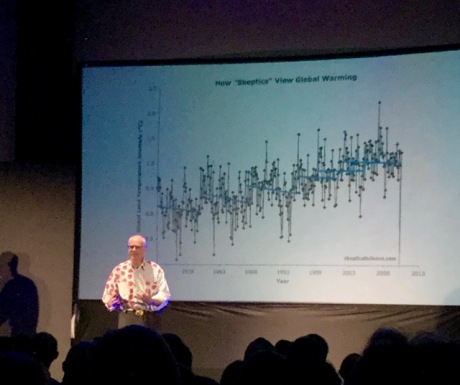
He also spoke about global warming deniers – a crafty lot indeed. They’ll take a warming curve, then select a piece of data from a larger data set that seems to suggest that warming is going down, then clap themselves on their backs for their cleverness.
Dr Karl also spoke about how IQ is getting higher each year (and no-one knows why). He also briefly discussed Steven Pinker’s book “The Better Angels of Our Nature”, where civilised behaviour seems to be on an upward curve. Long may it continue.
For many in the audience, we would have come these topics before, but nevertheless these are really interesting areas of discussion and activism, very well recounted by Dr. Karl.
Here’s Dr. Karl’s YouTube video “Great Moments in Science”.
QED is the UK’s largest conference on science and scepticism. It’s a get together for people who are passionate about science and evidence in contemporary culture and current affairs. It takes place yearly in Manchester and it’s now in its sixth year. This is my fifth year attending. As ever, it was a wonderful conference. We were really spoiled for choice this year with many tracks taking place simultaneously, so until I am able to master bilocation or out-of-body travelling, this is my account of just a small sliver of events happening over the weekend.
YouTube Debunkery!
The intro video this year was really superb, with production values in the stratosphere. It became clear how this was done when the speaker for the conference, Alan Melikdjanian aka Captain Disillusion, gave us an insight into how he makes debunking videos for YouTube. It was an incredible presentation, complete with audience polls, interpretive dance, hater comments, bad 90’s Powerpoint, arguing with himself on video, all done flawlessly with maximum comedic effect. The slides looked beautiful too.
In terms of technical presentation skills and using the different types of media to communicate a message, this was one of the best I have ever seen. Really, truly excellent.
Here’s one of his videos.
Good Advice, Bad Advice!
The next speaker was Petra Boynton, an advice columnist with the Telegraph. She showed how advice columns are a very old and venerable part of print media for over 300 years, and in many ways, they have not changed that much. It was interesting to hear how careful columnists needed to be, as context is everything. She very much sees this as a kind of public service, particularly when access to professional help has been cut back in recent years.
Naturoquackery
The next speaker was Britt Hermes. Britt had a very unusual story to tell. She thought she was a doctor, then found out she wasn’t. Britt studied naturopathy in Bastyr University in California, where she was indoctrinated in alternative medicine. Even though there was a small amount of medicine taught, everything was solidly encased in new age woo.
I’m taking down these notes and I’m thinking “Wow. These doctors are so stupid.”
During her studies, Britt went to Ghana. She learned to give intravenous injections of ineffective medicines to people who were very sick. She then went to Nicaragua where she dispensed homeopathic products to treat cardiovascular disease.
When she graduated, she started teaching in Bastyr. She moved to Arizona under Michael Uzick, which was where the wool was pulled from her eyes. Uzick appeared to be involved in a dangerous, so-called cancer drug called ukrain. She reported him to the authorities, with predictable consequences. She ended up leaving naturopathy, a profession which, by this time, she had spent hundreds of thousands of dollars in fees.
I realised I was a fraud.
Britt found help and support from within the global skeptic community. She has since set up a blog to expose the practices of naturopathy to the rest of the world. It’s hard not to see naturopathy as a kind of twenty-first century cult, despite it’s veneer of medicine.
Naturopaths can basically say and do what they want. There is no standard of care.
Britt is adamant that naturopaths should under no circumstances be given the title of doctor. They should not be treating children as they get only 10% the training of paediatricians.
There is no doubt that many naturopaths have good hearts. But without a medical degree, they are nothing more than good hearted charlatans.
Britt has stared a petition “Naturopaths are not doctors” to raise awareness of the inadequacy of naturopathic care, and to stop naturopaths being licensed as doctors in America.
You have to fool patients and you have to fool yourself. So I am glad to say, I am one of the most unsuccessful naturopaths on the planet.
Britt has shown incredible bravery in admitting her mistake and then challenging the fundamental basis of naturopathy to a world audience. Britt got a well deserved standing ovation from the audience for her talk.
Voters in most countries elect politicians to work in the national interest. This means taking strategic decisions that advance the cause of that country, whether that be economically, politically, culturally, scientifically, you name it. Politicians, and particularly senior politicians, are put there to make the right moves; not necessarily the popular ones.
And then we have Brexit. A constitutional referendum in July returned a wish by a majority of voters in England and Wales (but not in Scotland or Northern Ireland) for the entire UK (including Scotland and Northern Ireland) to leave the European Union. The Tory Party in the UK, currently in government, has promised to make good on this wish and is threatening to pull the rip cord in 2017.
I ask myself how any of the following predictions are really in the UK’s national interest:
Scotland’s departure from the UK. The Scottish National Party are the largest political party in Scotland. They have already tried once to break their links with the UK. Under Brexit they would almost definitely do it again. And they would almost definitely win this time.
UK banks fear that they may lose “passporting” or ability to trade freely with the EU.
The CBI in the UK are reporting a significant year on year drop in sales in September.
London may lose its top spot in banking to other cities, including Singapore, New York and Zurich.
A European army might come into existence following a UK exit from the EU, contrary to British wishes.
Dramatic fee increases are on the cards for British university students as research funding becomes uncertain.
A consensus is forming that a hard Brexit would knock off 9 billion pounds in value from investment banking and capital markets.
New border posts could be required in Ireland, threatening a hard won peace.
These are just a smattering of headlines from the last few weeks.
Flight of capital, brain drains, breakup of the UK, decline of strategically important industries, trade tariffs reimposed, worsened security situation: that’s one hell of a price to pay for restricting the number of Polish and Romanian migrants to England and Wales and putting one over on Johnny Foreigner.
If this is working in the national strategic interests of the UK, then I’m a Dutchman.
Among the things I think about sometimes is how we got here as a species, and where we’re going.
We tend to think of ourselves as a young species, having only discovered writing (and with it, history itself) in the past 5,000 years, and civilisation (with its permanent monuments) 5,000 years before that. Earlier than this, our history as a race of humans goes quite dark. Archaeology tells us a few things, but the further back we go, all we have are fragments from our past. We can quite easily forget that we are a very old creature indeed. How long ago was it since we discovered language, since we started singing, since we started praying, since we discovered a sense of humour? It’s hard to say, yet it’s quite probable that such traits predate homo sapiens, going back through multiple ancestral species. Were we to travel back a couple of million years, maybe we would still see ourselves in our austrolopithical forebears.
I remember reading a book some time ago, that one group of our ancestors (or possibly close cousins) spent over a million years fashioning an early stone tool with practically no development in all that time. That’s tens of thousands of generations just hammering away with little sense of innovation. They were rooted in the animal world – lives full of fury, struggle and passion, but not one given to legacy or creative accomplishment. Maybe there were stirrings there. Maybe, every so often, one of them came up with an idea, but they were quickly hit over the head, or eaten by a lioness, before that idea (or their genes) had a chance to spread.
I ask myself if that’s where we’re ultimately going back to. If anything has been successful in the long term on this planet, it’s been that patient toiling away with little progress through the generations. Among all the animals, a sense of constructive wonder seems to be selected against. In the single case where it has succeeded, it’s lead to an exponential increase in technological development, resulting in a potentially untenable situation full of nuclear weapons, over-population, resource depletion, multi-species extinction and the prospect of disastrous climate change. Maybe our ultimate fate (if we survive this time at all) is a return back to the animal realm. Maybe, 90,000 generations hence, our distant children will be back in the trees, or scurrying around in holes, or hammering again on rocks with little thought for art and music.
I think about the last person in that line, looking around at her species and wondering about it all, before death finally takes her away and the universe once again becomes dim and distant to humanity.






 Passive Impressions