There is a difference between Science and Religion.

Science needs evidence. Science embraces evidence. If the evidence tells you something that conflicts with your beliefs, then in science, the evidence wins. It must win, because that’s how progress happens in science. Scientists follow the evidence, irrespective of how uncomfortable that might mean towards their beliefs.

Religion needs belief. Religion embraces belief. If the evidence tells you something that conflicts your beliefs, then in religion, the belief wins. It must win, because that’s the way religion preserves itself, often passing down the generations. Religious adherents follow the belief, irrespective of whether evidence exists to support those beliefs or even if if it refutes those beliefs completely.

If you are a scientist, and the evidence starts to conflict with your beliefs, but you hold fast to those beliefs despite strong evidence to the contrary, you are no longer practicing science. You are practicing religion.

If you are a religious adherent, and the evidence starts to conflict with your beliefs, so you change your beliefs to come in line with the evidence, you are no longer practicing religion. You are practicing science.

There is a difference between Science and Religion and this difference is unreconcilable. A wide, yawning, unbridgeable gap. You either accept that evidence has primacy, or that belief does. You can’t have both. Efforts to reconcile the two are unlikely to be very productive.

There is a difference between Science and Religion, but perhaps the issue is somewhat moot. The real question is what difference this makes to most of us. The problem is our brains, you see. Our brains have an interesting relationship with ideas, both scientific and religious. In our brains these things tend to get mashed together, confused with each other. Our brains can accommodate conflicting ideas. While science and religion are different, when it comes to scientific people and religious people, the distinction is far more blurry.

Most people don’t think about religion or science all the time. Most people spend their time thinking about other things. Whether they left the heating on, the pain in their foot, the hallway that needs a paint job, the local team losing last Saturday. Most people have friends to talk to, families to care for, work to do. Muslim, atheist, Christian, secular, Buddhist: when it comes to life and everyday concerns, we become less different. We become more human. The gulf can be traversed. It’s no longer black and white. It’s complicated.

There is a difference between Science and Religion, but our humanity keeps getting in the way. 

Years ago, when I was religious, I found it difficult to imagine how I could cope with adversity if I didn’t have a strong belief in God. I felt that my religious faith was the key ingredient that helped me through in times of trouble. A quick prayer and the feeling that I was being looked over by a loving deity gave me great comfort.

I’m sure many religious people believe that it’s all very well for atheists to hold their views in good times, but just wait until bad times hit. There are no atheists in foxholes, as they say. The reality, however, is that most of us can get through quite terrible setbacks without relapsing into religious belief.

I’ve had a few big setbacks since I lost my religion all those years ago. Some of them have been pretty tough. I had plenty of dark times as I negotiated my way through them. But not once did I have recourse to prayer. No matter how bad things got, I never felt like trying to rekindle my religious beliefs. Honestly, I would have immediately thought it pointless and silly. It simply wasn’t an option.

But nevertheless, I got through these times and lived to fight another day. So how did I manage? Looking back, here are a few pointers.

I tried to be kind to myself. Bad things usually happen, not because you’re a bad person or that you need to be punished, but because such is life. People get old, or find themselves in the wrong places, or make mistakes they couldn’t possibly have foreseen at the time. Realising this made me feel less angry with myself. Guilt was one burden I didn’t have to bear.

I gave myself time. I tried not to expect that all the bad thoughts would go away permanently just by thinking a certain way, or doing something transient. The feelings come back no matter what you do. Realising this helped to reduce the urgency of needing to have solutions for everything. Some things in life don’t have easy answers. As they say, if you can’t overcome it, you can often outlive it.

I tried to live in the present. Realising that bad feelings pass, given enough time, allowed me to better allow the worst issues to roll over me. You roll with the waves.

I tried to acknowledge the pain and feelings I was experiencing. They were real to me, why fight hard against them? If I felt like crying, I would cry. If I didn’t feel like doing something, I left it go until I felt a bit better about it. You have good days and bad days. It’s not about surrendering, as much it is about giving yourself some time.

I tried to get on with life, getting back to the things I liked doing and to the work routine I was used to. It was difficult at times, but it allowed my mind to think about other things. I feel that brooding about the past too much is the mental equivalent of scratching a scab. It can prolong the pain and I’m not sure if that’s particularly healthy.

I sought out and appreciated the company of friends and family members. Just talking about things and the kindness they showed helped me so much. I appreciate that this is not something everyone can do, but it helped me. Even pets can be such great companions. They don’t think much about the future and they get on just fine. Maybe, during these times, neither should we.

I sought out professional help. A chat with a doctor or a counsellor helped me through the more difficult periods. Assistance like this has a big place in overcoming the most painful feelings.

Would my experience have been shorter or less painful had I kept my religious faith? It’s difficult to know, but I suspect there is little difference. There was no sense of help from a loving god as I went through it, but neither were there any feelings of despair or guilt that the same god wasn’t bothering to help.

Religious believers often thank their god for getting them through the dark times. But I think they are missing something. The truth might be that their success is only theirs to celebrate.

Here’s what most people think critical thinking is. You take on a position, then you develop arguments as to why this viewpoint is the correct one. It’s the stuff of debate, polemics, law and politics. We admire people who can present strong arguments, then defend their positions under withering pressure. Sometimes we elect such supremos to powerful positions. It’s a handy skill, not to be dismissed, often to be admired. But I’ll tell you one thing it isn’t: it’s not critical thinking.

Real critical thinking takes a bit more work.

To be truly critical about a viewpoint, first you need to figure out if it’s wrong. That’s not an easy thing to do, because it goes against our innate mental biases. Our brains are naturally predisposed to taking on positions then finding support for such positions. What critical thinking asks of us is to challenge this mental process head on; finding evidence that suggests it’s not true, or not valid under certain circumstances. From this a more complicated picture can be drawn.

A critical thinker needs to spend time to understand if their position is based on valid or fallacious logic. If you are basing your position on the mere fact that everyone else accepts it, that’s not a great starting point. Neither is it much help if it originates from an emotional feeling or a desire for something to be true rather than bothering to establish if it is true in the first place. There are a ton of pitfalls – logical fallacies – that can trap the unwary thinker.

Or maybe the sources themselves are invalid. A peer-reviewed scientific paper may hold more water than the flatulent utterances of a Daily Mail headline, but even this might require consideration if it’s rowing against other research on the same topic. Many newspapers and websites promote strong political, cultural or religious viewpoints. There may be vested interests involved, whose job it is to muddy the debate. It can be a minefield trying to winnow the grammes of wheat from the tonnes of chaff.

If you do put in the ground work to validate and perhaps adjust the stance you have taken, it’s then when argumentation and debate has a role to play. But even then, you have to be willing to accept that, even at this late stage, you might be wrong. There may be evidence out there that you failed to consider. You need to be open to this possibility.

Going through this process of formulating hypotheses and testing is one of the most valuable skills an education can give us. It’s the basis behind most forms of professional and scientific inquiry and it’s fast becoming a useful tool of business and management. So why aren’t our kids learning more about it in school? Why aren’t they getting any chances to practice it?

So many subjects are presented as just-so facts. The desire to complete the curriculum as expeditiously as possible trumps everything else. Where discussion is permitted, there is little effort to evaluate positions on their merits or to examine our biases and the many flaws of argumentation. Debates are little more than exercises in one-upmanship – opportunities to talk across each other while playing to the audience. Being wrong is something to be avoided at all costs. Our education system is miles from where it needs to be.

We have to find ways to break this cycle. We need to give curiosity, exploration and inwardly directed criticism greater prominence in our educational system. We need to elevate hypothesis formulation, testing and investigatory work, allowing kids to make mistakes as they try to figure out what is right and what is wrong. Instead of telling them the answers, give them the tools to find the answers for themselves.

A real critical thinker has to shroud themselves in doubt, and it’s from doubt that real critical thinkers are born. Our education system has become too enamoured with certainty to give this much consideration. We need to find ways to change this.

Confirmation bias has to be one of the most pervasive – and shittiest – aspects of human nature. By definition, it’s our natural tendency to only search for information that conforms to our preconceptions. In other words, we are naturally disposed to seeing only what we want to see.

And it’s all around us. You don’t like someone? You’ll only see their bad points. You had a bad meal in a restaurant? The service will be bad too, and they left a stain on the tablecloth. The wrong party got into power? Look at the mess they created.

If you have a vested interest in anything it’s likely that the gales of confirmation bias will roar around you. If you’re selling or promoting something it’s likely you’ll jump with delight on information that could promote your business. You’ll jump with annoyance, though, on any statement to the contrary. The same goes for fossil fuels, quack autism cures, homeopathy, fortune telling, you name it.

I want to take the German refugee crisis as an example, because I’m currently stuck in a debate about it. Because of the devastation of Syria and Iraq, tens of thousands of refugees are arriving in Germany each week. A million people could come there in the coming months. This is undoubtedly going to put stress on everything: schools, housing, hospitals, social services and policing. It wouldn’t matter where the people came from or what their religion was: a million people arriving from anywhere would pose big problems to residents.

Many locals are less than happy. Listening to them I get the impression that the refugees are the worst people imaginable. A lot of the arguments hinge around stories of criminality or personal affronts. Sheep getting stolen, youths going to the toilet on doorsteps, local women being insulted as whores, that kind of thing. Terrible stuff indeed.

But here are a couple of things that make me pause.

First, are all the stories true? When hearing stories that we badly want to hear, our critical faculties often disappear. The statement itself is proof enough. Because it conforms with what we already believe, why be sceptical about it?

Second, what about the disconfirming stories? The stories of immigrants or refugees doing nothing of the sort? Of minding their own business? Of doing something nice for other people? You won’t hear many of these because nobody wants to talk about them. Nobody likes a good story ruined.

Third, in what way does a story like this extrapolate out to the wider community? You will find criminality everywhere and desperation may provoke additional anti-social behaviour amongst some people. Even still, lots of stories like this are unlikely to be indicative of a mass movement of people, hell-bent on exploiting their hosts.

Fourth, because these people are escaping a bad situation, doesn’t necessarily mean that the badness is coming with them. If they loved the awfulness of ISIS and government terrorism so much, then why are they leaving in such numbers?

Now, it’s quite possible that it’s me who is biased, that it’s me who is giving the refugees far too much credit and that I am not considering the genuine problems of local residents. Maybe I’ve become too leftie for my own good and it’s addled my brain. It could be. After all, I’m just as susceptible to confirmation bias as anyone else. However my experience is that most people are basically decent. They are more interested in washing machines and putting food on the table than they are about forcing others to conform to their way of thinking. Kids tend to behave like kids everywhere and while it’s more complicated with adults, it’s the complications that make it such a muddy picture. There are good people and bad people and every shade in between. If we ignore all this variety in order to adopt a convenient fantasy that they are all the same, we take steps down some very, very dark pathways. Perhaps that’s just wishy, washy, liberal me talking.

Hey mum. It’s me, Marty. I’m back from 2015.

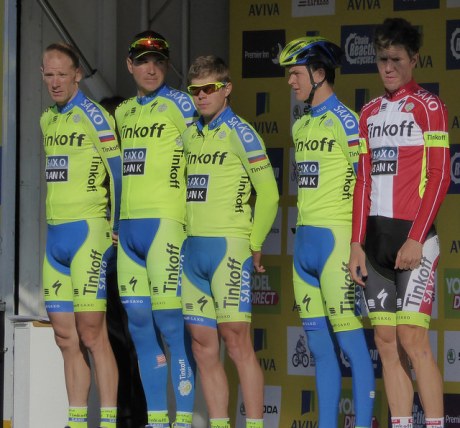
Yeah, it’s nice. Not at all what I expected though. No flying skateboards. No hover cars. Not even a new version of the space shuttle. Lots of people still wearing jeans and t-shirts. I mean, they had 30 years, but no polyester jump suits to be seen except, hmm, hold on – cyclists. You have regular people and then you have cyclists. Now *they* look like proper future people. They wear tights and on top of their head is a replica of that face-sucker thing in Alien. These people thought (think, will think, may think – time travel tenses really need to get sorted out) that this is a fashion statement:

Tinkoff Saxo cycling team

Tinkoff Saxo by Morebyless cc licensed.

It’s not even fashionable here in 1985. And that’s saying something.

Also, their phones. Ye gods. There’s not a phone box to be seen anywhere. Instead they all have these portable phones that fit in their pockets. Well, to call them “phones” is being generous, because I rarely saw (will see, may see) them being used to call anyone. A better name for them would be “tickle devices”. People spend their days pawing them, jabbing them, swiping the them and thumbing them for goodness knows what reason. I think it might be a sexual thing. And possibly something to do with cats.

Tickle, tickle.

Swipe, by Jeremy Keith. cc licensed.

They use these tickle devices to “google” things. You see, in the future, whole armies of people will be employed to answer questions. You type in a question and someone reads it, opens up an encyclopaedia and gives them a list of possible answers to the question. The researchers at the other end are a bit thick though, because most of the answers they give are wrong. I don’t think they are getting paid enough. My heart goes out to all those people whose job it is to give directions to drivers. I mean, it must be a hell of a boring job just calling people up to tell them they need to turn right at the next roundabout.

Can't you see we're eating?

And it’s all about coffee these days (those days, those will be the days). Maxwell House or Nescafe instant granules is not good enough for these people. You can’t even ask for a coffee at these places. You say to them “can I have a coffee” and they just look at you as if you’re stupid. There’s a whole vocabulary now. It has to be an Americano (black coffee) or a Latte (coffee with milk) or a Frappuccino (yep, people in 2015 will pay to drink cold coffee). The same goes for chocolate and tea and milk and bread and breakfast cereals. And it’s low fat and gluten free and l. casei immunitas. To go shopping in the future, you need a masters degree in nutrition, otherwise you’ll probably starve to death.

So I’m glad to say the world hasn’t (isn’t going to have, may not have) ended in nuclear holocaust and that most people seem pretty normal, if it’s all a bit West Coast and healthy and sporty and image conscious. The future is to be welcomed, even if we’ll all need to take the scenic route to get there. But the cycling outfits. Man, that’s going to take some getting used to.

Fiona O'LearyWe were delighted to host Fiona O’Leary last Friday in Blackrock Castle. Fiona is a prominent campaigner on the issue of childhood autism. Over the past few years, she has proven to be a thorn in the side of groups who profess to be able to ‘cure’ the condition. She has been the major force behind a number of exposés and media investigations across Europe and the US, resulting in the closing down of lucrative illegal operations selling highly dangerous medications to the parents of autistic children. Fiona is tireless in her energy, passion and dedication. She attributes this to her own experience on the autistic spectrum – almost unable to anything in half measures.

Fiona gave a great talk – lucid, wide-ranging and often shocking. She gave us an insight into the activities of organisations such as the Genesis II Church, who claim that industrial bleach can cure Autism, or David Noakes, who sells a blood based product called GCMaF to parents of autistic kids. These people have been helped in Ireland by health-care professionals, some of which are likely to get debarred as a result of Fiona’s work.

Rather than recap the talk in its entirety, here are some of my take-aways.

Autism is not a disease. Talking about it as if it were a “disease” that can be “cured” is misleading and insulting towards people with autism and their families. Unfortunately, there is a view out there that a cure exists, but big pharma or the medical establishment are actively working to suppress it from the public. The groups selling magic potions such as GCMaF or MMS seem to see themselves as plucky counter-revolutionaries who are in a fight with the establishment to get the truth out. It’s a very seductive narrative, but it doesn’t quite cover the fact that their purported remedies are both useless and dangerous. They are also in the business of selling false hope to vulnerable families.

Autism is not the fault of the parents. Some observers, harking back to the “refigerator parent” hypothesis, appear to prefer a narrative that kids who manifest autistic characteristics, do so because of a lack of affection in their earlier years. This hypothesis has long been debunked, yet prominent commentators still prefer nurture to nature.

The treatment of autism in some countries lags far behind international best practice. France, in particular, has been called out repeatedly for inhumane treatment of autistic kids. At the talk on Friday night was a family who fled the country in order to protect their autistic son. The people of France will have some considerable accounting to do in the years to come.

Autism is not a recent phenomenon. The huge rise in the incidence of autism diagnoses worldwide is mainly explicable through better detection and reporting over the past 30 years. Before movies such as Rainman raised the condition to public consciousness in the 1980’s, it was often misdiagnosed as a psychiatric illness for which institutionalisation seemed to be the only ready answer. If there are silver linings to this story, it is that autistic people are no longer confined to the shadows, no longer considered to be a source of shame to their parents.

Vaccines do not cause autism. Multiple scientific studies have now confirmed that there is no link between the two. However, well organised groups – a sizeable percentage of the autism advocacy community – dismiss the evidence, preferring instead to yell “conspiracy”.

Autism needs to be considered a part of the diverse human spectrum. This, ultimately, is what Fiona’s message was all about. Just like sexual preference, skin colour, eye shape, curly hair and male pattern baldness, it’s part of who we are and what makes us different. It can be debilitating and exhausting but the answer does not lie in paradigms that talk about cures and blame. Funding and support is required to enhance the lives of autistic people, so they can live happy, worthwhile lives.

There is a war going on within the autism world. The autism advocacy world is marred by infighting, verbal abuse, threats and character assassination. A huge section of the movement has embraced conspiracism over evidence, logic and critical thinking. The only weapons in their arsenal are emotion, anecdotes and bullying. In doing so, they are convincing none of the people who actually matter. Governments, philanthropists, foundations, trusts, charities and other non-governmental donors, who prefer well reasoned and well researched cases, are receiving mixed messages from advocacy groups. They may well be persuaded in the end to invest their resources elsewhere. How much progress has been wasted while autism advocacy fights itself to a stand-still over vaccines and big pharma suspicions and damaging concoctions such as MMS? There is a need, I think, for campaigners to work together and explore common ground, even if they have disagreements on certain issues. . Critically, they need to engage positively with the scientific community. It’s a Herculean task, akin to squaring the circle, but I don’t see an easy alternative. Until the advocates start basing their campaigns on the science, many kids and their families will not get the quality of life they deserve.

I want to thank Fiona and Tim. It must seem that they are fighting against the tide at times, such is the vitriol directed against her and her family. But it’s a worthwhile cause. The sidelining of the fanatics and the creation of space for more reasonable engagement is an important step in giving these families the support they need.
A few weeks ago, myself and some friends decided to go to the Joe Power show when he was in Cork. We were curious to know what went on at such events, so we purchased a cheapo voucher and headed along to his show in the Metropole Hotel last Friday night.

The audience was quite large: maybe as much as 200 people. It was a mixed bag of people, old, young, men and women. Certainly more women than men with more older people in attendance.

Joe started late. One of his first questions to the audience was whether any of them had been to a psychic show before. Very few people in the audience had been to one.

Joe got stuck in straight away, happening on one of the most serious of subjects imaginable: suicide. The manner and some circumstances to do with the death were discussed with family members. A troubling line of questioning, to say the least. When he was done with this, he asked the father if he had been to hospital or had some trouble down below? When the answer was negative, he told him he might need to go.

Joe then went to other members of the audience, some of whom were responsive to his questions, some less so. Here are some brief (low) highlights:

‘Anyone shot down? Planes?’ he asked, possibly forgetting that few enough Irish people were involved in WWII. (He counselled the audience member not to go on a plane).

He discussed divorce problems with another person and what their sex life was like.

A fire in the house? Yes – 40 years ago. ‘We can go back as long as you want’.

‘Why are there 3 people buried next to each other? A young boy or young man? ‘No, just two – mum and dad’ ‘You’ll probably find I’m right by the way. You might need to look back’.

‘Just to let you know he’s around and he can see what’s going on’.

Brought up some private family issue where a family member went to prison for a while.

Told one man he might be getting 18 months in prison in the future.

Told another man he should get tested, maybe for bowel problems. ‘Get the missus to check around’.

What also struck me was how much stuff he just got completely wrong. Lots and lots and lots of questions never hit their mark. If the questioning wasn’t going anywhere he would simply move on as if it didn’t happen. My top marks on the night went to the people who made his life difficult. One woman blanked him completely, so he quickly moved on – indicating that the reading wasn’t for her. There were a few others where his questions went nowhere.

He would leave his questions deliberately vague, so he’d ask if it was father, or father in law. Dates like 26 or 19 were converted into people’s ages if it suited. Wigs (he asked a lot about wigs) became hair extensions. Because many of the subjects were older, he touched on health issues such as cancer, diabetes and hospital visits, or lifestyle issues such as losing weight, pigeons and gardening. As if willing him to succeed, many of his respondents made his life easy. They would try to answer his vague questions on numbers and hair and accidents with something that happened to them, even though this often had nothing to do with the deceased relative. In this way they were able to connect to him despite the fact that the overall narrative was confused, mixing things happening today with something concerning the death.

Almost always, he would simply say vague things about the dead people, like “he’s looking after you” or ‘he misses you a lot and thinks of you’. I’ve written about this before, but grieving is a process which often involves letting go. I don’t think psychics help this process at all, because the underlying message is that they are still there, still watching. Such talk does not help people move on.

This is what passed as Friday night entertainment. Banality, sadness and voyeurism reigned. There were a lot of cheap laughs at the event, but they were often at the expense of the people involved. We are not entitled to be given this kind of window into their lives. People deserve more privacy than this. Professional counsellors, not public psychics, are a far better solution for such problems.

My advice? Next time there’s a psychic in town, save your money or go to the pub. It’s a better use of your time and money.

Without much doubt, the Volkswagen emissions story is one of the greatestl corporate disasters in recent decades. As a proud VW owner, I’m shocked that a company of its size and reputation would have ever allowed itself to get into so much trouble.

The highly abridged story is as follows. An independent test revealed that some VW diesel cars contained software designed to trick emissions testers. If the software noticed that the car was undergoing an emissions test, it would change the engine settings to reduce nitrogen oxide output to the lowest possible level, thus tricking the testers. When the car was allowed back on the road, the engine settings would be reset, allowing emissions – up to 40 times higher than legally permitted – to be released. VW put code into their cars that was deliberately designed to break US environmental laws. It also breaches environmental regulations in many other countries. Up to 11 million cars are affected and we are awaiting news on exactly what these cars are.

It was a monumentally audacious trick. It’s beyond me how, with 11 million affected cars on the road, they didn’t imagine they would eventually be found out. Now that the fraud is in the open, VW face massive lawsuits from a whole raft of countries. They cannot sell any more diesel cars in the US – both for this year and next year. Switzerland has banned the sale of further diesel cars. Presumably more countries will follow. All owners of affected cars may be compelled to return their cars to their dealers, so that a software fix can be applied to the cars. If the cars are not as powerful after the remedial fix or if taxes are increased for these models, VW face massive class action lawsuits from millions of annoyed drivers around the world. VW’s reputation – indeed the reputation of the German motor industry – is badly tarnished, resulting in enormous job losses down the line. This may spell the end of diesel cars. People with breathing difficulties, such as cystic fibrosis or asthma, may well be encouraged to sue Volkwagen for putting their lives in danger.

Given the implications as described above, I cannot understand how VW’s legal team would ever countenance such a thing. Their job is to protect the company under all circumstances. Permitting such a fix to go through would have been idiocy of the highest level. My assumption, at this time, is that they simply didn’t know, which should imply that the CEO did not know either. However the same cannot be said for their head of engineering. To pull off this massive fraud, somebody wrote the code, other people tested the code and yet other people signed off on the code. Testing must have been quite sophisticated to ensure it worked in real world conditions, so we are talking about a lot of engineers and a considerable enough budget to pay for all this.

For this reason, I do not believe this was a massive conspiracy orchestrated from the top of VW. You could of course argue that “everybody is doing it” as an incentive to commit the fraud, but so far it appears that just one engine produced by Volkwagen is affected. It looks like a solo run by someone in engineering – someone far too clever for their own good. Whoever dreamed it up, signed up to this scheme or attempted to cover it up should face criminal charges.

Despite the bad news, there is a silver lining. Ironically this could be the best thing to happen to international business culture in quite a while. The incident means that corporations need to double down on their business conduct policies. No matter how good any corporation perceives itself to be, this story shows that a small number of people can do irreparable damage to the entire enterprise in pursuit of short term profitability objectives. It also perhaps signals a concerted move towards cleaner technologies. In the medium term, testing of diesel cars will be revamped. There have been significant issues with these tests for years, with the industry arguing vociferously against more regulation. They have now lost this argument. In a year or two, all diesel cars will be subjected to a far more stringent regime. This is good for all of us. In the longer term, it is likely that diesel will diminish in importance, though it could be argued that electric vehicles cannot match the power and durability of diesel engines. Either way, it will signal a major change in the industry.

Whatever the outcome, plenty of lessons have been learned.

CPVGTgyWcAAa1ZI

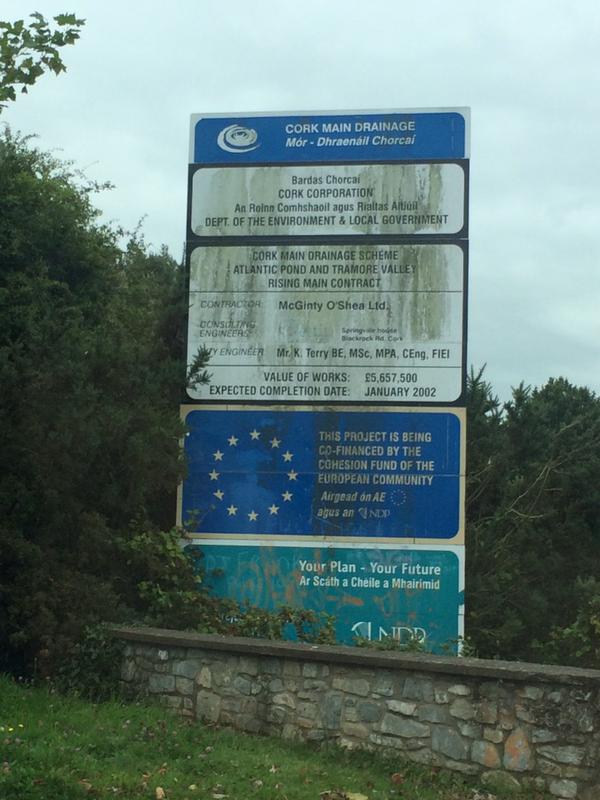
Skehard Road, near the Mahon Shopping Centre, Cork.

Expected Completion date January 2002?

The only thing this sign is advertising now is copious algae, dirt and graffiti.

Surely it’s about time it was removed?

Lights in the sky shining down on Cork City?

(Click to enlarge)

Lights from the Sky

Yes, but before you contact the UFO hotlines, it was just the sun shining through holes in the clouds. The spotlight / laser effect was quite stunning that evening.