Hundreds of years ago, people believed that the devil lived among them. Fearful people would witness their crops fail, their children get sick and die, their livelihoods destroyed by fire or flooding. They would look around for a cause of such evil. Particular attention would be paid to the convenient scapegoat – perhaps an old women, a stranger from out of town, or a Jew. Maybe these people were heard saying something, or maybe they were seen doing something just before the calamity struck. For the medieval mind, this was all that was needed. The devil was afoot, and because these people had done something suspicious beforehand, they had clearly channeled his evil for their own malevolent purposes.

“Because it happened beforehand, it caused it”. It’s called the’post-hoc fallacy’. Because the witch had cursed an official, she had brought on the sickness. Because the Jew had refused to give a loan to the alderman, he had been responsible for the great fire. It’s nonsense, right? It may have been a coincidence or a distortion of fact, but this, to the medieval mind, was beside the point. It happened before, therefore it caused it, therefore the witch is guilty.

The same medieval thinking persists today, except now its not witches and the devil. It’s vaccines and Big Pharma.

“Because my child received the HPV vaccine and subsequently got sick, the vaccine caused the illness”. The only evidence is a co-incidence, but to a fearful mind, this is enough. Why not other childhood vaccines like TDap, or MenC? Why not a genetic predisposition, or a viral illness? No. It was the witch, or should we say, the HPV vaccine. And the great evil behind it all: Big Pharma.

It’s the job of science to show that there is a correlation between two events. It’s the job of science to find cause amongst hundreds of probable causes. And the scientific results to date are clear: there is no connection between the vaccination and subsequent illnesses. Kids get ill at the same rate, irrespective of whether they have been vaccinated or not.

To the fearful mind, all this evidence is too much. Get away from us with all your studies and numbers and percentages. Let’s just burn the witch and be done with it. Why choose a rational course when ignorance and emotion will do?

Our medieval tale tells us something else. When the cause of the fearful is taken up by officialdom, by well-known celebrities and by politicians on the make, when fear overrides fact as official policy, things quickly get much worse. The fear is legitimised, stifling the voices of reason amid censure and threats. Official sanction permits it to metastatise into other areas of policy, thus multiplying the fear. In the case of HPV, perhaps we will not burn witches, but we will burn away our options, so that a now preventable cancer can continue to wreak damage on young lives.

Politicians, journalists and opinion formers must stand up, not for what’s popular, but what is true, based on the very best science and expertise. Following the route of least resistance and aligning with the fearful is not leadership. It is the opposite of leadership. We’ve seen these patterns before and the chaos they have caused. We cannot afford to repeat them.
One of the great benefits of being the dad of teenagers is my ability to use The Force at each and every opportunity. I am like a Jedi Knight, inhabiting a world of constant adventure, using The Force at every opportunity to fight evil and set the galaxy to rights.

Ok, that might be a bit of an exaggeration. When I say “Jedi Knight”, I really mean “Arsehole” and when I say “The Force”, I really mean “Arsehole Factor”.

I have this fantastic capacity to turn the once blissful world of my teens into a dystopia of pain and suffering in seconds. No light sabre needed. All that’s needed are magic words such as “have you started your homework?” or “put away your phone”. These are powerful enough to suck the air out of the room, leaving a mass of blistering resentment in its wake.

I have superpowers. At a single command, I can force my kids faces into their open palms. I can get them to roll their eyes upward into their skulls. My reverse magnetism ensures that when I enter the room, they leave immediately. I can get them to mutter swear words under their breath, and when I follow it by “what did you say?” I can predict exactly the answer I will get.

I have been practicing. Dropping them off to their friends fifteen minutes late. Serving them broccoli and carrots at dinner. Bopping to CHVRCHES at inappropriate moments. Do not underestimate the Power of my Uncoolness.

One day soon, I will lose my powers, so I’m going to revel in picking my teeth in their presence, asking them questions about Napoleon that I know they can’t answer, and starting each sentence with “when I was your age”. The Dark Side must be balanced eventually, but not just yet.

On holidays in the UK when it happened. Hadrian’s Wall. I had no idea something big had occurred until I got back into the car for the trip back to the rented cottage in the Lake District. 
We picked up the thread of events from BBC radio. It still wasn’t clear whether the attacks were over or still ongoing. How many planes overall? Were there more horrors yet to unfold? Reports were coming in from Pennsylvania. Another plane, burning in the woods. Further collapses at the WTC. Who, what, why: unknown.
I remember that sinking, horrible feeling of powerlessness and fear; mystified at the depths to which humanity will go. Like staring into the abyss. I had felt this before, but never with such intensity. Thousands dead. How many thousands? They didn’t know. The journey was one of silence, interspersed with the occasional expletive. 
It was late that evening before we saw the TV images. The fires, the collapses. Images nailed into our collective consciousness forever.
I remember thinking: if this is what religion is capable of, I’ve had it with religion. I’ve since extended this to all kinds of political ideologies. A curse on all their houses.
I wish we could say this was the worst thing we would ever witness, but the catalogue of horror remains an open book. 
🌹

I created this blog 10 years ago. I’ve been posting to it occasionally and regularly over that time. My blogging has been quite random, mainly covering the boundaries between science and pseudoscience, but it’s also been a place to post my photos.

The original name of the blog was “Sunny Spells and Scattered Showers”, shortened subsequently to “Sunny Spells”. A few years ago, I became aware that another blog of the same name had been created. This other blog has been quite successful. It talks bravely about the very important topic of depression, a topic indeed close to my own heart.

In order to avoid confusion between our blogs, and perhaps to give my blog a name more attuned to the things I write about, I have decided to move to a new site: passiveimpressions.com. Over the weekend, I will move all my content will there. Any hits to this blog will be automatically redirected there.

Stay tuned. If you are a follower of this blog, I hope to see you on the other side.

My thoughts on the Gardasil meeting in Ballincollig this evening. This is going to be a long post, sorry!
It was well attended, maybe 150 people there. A large audience in any case. 
The speakers were Jill, a lady who had cervical cancer some years back, Matt Hewitt, a consultant gynaecological oncologist in Cork, and Professor Margaret Stanley, emeritus professor of Ephithelial biology in the University of Cambridge. Jill talked about her own experience of cervical cancer. Dr Hewitt discussed the cancer itself, its treatment, its prognosis, and how current diagnostic techniques (e.g. smear tests) were inadequate. Professor Stanley talked about the vaccine, how it works and the evidence to date of its effectiveness and safety. The meeting was then opened for questions. Dr. Robert O’Connor, from the Irish Cancer Society, chaired the meeting.
The meeting was broadcasted on Facebook and a video of the meeting can be seen at this address. https://www.facebook.com/IrishCancerSociety/
I thought all the speakers did a very good job in presenting the case for the vaccine, although what the attraction was with Comic Sans font is, I will never know. Dr Hewitt was really matter of fact. Although he is often gratified by cases such as Jill’s, he has to tell one person each week that they will die due to cervical cancer. The prognosis after Stage III is really poor. He talked about how the smear test was not perfect and that, outside of the developed world, the infrastructure was simply not there to perform smear tests on women, so cervical cancer rates are still very high. A vaccination programme would address many of these issues.
Dr Stanley spoke about the vaccines and the science. She discussed the different strains of HPV, calling out HPV 16 and HPV 18 as the really bad ones. Over 80% of people will be infected by HPV at some time of their life, but only a small percentage of these will go on to develop lesions and cancer. HPV is not only responsible for cervical cancer, but also anal cancer, penile cancer, neck and throat cancers also, and of course, genital warts. She talked about how cervical cancer was particularly a problem for younger women under 35, as it is still difficult to detect and diagnose cancers in this age group. The current Gardasil vaccine hits four types of HPV, but trials are underway for a vaccine that addresses 9 types of the virus – addressing 90% of issues cause by the virus.
The vaccine is currently administered in 3 doses for people over 15, and in 2 doses for people under 15. Most girls in Ireland now get 2 doses. The variance in the doses is because children under exhibit much better immune responses than adults. Across the EU, Ireland is no different than other countries in the age at which young teens receive the vaccine. Results from Australia have been very encouraging, with big drops in cancers and warts. Now Australian boys are receiving the vaccine as part of the overall programme. To date 230 million doses have been given to 85 million people and the health outcomes continued to be monitored intensively by the various regulatory authorities around the world. 
There are 2 ways to monitor the outcomes – passively, by checking the self-reporting through individuals and doctors, and actively, by comparing vaccinated populations with unvaccinated populations, and checking if there is any overall difference between these groups. To date, regulatory authorities across the world are satisfied that the vaccines are safe. They will continue to review the data on an annual basis. Professor Stanley also mentioned that vaccines tend to have very specific side-effects, and the side effects being reported about Gardasil are not consistent with these. What is not at issue is that children do get sick during childhood and some illnesses are debilitating and long lasting. In some cases, children get sick after having had the vaccine, but the question is whether this is caused by the vaccine, or a co-incidence. Research, based on over 100,000 girls presenting to Emergency Rooms in America, then matched against when the girls received the vaccines, is that the vaccines are not causing the illnesses. 
One of the points made by Professor Stanley was that in all trials, all deaths are monitored for 5 years, whether they be from suicide, illness or car accidents. I think one woman in the audience thought that the vaccine was causing all these deaths. That was not at all what the Professor has said. Deaths occurred with equal likelihood whether people took the vaccine or not.
Q&A
One woman lamented Andrew Wakefield having being responsible for the re-emergence of measles. True, but somewhat off-topic.
Another woman was devastated that her daughter, who was very ill, had been given 3 doses of the vaccine instead of 2. Yes, this is called science. The vaccine schedule was changed when it was found that the girls did not need a third dose. She seemed to be of the belief that the 3rd dose was an overdose, which is a misunderstanding of how vaccines work. 
Then we had a shouter. This woman also has a very sick daughter and she started shouting about how the HSE does not show the information leaflet and shouting how if she had read the information leaflet she would not have allowed the vaccine to be administered. I could hear murmurs of agreement with her from the audience. “Let her speak, etc”. REGRET have made a connection between the information leaflet and the illnesses affecting their children, despite the face that information leaflets must show all reported side effects, whether or not there have been any studies to examine the linkages. She was shouting down the speakers and it took a short while to get further questions. 
Another woman asked about the Number Needed To Treat, suggesting that 250 to 300 vaccines needed to be administered to prevent just one extra HPV case. The number given by the doctors was 159. While this still seems like a very small number, it was pointed out that it’s higher for pre-cancers. In any case we should also remember that cervical cancer is not a common disease in the population, but nevertheless devastating to those people who do develop it. Paralytic Polio also had similar treatment numbers.
The next woman got very agitated about her boys getting the vaccine. To her, the vaccine seemed like an invitation for her 13 year old boys to have oral sex. Um… no.
Heather then spoke. Heather also had cancer. “If I thought I could have a vaccine, I would absolutely urge people to go for it”. Yay Heather. Big clap for her too. 
Jackie wanted to know if the Australian vaccine was the same as the one in Ireland. Yep.
Another woman asked about Gardasil 9 and whether it was available in Ireland. The answer is no, not yet. 
The final question was about bad reactions in animals. Dr O’Connor explained that the doses given to animals were often far greater than those given to humans and that there was no evidence of it being an issue. 
The Q&A then came to an end among more shouting, but also a very big clap for the speakers. REGRET did not have it all their way tonight, despite a clear attempt by Shouty Woman to hijack the meeting at one stage. Apparently there was far more disruption at the Galway meeting, bordering on a security incident.
I spoke briefly to Dr O’Connor and Professor Stanley afterwards. Very nice people. I didn’t see any of the REGRET people speaking to them, but they may have. Shouty Woman was holding court with some of her team towards the back of the room.

Imagine tending to a very sick patient who was about to die. Imagine having, on one hand, a doctor or nurse working with the patient to make their remaining time as comfortable as possible, and comforting the family in their grief. On the other hand, you have a preacher telling that patient that they must immediately convert over to Jesus before they passed away, unless they wanted to go to Hell. Who would you choose?

Or imagine going to university, taking geology or botany or zoology, and having two classes for each subject – one that presented the scientific view, and the other threatening students that they must deny evolution and accept an 8,000 year old Earth, in order to pass their final exams.

Not appropriate, right? But this is the problem we seem to be increasingly facing these days – one of ideology over expertise.

There was a debate on the radio a few days ago where there two worlds came clashing together in an interesting way. The subject was vaccinations. On the one hand, you had people arguing from scientific and medical perspective, while on the other hand, you had people with strongly anti-vaccination worldviews. (They prefer to call themselves “vaccine informed, but let’s call a spade a spade, shall we? In the end, it amounts to the same thing).

If you were a parent, concerned about nasties such as whooping cough, rubella, measles and the flu, whose advice should you listen to? Your doctor, who, has the training, clinical expertise and direct experience working in the community with patients? Or perhaps some random person with none of this experience who tells you to ignore or distrust the doctors, that they are all shills or dupes, that they have done all their research on the Internet and are therefore more knowledgeable?

This is the choice that people have. And it should be a no-brainer. In fact, for decades it has been a no-brainer. Most people wouldn’t even think about going for the ideologue over the trained expert.

But it seems this is not as much the case today. More people choosing the naturopath over their doctor, choosing detox over vaccines and choosing all sorts of fad diets so they can avoid cancer and live forever. In certain areas, ideology is starting to win over expertise.

Much of it is marketing. Ideologues are getting better at exploiting hopes and fears. There are certain messages they put across that have an emotional impact. Tell people Big Pharma is out to get them. Tell them they only care about profits and not health. Tell them that there are poisons and chemicals being injected into their children. Tell them there is another way, and that it’s being suppressed. Tell them about the brave lone pioneers who have been castigated for their views. These are powerful, emotive messages that can be applied to any situation. They do not need facts to support them, just half-truths, glimmers of hope and a large dollop of fear.

Experts are to be distrusted, according to the ideologues. Experts, particularly individual experts, can sometimes get things wrong, so the ideologues use that against them. Knowledge is often incomplete, as is the way with science, so ideologues will exploit the gaps in knowledge for their own purposes. Companies sometimes do unethical things, so ideologues will use this to portray them in the worst possible light.

But let’s not kid ourselves – when it comes to a fight between expertise and ideology, expertise wins. It has the facts on its side.  Just maybe not the marketing.

It strikes me that Hillary Clinton is going to have one of the easiest campaigns of any candidate for American President in modern history.

In normal times, elections often focus on policies and the decisions likely to be made should they rule the country. Serious politicians will have thought at length about unemployment and growing the economy. They will have detailed plans on social policy, helping the marginalised, crime, education, health, transport, environmental issues and defence. This is to convey the impression that they are ready for government, that they have new ideas and that their policies are better than the opposition. In serious elections with serious politicians, these issues will be teased apart from every angle imaginable. The politicians will get grilled on their grasp of the issues; they will be hammered for their mistakes. Attritional battles will be fought on many fronts, requiring super human energy from the candidates.

These, of course, are not normal times. Clinton’s policies are wholly subsidiary to the personality and sheer instability of her opponent. She could have a plan to introduce compulsory military service for twelve year olds, or to drill a hole through the centre of the earth, or to chocolate-bomb Djibouti, and no one would care. As long as it’s her in the Presidency and not the impetuous man-child who happens to be the only opposition candidate in town, how bad could it be?

So while he rants about walls and guns, political correctness and single mothers, while he insults military families and respected judges and while he threatens assassinations and insurrections, Hillary can sit back, knowing that she doesn’t need to defend her policies in any great detail.

And honestly, that’s a great pity. In the end it’s these policies that will have the greatest impact on the lives of ordinary Americans and the rest of the world. A credible opposition would at least be able to apply forensic scrutiny to her platform, giving us an insight into the type of Presidency she might have in store. We already know what kind of dystopian disaster a Trump administration might be, but with Hillary, well, we’re going to have to take her word for it.

A whole field of ragwort near the Two Mile Inn by Midleton / N25. Ragwort is classified as a noxious weed, capable of causing liver damage to any animal that eats it. Each plant produces 50,000 to 200,000 seeds, so this field will produce literally billions of seeds in the coming days and weeks. This is about as bad as I have ever seen.

For more information about ragwort:

http://www.ihwt.ie/site2/welfare-campaigns/welfare-information-tips/797-2/

http://www.independent.ie/business/farming/keep-your-land-free-from-fatal-ragwort-26647422.html

http://www.irishtimes.com/culture/time-to-weed-out-ragwort-and-japanese-knotweed-1.956953

http://www.irishstatutebook.ie/eli/1936/act/38/enacted/en/print


I’ve just finished reading a history of the Plantagenet kings. Even though I am fascinated by the late Middle Ages, it’s now apparent that I am woefully ignorant about the history of our islands during this time. This book by Dan Jones has given me a better understanding of the politics and personalities involved. These are remarkable stories of power, tyranny, conquest, betrayal and ignominious defeat. A constant theme throughout this period is the struggle by the nobility to exert control over volatile kings, starting with the Magna Carta and leading in due course to a whole body of laws and ordinances designed to place limits on authoritarian rule.

What strikes me most is that the greatest of these kings were often the nastiest. Henry II, Edward I and Edward III visited quite incredible levels of violence on their neighbours: the Welsh, the Scots and the Irish. It’s interesting to me why history calls them great, given the extraordinary amount of bloodshed and cruelty involved. Perhaps it’s because people see greatness in those rulers who go to great ends to protect their realms and defeat their enemies. England’s great nemesis was France, so to guarantee peace, the neighboring realms needed to be brought under military control using all means necessary. When people felt fearful and insecure, they didn’t want a ‘good king’. They wanted a tyrant.

To me, this is a lesson for the current times: given the right circumstances, great power is achievable, if you only sow fear. Make people frightened. Find an enemy and tell them how degenerate and evil they are. Paint a picture of woe and downfall lest the enemy win. Tell them they will soon win unless you are put in a position to protect them. Ergo Putin, Orban and Erdogan. Ergo Donald Trump. Tyrannical, hateful, dangerous, megalomaniacal- and wildly popular in their own countries. It’s not really because their supporters are ignorant or racist – though some surely are – it’s because they are fearful. The English Planagenet kings knew this, and so too do the presumptive dictators of today. The right circumstances – a widespread feeling of insecurity and gnawing despair – exists in Russia, Turkey, America and parts of Europe, and so these people are greeted with open arms.  We’re not so far from the people of the Middle Ages as we might think.

I’m just back from a wonderful week in Northern Ireland. I used to work there in the 1990s, but it’s over 20 years since I was last there.

I had my kids with me, so I wanted to share with them how remarkable a place it is, what life was like back then and to see how things have changed since.

Day 1: Belfast

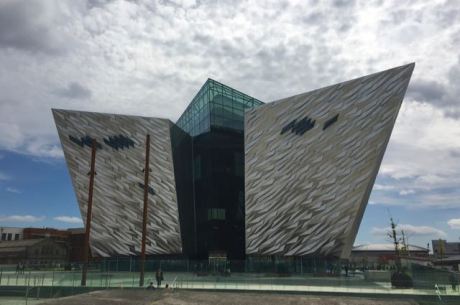
Our first day involved a bus tour around Belfast. There are a ton of tour companies advertising trips around the city on a step-on, drop-off basis. There are a ton of things to see, from the new Titanic Quarter to Stormont, the West Belfast peace walls and the flashy new shopping area in the centre of the city.  Right beside the Titanic exhibition are the film studios where Game of Thrones is produced – that went down very well with my elder teens. Even though it’s such a long time since I lived there, I was surprised how familiar it all seemed. Once I got my bearings, I could relate so well to the place – that magnetic accent, the effortless humour, the dark mountains in the distance.

IMG_7165

Titanic Quarter

IMG_7173

Game of Thrones Studios

IMG_7181

Victoria Square

IMG_7193

Belfast City Hall


Day 2: Belfast and Donaghadee

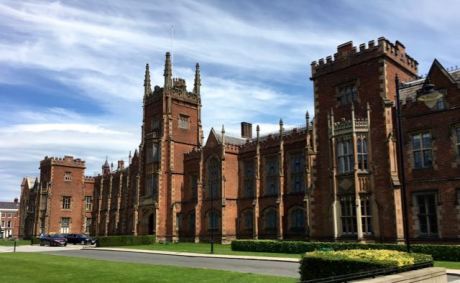
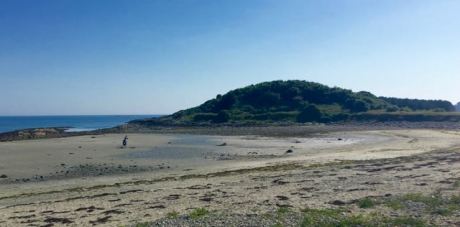
After a trip to Stormont and a walk through Queen’s University, we drove out to Donaghadee, Co. Down. In the distance, you can see Scotland and the Isle of Man.

Given all the trouble in the world – in Nice, in Munich, in Turkey, and further afield in Syria and Afghanistan, this place seems one of the safest places to be. Years ago it was not like that, but I saw no appetite for a return to the bad old days.

Version 2

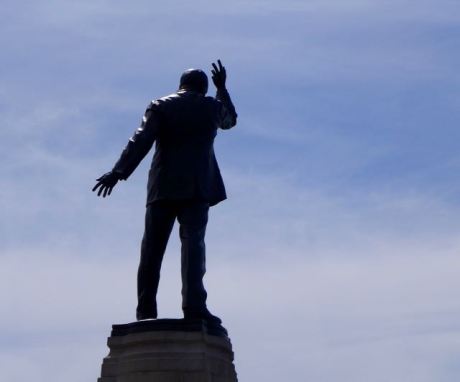
Carson Face Palm

IMG_7229

Queen’s University

IMG_7235

Statue in QUB

IMG_7257

Donaghadee


Day 3: North Antrim Coast

One of the most beautiful parts of the island, if not the whole world, is the north Antrim coast. In a small area you have Ballintoy Harbour, the Carrick-a-rede Rope Bridge, the Dark Hedges, the Bushmills Distillery, Dunluce Castle and, of course, the Giant’s Causeway. This is Game of Thrones country for real: massive dark basalts covered the area 60 million years ago, creating a landscape utterly different to the rest of Ireland. I so much wanted to return back here again.

IMG_7283

Antrim Coast

IMG_7374

Carrick-a-rede Rope Bridge

IMG_7392

Ballintoy

Version 2

Giant’s Causeway

Version 2

Dark Hedges

Day 4: Coney Island

On and on, over the hill and the craic is good
Heading towards Coney Island.

What a day Tuesday was! One of the hottest days of the year, hitting 30 degrees in some places in Ireland. We travelled south towards the Mourne district, stopping off briefly in Downpatrick then bathing in the cool waters around Coney Island, just by Ardglass. I can see what Van Morrison saw in this place.

And all the time going to Coney Island I’m thinking,
Wouldn’t it be great if it was like this all the time?

Version 2

Mourne Mountains

IMG_7627

Downpatrick

Version 2

Coney Island

Version 2

Mourne Mountains

Day 5: Derry and Malin Head

Travelling the Glenshane Pass between Belfast and Derry, you get this strange feeling of deja-vu. There are uncanny similarities between it and the road between Cork and Killarney, just by the county bounds.

Derry has a very different character to Belfast – this walled city, looking over the Bogside and the Inishowen peninsula. It is a crucible for many of the key events in Irish history – dating from the early middle ages to living memory – the civil rights marches and Bloody Sunday, 1972. I really like this city. Friendly to a fault and dripping with character.

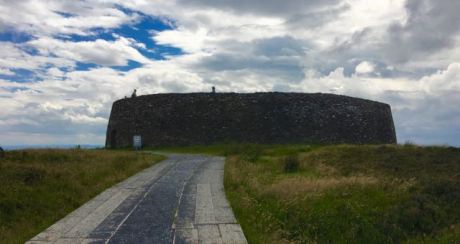
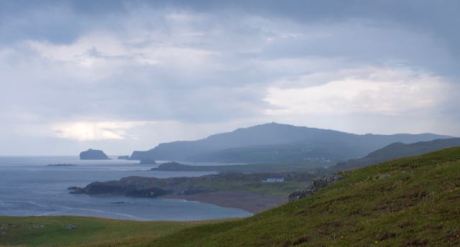
From there we headed out to the walled hill fort of Grianán Aileach, then travelling north to the very northern tip of the island, Malin Head. Driving rain cut our journey short, but it was a trip worth taking.

Version 2

Derry – looking down to the Bogside

Version 2

Grianan Aileach

Version 2

Inishowen Peninsula

Version 2

Malin Head