Archives for category: Uncategorized

No Googling

The table quiz is under threat. For many years, table quizzes (or pub quizzes) have been a terrific way to raise funds for good causes. However the format needs an urgent rethink, otherwise this source of evening enjoyment will die very quickly. The immediate reason? Cheating. The root cause? Google and Smartphones.

If you are not from Ireland or the UK, you may be unfamiliar with table quizzes, so here’s the skinny.  A large group of participants meet together in a pub. They are split into teams of four people. A quiz master reads out a series of questions that the teams must answer in a short period of time, 2 to 3 minutes usually. Usually the questions are batched together in rounds – maybe 5 questions at a time so that the teams can get an indication of how well (or how badly) they are doing. There are typically 10 rounds overall. The team that gets the most answers right wins. It’s good fun – a combination of teamwork, competitiveness and perplexing problems to while away many a dark Irish winter (or summer) evening.

Enter the smartphone. Smartphones make it pretty easy to cheat. Just log on to Google over a mobile network – ask your question, and the answer will be shown to you within seconds. It’s quick, it’s covert, and it gives those who possess an iPhone or comparable device a huge advantage over less technologically savvy (or more scrupulous and honest) teams.

Almost any what, who, why, where and how question can be answered immediately through a Google search, but it doesn’t stop there. Google translates into multiple languages, it performs simple arithmetic, it can give you synonyms and dictionary definitions, unit conversions and it will tell you what happened on a particular date in time. Most table quiz questions should be answerable in less than half a minute through a quick search of the Internet. 

Yes, yes. Quizmasters will ask that mobile phones are not used, but it’s increasingly unlikely that such requests can be effectively enforced, particularly if you have a large group involved. Access to the mobile internet is extremely easy these days. It’s better instead that quizmasters adapt their questions to the new reality.

Here are a few ideas that will help to limit the power of smartphones in table quizzes.

1) Use more picture questions. Picture rounds are already a staple of most table quizzes, but it becomes more important when hidden smartphones are being used. While words and descriptions can be easily googled, photographs of faces, objects and places are less easy to look up (for the time being). 

2) Use more audio soundbites. Again, sounds are common in table quizzes, and again they are difficult to google. Be aware though! Music, particularly if it is played for a long period of time, can be identified using applications like Shazam. Also be aware that common soundbites, like “One small step for man”, or “I have a dream” can be easily googled. You need to keep your soundbites relatively difficult to uncover, so that people have to concentrate on the sound and the voice, rather than the content. Also consider non-human sounds, such as birds, animals or machinery.

3) Get them to solve puzzles. Examples include:

  • Odd One Out. Give people three or four names or words and ask for them to identify the odd one out. Yes, people can google for more information, but the chances are that they will soon run out of time. It’s one of those things that you either get immediately, or you will have difficulty resolving.
  • Complete the sequence. Try some simple sequences, based perhaps on simple formulas or less obvious sequences like [7,4,1,8,5,2]*. . Just make sure that your sequence isn’t too obvious! Offset it by a fixed number perhaps. For instance [2, 4, 8, 16, 32..] is pretty obvious, but [5,7,11,19,35..] is less clear, even though it’s the same sequence offset by 3.
  • Maths problems – Yes, the ones we were subjected to when we were yinglings. Jim has 70 squaggles. Each squaggle is composed of 13 mirdles. Jim gives 10 squaggles to Bill who only wants 25 mirdles and who gives 3/5 of the remainder to Bob. How many mirdles does Bob have? It’s simple algebra but it will drive the smartphone cheats crazy.
  • Lateral Thinking Problems. These are the type of stories that have a very easy answer if you question your assumptions. For instance “A man who was not wearing a parachute jumped out of a plane. He landed on hard ground and yet was unhurt. Why?” (OK, that one was easy, but more difficult questions are available in books such as this one, and will keep the audience thinking)

4) Go Local. Although general knowledge is likely to be prominently displayed on the Internet, often local knowledge is more patchy. What is the name of the pub on the corner of Main St and High St? Who is the former principal of the local school? What club won the local athletics contest in 2005? Just check that such information is not already available on Google or Wikipedia before setting questions.  

5) Rapid-fire rounds. Give people more questions than they could possibly handle in a short period of time. Ask 20 or 30 questions in a single round. (It can be provided to them on a piece of paper). Yes, people could use a smartphone to answer the questions, but the entry of the questions alone will lose them time. This will put them at a disadvantage compared to more knowledgeable teams. 

6) Individual rounds. Nominate a member of each team to walk up to the platform and answer a series of questions in full view of the audience. Not so easy to use  a smartphone when every other team is looking at you!

Can you think of any other ways to keep Google out of the table quiz? Let me know!

* By the way, how did you get on with this sequence?

This was meant to be the last entry in my 2019 time capsule series, looking at current world issues and how they might develop over the next 10 years, but I think I will add an extra posting tomorrow, and then I’m done. Today I look at some of the after-effects from the Bush era wars.

Iraq

iraq-warIn 2003, George Bush and Tony Blair marched into Iraq on a wing and a prayer. It was arguably one of the greatest and most avoidable foreign policy blunders in decades. Iraq was a tinder box under the rule of Saddam Hussein, and the first year of occupation was an object lesson in how not to invade a country. By 2005, the “coalition of the willing” were stuck in the middle of a vicious civil war between Sunnis and Shias. Now in 2009, the US is starting to think about pulling its troops out and leaving the region for good. The big question is whether Iraq will manage on its own once the Americans have left, or whether the warring tribes will pick up where they left off. My bet is that it will do just fine. Ten years should tell a lot.

Afghanistan.

talibanIn 2009, Afghanistan is as close as you will get to witnessing hell on Earth. Afghanistan is the archetypal failed state. Divided up by tribal leaders, it resembles the world as it was back in the 14th Century. It took a bunch of religious madmen – the Taliban – to create a semblance of order in the place until they backed the wrong horse and got ousted by NATO after the 9/11 attacks. Now they are on the resurgence, fed by hordes of uneducated boys crossing over from Pakistan, and whole areas are now back under Taliban control. It is likely that a very large troop increase will be required to establish any sort of security in the country. My guess is that Afghanistan, like Somalia and the Sudan, is a generational problem, and that the militaries of many nations will be based there for decades to come. Reinvigorating failed states could well be one of the most important political and economic challenges of the century.

great-circle

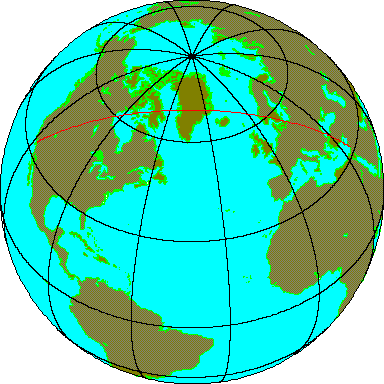
When I was younger I used to get very confused about how, if you were travelling to San Francisco from Ireland that you need to travel over Greenland and the cold wastes of Northern Canada to get there. Hold on, isn’t San Francisco to the south of Ireland? So why the hell do planes need to fly north to get there? It didn’t make much sense to me.

What I didn’t fully appreciate at the time was that spherical geometry is very different to planar geometry, and the fastest way to get from one location on the planet to another is a great circle – a ring around the centre of the earth connecting both points. Great circles do not care about arbitrary definitions such as North and West, only the shortest distance between two points, and if that line crosses over the North Pole, so be it.

Anyway, a few years ago I came across a mapping program on the Web called the Online Map Creator. The program produces maps of many different shapes and sizes in multiple projections. The one that captured my imagination however was Azimuthal Equidistant Projection. If you imagine drawing ever increasing circles around a chosen location on the planet you will get the idea. Consider, for instance, where you are right now. The 10 km circle represents all locations 10 km away, the 1000 km circle represents all places 1000 km away, and so on until you can’t go any further, i.e. the other side of the planet, about 20,000 km away from you. Each point on each circle represents objects that you would come across if you were able to point a telescope at a particular compass angle and see everything on the surface of the globe in that direction. It’s the route an airplane would take, if it didn’t need to worry about atmospheric currents and headwinds etc. Areas tend to get more distorted the further away you go. The extreme is other side of the world from you. No matter which direction you go, you will end up at that point eventually, so every point on the edge of the circle is actually the exact same location on the far side of the planet.

Here are a few maps I made using the map generator.

1) London, England.

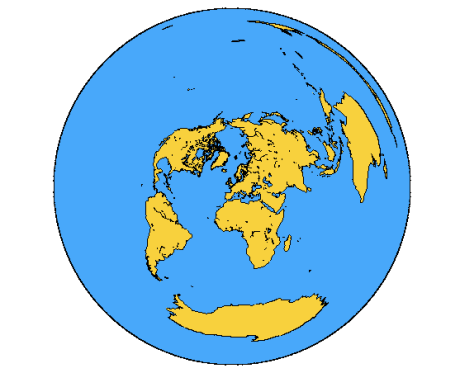
London Azi

Notice that if you start out due west from London, you will end up, not in Canada, but flying across Cuba and Mexico. To get to Japan, you need to travel across the Arctic Ocean and northern Siberia. Also note how huge Antarctica and Australia are compared to everywhere else, and if you look closely you will see an enormous narrow island taking up nearly 70 degrees from North to East – that land is New Zealand, on almost exactly the opposite side of the world to the UK.

2) Chicago Illinois

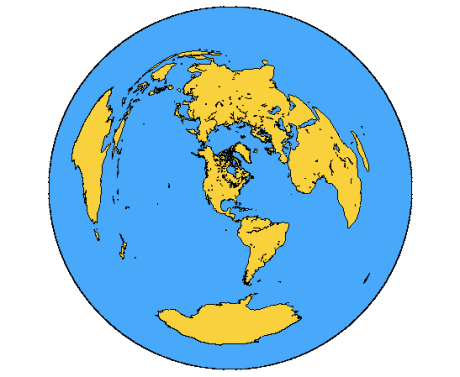
Chicago Azi

This map shows that if you wish to travel from Chicago to Thailand, you need to cross over the North Pole, even though Thailand is close to the equator. It also indicates a considerably northerly path for Japan and China. To travel to Mozambique in southern Africa, you need to set out due East. Australia and Antarctica are enormous, again because they are furthermost from Chicago.

3) Sydney, Australia.

Sydney Azi

Look at how West Africa is distorted! West Africa is now gigantic compared to the rest of that continent, again owing to the fact that it is nearly on the other side of the world. The Iberian peninsula is similarly disfigured. To reach Chile, you need to travel South East, and traveling to parts of eastern Brazil requires a southern journey over the Antarctic ice cap.

4) Beijing, China

Beijing Azi

This is an interesting map. Most of the globe is recognisable and relatively well proportioned (OK Africa is a bit oversized, but we will ignore this). But look at South America! If you look closely, there is a ring of yellow encircling this map. Clearly the furthest point away from Beijing is in Argentina and as a result the mapping severely distorts the continent, The black lines are a bug that I can’t quite explain. In addition Hawaii looks a lot bigger than it should look, given it’s distance from China. I have a feeling that more gremlins are at work here.

Most people will agree that we are now going through a period of time that will be remembered for a long time, like World War II, 9/11 or The Great Depression. It’s probably the first time in world history when the entire globe has been caught in the grip of a sudden and calamitous economic crisis. No country has been untouched. Governments,  businesses and households worldwide are desperately fighting to shore up their reserves while avoiding financial meltdown. The problem is far from over and recovery will take many years.

Last month, Dominique Strauss Kahn of the IMF gave the current economic crisis the rather unimaginative appellation “The Great Recession“. Given that we still don’t know how long this crisis will last, or how deep it will be, events might yet consign this name to history.

Doing a quick trawl of the web, I have discovered a few potential alternatives.

  • The Great Deception (*)
  • The Bush Kaboom (*)
  • Depression 2.0 (*)
  • The Flump (*)
  • The Clump (*)
  • The Not So Great Depression (*)
  • The Repression (*)
  • The Econopocalypse (*)
  • World Crash I 
  • The De-Hummerization (*)
  • The Great Uh-Oh (*)
  • The Boomer Bust (*) 
  • Econorrhea (*)

And what would you call the young people who will be shaped by these events? Generation OMG.

So, I’ve decided to move over into WordPress to be closer to some folks I correspond with on a regular basis. Yahoo 360 was not my kind of place..

Nice place here. Good view. Smells nice. I like the wallpaper. Now pardon me while I mess about with the knobs and switches for a while..

For the sake of completeness, here’s the address of my old blog.