Archives for category: Uncategorized

A few days ago I saw a poster that advertised a talk on the merits of creationism versus evolution. A gentleman called Philip Bell (BSc Zoology) is crossing Ireland and the UK on a one man mission to convert us all to a Young-Earth, biblical view of the Universe.
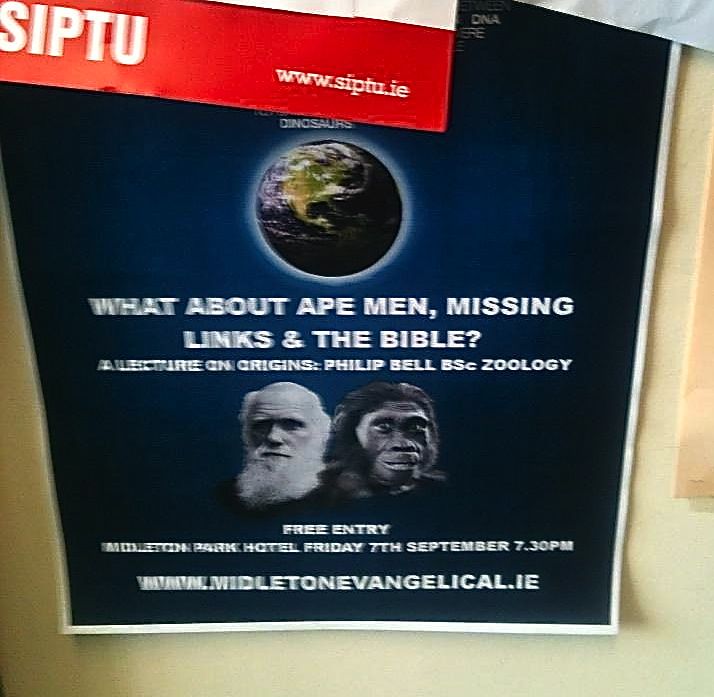
They are coming for us. Here in Ireland. Should we run for the hills?

I don’t think so. For me, the whole thing is rather laughable. Most kids are taught about evolution in school, and it’s rarely an issue for parents. Evolution here is taught as a scientific subject, not as a moral issue. Biblical Creationism, to-date, has only found purchase in small evangelical communities across the country.

I cannot imagine anyone in Ireland being interested in a talk like this unless, a) you happened to be convinced creationist already, b) you are sceptical of creationism and interested in challenging their claims, or c) you are there because someone else decided you needed to be there (journalists, kids, etc.). There may well be genuinely undecided, non-afilliated seekers around who are interested in human origins, but I suspect they are a small minority. In the main, it’s probably an exercise in preaching to the already converted.

And the subject: listening to someone waffle mendaciously about Darwin, Dawkins and CS Lewis while peddling Genesis? Eh, don’t I have to get my hair washed, or something? Anything?

Ireland is not America, where a significant minority of the population are born into a fundamentalist creationist tradition and where creationism has taken on political overtones. It’s difficult to see creationism gaining purchase any time, except amongst the tiny evangelical community.

This community, while growing, will need to compete for ideas like everyone else. It will continue to gain adult members for various reasons which have nothing to do with a dislike of Darwin’s great idea. More likely, converts will arise from pastoral and charitable work with the community, the numbers bolstered by convinced evangelicals arriving into Ireland from abroad. Maintaining these ideas among their children will be more difficult, as parents will need to be much more attentive than many of their American peers in controlling the information their kids are exposed to. It’s an uphill battle for them in the age of international travel and the Internet.

And here’s another question: how strong are creationist ideas even in America? We often here the statistic that nearly 50% of the US population are creationists, but how many of these people think much about origin stories in the same way they think about baseball, the Dow Jones and traffic on the Interstate-95? I suspect that, even in the US, the proselytisation of creationism is pursued only by a very small, determined, group of people, who get far more attention than they deserve, as the majority of people they try to convince probably don’t care very much.

Do a Google image search on “creationism”, and you will see something very interesting. Pages and pages of send ups and jokes about creationists. At least on the Internet, creationists are figures of ridicule. Ken Ham is treated with derision. While there are many motivated people in the ranks of global creationism, the opposing site is at least as vocal and focused. Creationism does not look like winning significant mindshare any time soon – even on their own home territory – without major changes in public education and an attenuation of the separation between church and state.

The way in which creationists around the globe believe they can achieve their aims is not through mass persuasion, but instead through more subtle strategies like influencing school boards, lobbying for changes in legislation and fooling unwary state authorities to adopt their viewpoints. This is the area where skeptics need to remain vigilant, and wise to the tactics being used by creationists.

Image

Say you have a population of mosquitos. Each mosquito has a needle-like mouth, enabling them to puncture the skin of bigger animals and suck their blood. Some mosquitos have average size needles, some have slightly smaller needles, and some have needles that are just that little bit longer. 

The longer ones enable the mosquitos to suck more blood and to penetrate tougher hide. These mosquitos have a slight advantage compared to their peers. The next generation have longer needles too, so this small benefit tends to spread among later and later generations. 

Over time, all the mosquitos in the population have larger needles. Other mosquitos, in other populations, develop special characteristics to fit their circumstances, so that after a long period of time they look, behave and interact differently to each other.

That’s evolution. Fairly logical, wouldn’t you say? 

I’ve written up some thoughts about skepticism and why its important. Feedback and comments are welcome.

Colm's avatarCork Skeptics

In a few years time, there may well be no rhinos left alive. And when I say no rhinos, I do not mean “none left in the wild”. I mean none in the zoos either. The captive animals will have been killed too. The reason for this is an insatiable desire among some people for rhinoceros horn – a material thought by some to possess magical healing powers. It’s really just a mass of keratin – the same substance that your hair and fingernails is made from. There is good money to be made from this trade. International criminals have stopped at nothing: butchering animals all across Asia and Africa, even breaking into museums to steal horns for the black-market. Some say it’s worth more per gram than cocaine. In pursuit of an odious delusion, we are witnessing the imminent extinction in our lifetime, of an animal, variants of which…

View original post 763 more words

In an article in the Sunday Times today, a number of retired members of the Irish police force (Gardaí) expressed their dissatisfaction with psychics who claim to have information on the whereabouts of missing persons. On numerous occasions, Gardaí have been forced to conduct searches based purely on tip-offs from psychics and clairvoyants. No bodies have ever been found as a result of these types of searches.

“They always say a body is buried near a tree, or in water, or sometimes on a stretch of coast”, said retired assistant commissioner Martin Donnellan. “When nothing is found they’ll say the spirits are sending them the wrong signals”.

“I have never seen one of them provide any information that was worthwhile”, said retired cold-case detective Alan Bailey. “They usually claim the victim came to them in a dream, and asked them to convey a message”.

According to these sources, psychic meddling has become a big problem. Gardaí often waste precious time and resources to conduct searches they know will have no useful outcome. Psychics make contact with families, who in turn put pressure on the police to conduct a search. “In truth”, says Donnellan, “such searches are being conducted to appease families”.

The involvement of one British psychic, Diane Lazarus, was described as “unhelpful and distracting” after she claimed to provide information concerning the murderer of teenager Raonaid Murray in Dublin in 1999.

Psychics have offered their “services” in the cases of Annie McCarrick, Amy Fitzgerald, Mary Boyle, Jo Jo Dullard and Deirdre Jacob, among others. In each case the information provided has lead nowhere, instead creating false hope for the families of the victims. 

If psychics were effective, we would have heard of it by now. Psychic policing would be an active part of crime research and every police force in the world would have a psi-division. There would be abundant, successful peer-reviewed studies available and a history of solved disappearances. Instead, this field of inquiry remains where it’s always been: mired in the realm of science fiction.

Psychic investigators are engaged in a process of deception, always of others and quite often themselves. They waste police time and police resources. They provide false hope. They reopen old wounds, forcing families to re-live the terrible times of the disappearance. Their currency is delusion and the effect, almost always, is misery.

Ideally, psychics should be held financially and legally responsible for every claim they make regarding disappearances or unsolved murders. Like cigarette manufacturers, they should be forced to provide an explicit, official warning in all cases where they provide an input into a crime case, if the only information they have is from a dream, a vision or a claimed supernatural source. All cases where psychics fail to provide useful information needs to be publically registered, so that families can review for themselves how utterly useless their services are.

Until proper evidence is provided to the contrary, it is about time we allowed police to fully engage themselves in modern policing, keeping the delusional practices of psychic investigators where they should remain: in the movie theatre. 

Yesterday, an acquaintance mentioned to me that he had information about a product, that, once fitted to your car, could increase the car’s fuel efficiency by 30%. This is quite an extraordinary claim. No sooner were the words out of his mouth, than my baloney alarms were tinkling gently. 

To support his case, he showed me a photograph that looked like something out of a Maplin hobbyist set, complete with an A4 page of benefits. No sources. No studies. My alarm bell was now ringing madly. 

I had just one question. “So, if this invention is so great, how come engineers in the automotive industry are not all over it?”. 

The answer that came back was predictable. “Because the automotive industry has done a deal with the oil companies to keep the price of oil high”. The alarm system was now blaring furiously. As in James Bond “Get Out Of The Building As It Will Self Destruct In 30 Seconds” furiously.

Now, just imagine if this were true: that the car companies had conspired with the oil companies to suppress the use of this revolutionary technology. Car companies are expected to compete with each other. In this scenario, just one car company deciding not to co-operate with the oil companies could expect to win a huge amount of market share very quickly. Thirty percent improvement in fuel efficiency would be an enormous advantage over the competition; this would translate into millions of additional vehicle sales. The only way you could imagine this kind of advantage being suppressed would be for the oil companies to compensate the car companies handsomely. And when I mean handsomely, I’m talking billions, perhaps tens of billions of dollars. Even worse, they would have to work with ALL the major car companies – paying them all billions – to avoid even one car company going it alone. It would become a bidding war among all the car companies. Ouch. 

So here we are – we have thousands of employees all across both industries – all keeping quiet in order to suppress a wonder-technology that would drive sales into the stratosphere, and it gets worse. Any auditor worth their salt would quickly notice a glaring hole in the accounts of both the oil companies and the car companies, which would both now be funnelling huge amounts of cash between them for nefarious purposes. Auditing firms thrive or die on their reputation. Just ask Arthur Andersen. Their silence, if granted, would be very expensive indeed.

And what about the government and its pesky regulators? Well, my acquaintance obviously knows something the rest of us don’t know, and he’s not particularly well connected to the industry, so it would stretch credulity to believe that government regulators and antitrust investigators wouldn’t be smelling a rat either. If they’re keeping silent too, then… boy this is now getting very expensive for the oil companies, who apparently have everything to gain, and nothing to lose, by keeping oil prices high. 

I even doubt if the oil companies would have anything to lose. We live in a time when a number of huge economies around the world are flexing an unprecedented level of economic muscle. Many people in these countries would love to have a car, or a bigger car, and high oil prices are preventing them from doing this. Lower oil prices would translate into more car purchases in these regions which would tanslate into, yes, more oil demand. Obviously the economists in these oil companies only got as far as 10th Grade in school if they believe that suppressing demand is the way to go.

And what, you may ask, is this wonder technology that gives cars a 30% increase in fuel efficiency? Distilled Water. Yep. That’s the technology that THEY don’t want you to know about.

The theory is that, by running an electric current through water, you can create hydrogen gas and oxygen gas, which when mixed together with a bit of heat, can create energy. Amazing. Except for this pesky thing called the Second Law of Thermodynamics. Without going into any great detail it states that, to get energy from water, you have to put more energy into it in the first place. Always. No exceptions. Ever. As it’s one of the most tested principles in physics, there’s a Nobel Prize awaiting you if you can disprove it. Fuel cells will actually REDUCE fuel efficiency if they need to separate the hydrogen from oxygen in water during a journey. Maybe my acquaintance forgot to mention a minus sign. 

So, yes. It’s an extraordinary claim. It’s too good to be true. It would require a cast of millions to accomplish. It ignores physics and basic game theory. Other than that, I guess my acquaintance is onto a good thing.

But, hey, what do I know?


CC Licensed image via s.alt (Flickr)

I don’t do New Year’s resolutions. It’s simple really. The days are short. The weather is dreadful. People are generally in bad form. Everyone is sick with runny noses and headaches. We all need time to recover from the craziness in the run-up to Christmas.

It’s better, I think, to sit back and rest. To waste our hours in idle pursuits with friends, family and loved ones. To eat and drink with abandon. To get some exercise, if the weather permits it. To recall the year – its highs and lows.

Resolutions can wait.

I prefer to start my year in mid March. The buds are yawning and stretching. The celandines are popping their yellow heads from between the leaves of grass. It’s a time for lambing and calving. Daytime and nighttime are nicely balanced. The shadows are easing. Photographers are emerging from hibernation.

So, let’s set our sights on the Ides of March, Patrick’s Day and the Vernal Equinox for resolutions. For the time being, we should wrap up and gratefully accept all offers of mulled wine and hot whiskey that come our way.

* Image “Raindrop 2307” via s.alt / Flickr (CC Licensed)

In 1584, the philosopher Giordano Bruno speculated that the Universe might be full of planets just like our own. For daring leaps of the imagination such as this, the Church duly branded him a heretic, rewarding him with imprisonment and a fiery death at the stake.

Today, we went one step further to proving him right. At a press conference earlier today, astronomers announced the discovery of two planets the same size as the Earth. These are the smallest planets ever discovered outside our solar system and the first definitive proof that worlds on a similar scale as our own exist.

The planets, Kepler 20-e and Kepler 20-f, are very close to their parent star, and therefore too hot to bear any real similarity to our home world. The news comes hot on the heels of the discovery of a planet in the “habitable zone” around a star, where it is possible for water to exist in liquid form. We are now hot on the trail of a planet that meets all the basic criteria for supporting life.

The discovery comes via Kepler: a space telescope that is surveying thousands of stars in a small area of the sky, roughly in the region of the Summer Triangle. It records the light emitted from each of the stars over time, playing close attention to any slight dips in brightness. These dips may indicate a planet moving in front of the star and momentarily blocking its light. Kepler’s systematic approach has revolutionised the science of planet hunting. To date, with just over a year’s data processed, it has found over 1,200 candidate planets.

It is surely only a short time now before a small Earthlike planet is discovered that is just the right distance from it’s parent star to support life. Who knows what may be discovered in the future about these small, watery worlds? We live in hope.

Today I came across a website dedicated to a young Irishwoman who has been fighting cancer throughout 2011. Hannah Bradley was diagnosed with brain cancer earlier this year, and since then she has been in and out of hospital, undergoing surgery and radiotherapy in an effort to keep the tumour at bay. It has truly been a terrible time for everyone involved.

Honestly, I cannot imagine how I would react if I were in such a position. When treatment options are limited, people are motivated to help as much as they can. There is clearly a strong desire to keep her alive, to not lose hope, and for this they must be commended. 

On Hannah’s website, the desired course of action is the clinic of Dr. Stanislaw Burzynski in Houston, Texas. Burzynski advertises treatments involving “antineoplastons”. These are molecules, so the claim goes, that attack cancerous cells, leaving healthy cells alone. Unfortunately, there is no proper scientific evidence that these treatments work, and Burzynski has not shared the data with the wider medical community in order for the treatments to be validated. Furthermore, his treatments have not been approved by US regulators. Burzynski is getting around this by presenting the treatments as experimental. This would possibly be ok, except for the surprisingly and stupendously high cost of such an experimental approach. The bottom line is that his clinic exists on the fringes of the medical world. Instead of working with scientists and oncologists to prove for once and for all whether his course of treatment is scientifically valid, he has rejected it all in favour of direct approaches to patients and the use of slick marketing and testimonials. Burzynski presents himself as the lone genius who has challenged the might of the medical establishment. This would be fine if he had properly controlled, peer reviewed evidence, but so far, he has not been able to provide this. The burden of proof clearly rests on his shoulders.

Over the past few weeks, challenges to Burzynski’s methods have been met by a barrage of legal threats from an individual who appears to be associated in some way with the clinic, including a personalised attack on a 17 year old blogger that beggars belief. This is not the right way to meet such challenges. The right way would be to provide the facts, and to let these facts speak for themselves.   

Hannah’s friends have clearly decided that Dr. Burzynski holds the keys to her recovery. Data is emerging throughout the Internet each day that this is not the case. I understand that Hannah’s team will feel that they have invested themselves on a course of action – that perhaps it is too late to change course – but for Hannah’s sake, they need to take this new information into account. It will make for very uncomfortable reading and there will be a natural tendency to rationalise it away as the product of some very mean and nasty individuals. The people who are presenting this information are not bad people. Many of them work closely with cancer sufferers, and many of them will have lost family and close friends to cancer. If Team Hannah were to reach out to some of these critics, I expect they would be listened to sympathetically and provided with second and third opinions. The question “what would you do?” can always be asked.

I know that the medical establishment can sometimes appear cold and arrogant. I know that there are limits to what is known and that doctors can sometimes give patients a message that they never want to hear. It is heartbreaking to have someone say “We can’t do any more”. The natural inclination is to say that they are not trying hard enough. Sometimes, perhaps they aren’t. But, no matter how inadequate doctors may seem, there is a world of a difference – a universe of a difference – between medical science and outright quackery. 

Cancer is shit. Real shit. It’s the plague of our times. Some day, hopefully, our children or grand children might look back on the world today and ask how we managed through it at all. The hard, thankless work of medical researchers will continue to push the frontiers forward. They have already accomplished wonders, but much more needs to be done. Given time, there will be enormous advances. Unfortunately for some, time is running out.

I wish Hannah the very best. I hope she can get through this nightmare of a year and emerge with this awful thing in remission. If her doctors can still help her, I hope they are doing everything within their powers to give her the best possible chances. I don’t know from her blog if the cancer has metastasised, whether chemotherapy has been tried or even if it is effective against such a cancer. If options within the medical literature are still available, then I expect they have already been seriously considered by all concerned. If options no longer seem to exist then yes, it’s heartbreaking. Being there, at such a time, possibly trumps doing something. I wish her the very best.

References

a) The False Hope of the Burzynski Clinic (Andy Lewis)

b) Stanislaw Burzynski: Bad medicine, a bad movie, and bad P.R. (David Gorski)

c) Antineoplastons (Skeptical Health)

d) Burzynski The Movie: Hitting you over the head with pseudoscience (Orac)

I participated in a “Speakathon” over the weekend in aid of the local Marymount Hospice.

Toastmasters clubs around Cork each got an hour long slot, and each member got a few minutes to speak on any topic they wished to discuss. Because I am president of two Toastmasters clubs, that meant I needed to come up quickly with two speeches.

In the evening session on Friday night, I spoke about how I had entered into a DNA study that will help determine the origins of Irish people. All my great-grandparents come from the same part of Ireland, so I would be an ideal candidate for such a study.

In the morning session the following day, I spoke about how you can improve your presentation skills by applying some very simple techniques. I hate traditional Powerpoint “bullet point” templates. By adding some images and animation you can bring any presentation to life, making it interesting for the audience.

In the evening I hosted a Cork Skeptics meeting in Blackrock Castle. We had two talks. Síle Lane, from Sense About Science spoke first, and talked about what her organisation was doing to address misinformation in the media. The efforts here have been admirable. Sense About Science have recently kicked off a campaign called “Ask For Evidence” which seeks to encourage ordinary people to request peer reviewed evidence from companies when presented with extraordinary claims.

The second speaker was Brian Hughes from NUI Galway. He is a lecturer in psychology and a prominent sceptical blogger. He spoke about how normal people are particularly bad at statistical reasoning, and how we tend to consistently overestimate our abilities and ignore data that contradicts our world-views. He discussed some interesting studies that indicate that depressed people can often be more realistic in their estimation of themselves, and suggests that fantasy and misconception might be an evolutionarily necessary condition for humans. Quite fascinating stuff.

So, a busy and thoroughly enjoyable weekend. A lot of time spent on my feet, talking and thinking about things that interest me.

“At the end of the road, turn left”

These words should strike fear and loathing into the hearts of all right thinking people. I refer, of course, to the satellite navigation system, or Sat-Nav: a device more common in cars nowadays than the furry dice or pine tree air-freshener.

Now, don’t get me wrong. I think Sat-Navs are great. They do a great job, except when they have to give directions.

I took one along on my recent holiday in Europe. This Sat-Nav had quite a personality. I called her Sally. Sally’s maps hadn’t been updated in 5 years. New roads and motorways, that were built since 2006, did not exist, according to her. She had missed out on some of the best years of the Celtic Tiger. For example: I was crossing the new bridge in Waterford, on our way to Rosslare, and Sally thought I was flying. “Turn left” she would say. “Turn right”. “Take the next goddamn road”. I paid no heed to her advice. It was as if we were a married couple.

On this trip, we went to Brussels. Now, in general, I have no qualms with the designers of Sat-Nav systems, but I am sure of one thing. When they were mapping Brussels, they were drunk. They also were snorting huge bags of cocaine and popping LSD pills by the truck-load. I am sure of it. Either that, or the street planners in Belgium have been very busy since 2006, redesigning the entire city just to piss me off. The result is that the Sat Nav street plans of Brussels bear little resemblance to the actual city that bears the same name. It is possible that there is a “Brussels” in Outer Mongolia that the Sat Nav planners confused the city with. Next exit, Ulan Batar.

I was travelling through these big tunnels under Brussels when Sally suddenly said “turn left in 80 metres”. If I had paid heed to her instructions, I would have been killed straight away. Bang – right into a wall. Sally had decided to forget what tunnels were. To her, I was dilly dallying down a tree lined avenue, birds in the trees, wind in my hair, instead of zooming, headlights on, through the dark, undulating bowels of a major European city.

Now, you need to understand one other thing about Brussels. Due, no doubt, to a row at the highest levels within the EU over the language to be used on the city’s road signs, the powers that be in Brussels made an executive decision. They banned all road signs. Every last one of them. I have a theory that these Eurocrats are simply tourists, who went there for a few days; tried to leave and just gave up. They found a street corner somewhere, stopped their car, sat down in despair, and before you knew it they had rented a house, married, brought up a family, became local pillars of the community and died, all without ever leaving the city once.

You would think, therefore, that a Sat-Nav would be a godsend in a city like that. Right? Wrong. We were trying to leave the city, when we came upon some roadworks. In front of us were orange signs, orange vans and the bright orange suits that construction workers on the continent wear, that make them look like Oompa Loompas. We needed to divert, but Sally wasn’t getting the message. “On you go”, Sally was telling us. “Barrel through them at high speed like a good lad. If the roadworks don’t exist on my maps, they don’t exist at all.” Not fancying a prolonged spell in an orange jumpsuit myself, I decided to seek other options. I went left. Then right, then left. I followed all her instructions to the letter. All was going well until I found myself, 5 minutes later back at the self same roadworks. New strategy – I turned right this time. More labyrinthine winding streets. 5 minutes later, the men in the orange trucks were waving at me this time. Sally was like a moth, banging her head against a spotlight. She had claimed this place as her own.

It was when she had lead me right back into the centre of Brussels that I really started getting annoyed. “Take the next left in 100 metres” she would say. “No I damn well won’t!” I would should out. “Bear right at the next junction” she would declare. “I’m not listening”, I would respond. “Go right on the roundabout, first exit” she would suggest. “Screw You!” I would retort.

At a traffic stop I sent the following message to my pals on Twitter:

Question. How the HELL do I get out of Brussels?

Immediately, I received the following helpful reply.

Practice.

It was going to be one of those days.

On my return journey, we visited Paris. Paris is just like Brussels, just infinitely more complex. Sally’s task this time was to direct me from Versailles to the hotel where we were staying. The hotel was about 5 miles away. Not a problem, you would think. Sally sent us to a toll road. After paying the toll we were given two directions to travel. “Nanterre” said one sign. “Creteil” said another. Brilliant, except I had no clue where these places were. Sally remained silent – deliberately. We took the wrong road. Now 15 miles away, I tried to turn around. “No Tolls”, I asked. Sally ignored me and sent us back down the same way. The toll had now doubled this time. A journey of 5 miles had become a 30 mile long nightmare, cost me 20 euro, and managed to send me in precisely the wrong direction.

Now that Sat-Navs have become commonplace, it is only a matter of time before the next step happens. They become sentient. They acquire a personality. When you disobey their instructions, perhaps they will sigh. Or mutter something sarcastic under their breath. Maybe they will start shouting at you, telling you that you never listen and that it’s your own fault you’re lost. When that day comes, as it inevitably will, I have already decided what I will do.

I’m digging a big hole in the ground and I’m staying there. You can call me to let know when it’s safe to come out.