Archives for category: politics

Map of Ireland

Map of Ireland by Tourizm Maps © 2006

So far, 2007 has been a momentous year in terms of the political situation in Northern Ireland. Sinn Féin, (the Irish republican party and erstwhile political wing of the IRA), has agreed to join the policing board, announcing finally that the war is over. On the other side of the political fence, the DUP (the majority Unionist party lead by the firebrand preacher Ian Paisley) has greatly lessened it’s rhetoric and looks set to enter into a power-sharing administration with Sinn Féin some time later this year.

Compared to the situation 15 years ago, the current political situation is an incredible departure from what seemed at one stage like an endless war. Even in the last 5 years, the IRA have decommissioned, abandoned criminality, stopped punishment beatings, disbanded as a military organisation, finally agreed to the rule of law and for all this they must be wholeheartedly commended. The Sinn Féin organisation seems now to have fully committed itself to a democratic political path. The ballot box has, at last, won out over the armalite.

Sinn Féin sees itself as being in government, sometime within the next 10 years, both in Northern Ireland and the Republic of Ireland. This is not a pipe-dream by any degree of imagination. (Since the 1994 ceasefire it has managed to garner over 10% of the vote in the Republic, making it the 4th biggest political party here). Their stated vision is to finally unify the island, North and South, to end all British influence there.

My question at this stage is – how? Any attempt to transfer power from Britain to the Republic of Ireland will be robustly resisted by Unionists who have not changed their stance (that Northern Ireland remain British) in the last 100 years and, after the low-intensity war of the seventies, eighties and nineties (a.k.a “the Troubles”), are probably more entrenched in their views than ever. How does a party such as Sinn Féin succeed in convincing Unionists that joining an Irish Republic would be in their best interest? The party is avowedly anti-British, working class, socialist, with paramilitary roots and structures that have created a huge degree of distrust within Unionism – an obstacle I can’t see them easily overcoming in the coming decades.

In addition, Sinn Féin have abided by a system of power-sharing in Northern Ireland which gives proportional representation to minority parties based on their share of the vote. Majority rule is clearly a non-runner in Northern Ireland when the political views and loyalties are so far apart. Sinn Féin are a minority party – the second biggest after the DUP – but the percentage differences are relatively small and it is probable that some time in the next 30 or 40 years, they may become the biggest party in Northern Ireland. The problem for them however is that, having resisted majority rule for so long, they can’t just dump power-sharing when they become the majority themselves. Whether they like it or not, they will be joined at the hip to the Unionists in Northern Ireland for the forseeable future.

Neither is it likely that Sinn Féin will ever become the dominant political player in the Republic. Politics in Ireland is based around coalitions with centre-right parties such as Fianna Fáil and Fine Gael taking much of the vote. Apart from Sinn Féin, none of these parties have much stomach for a constitutional fight with Britain or with Unionists over how they should be governed. It’s a view which would resonate also among a large proportion of Southern Irish voters who are more interested in economic prosperity than they are in some sort of political reunification of North and South.

Sinn Féin, therefore, are left with an aspiration, in much the same way as the incumbent Irish political parties “aspire” to re-unification on the island. When it becomes likely, as I think it will, that Sinn Féin will not make much headway in achieving re-unification, what happens then? Is there a possibility that the old chestnut of Irish Unity will come back to haunt this island again some time in the future, and that, yet again, war or hostilities will break out as they have done so many times in the past?

Hopefully, the answer is no. In the end, the Troubles were not so much about political re-unification as they were about civil rights and achieving political influence and justice for the Nationalist community. A well-run political system in Northern Ireland with true representation and fairness may do a lot to head off any future problems as will a Northern Irish state that works hand-in-hand both with Britain and the Republic of Ireland.

Only time will tell.
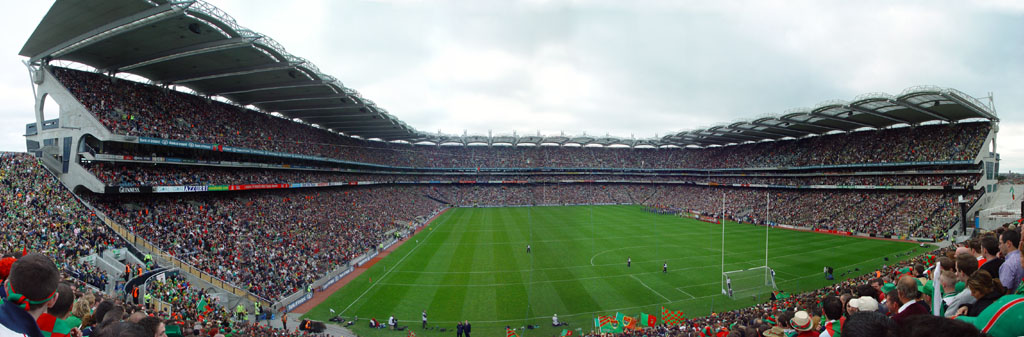
Croke Park

Some of you may know that Ireland has two unique field games – hurling and gaelic football. Both games have massive followings and they draw a fanatical attendance from all over the country during the summertime each year. The two games are by far the biggest sports in Ireland. The games are strictly amateur, and much of the attendance money gained has gone into developing the games and the sporting infrastructure around the island. The greatest achievement from decades of investment is a huge stadium in Dublin called Croke Park. It’s truly enormous. It’s the fourth largest stadium in Europe and it has a capacity of over 80,000.

For decades however, Croke Park has been strictly off-limits to the “foreign” games of rugby and soccer. No major international sporting event featuring these two games has ever happened there. The reason for this is wrapped up with the history of modern Ireland and the foundation of the Irish state.

The Gaelic Athletic Association, or GAA, is the ruling body for hurling and gaelic football. They have always been passionately devoted to promoting all things Irish (particularly Catholic Irish), and this view was hardened during the the War of Independence when in 1920, British Auxiliaries opened fire on a crowd of supporters during a match in Croke Park, killing 13 people. For a long time afterwards, no foreign games were permitted in any GAA ground in the country including, of course, Croke Park*. What’s more, members of the GAA were not even allowed to attend any games of rugby, cricket or soccer. Even though this particular restriction was repealed in the 1970’s, the ban on the use of Croke Park for “foreign games” persisted into the 21st century. Although there has always been a lingering sense of anti-Britishness within the GAA, the prevailing view among supporters of the ban was that the other sporting organisations (i.e. the FAI and the IRFU) had done nothing to deserve access to it – that they were riding on the GAA’s coat-tails, in effect.

All this changed in 2005, after a very passionate and drawn out public debate. The GAA finally agreed to open Croke Park temporarily while Landsdowne Road, the home of rugby and football on Dublin’s south-side, was being refurbished.

Tomorrow, Croke Park hosts its first ever international rugby game – Ireland versus France. It’s a sell-out (and some GAA supporters think it’s a sell-out in another way too), with an attendance that will be more than double that of any home rugby international ever played in the country.

A week or so from now, Ireland will play England in Croke Park. The Union Jack will be hoisted there, and God Save the Queen will ring out from within the stadium grounds.

It’s a bit of history alright.

* with the exception of American Football, Athletics and Australian Rules. Go figure.

Wikipedia is one of the most surprising hits to arise out of the Internet age. The proposition, when it was introduced back in 2001, sounded ludicrous. “What if, instead of having an encyclopedia compiled by a small group of experts, we open it up to millions of people and let them write it up instead?” It sounded preposterous. Letting non-experts provide and monitor the content sounded like a recipe for pure anarchy. Few restrictions were imposed. A few seeder articles were written by the in-house team, and then control was handed over to the mob. Despite trenchant criticism, it has been an incredible success. Now, 6 years later, it has 6 million articles in 250 languages, greatly overshadowing physical offerings such as Encyclopedia Brittanica and the World Book. And the thing is, somehow it works. It has evolved into a huge self-correcting, authoritative, dynamic organism. False, biased and slanderous entries do get written, but in general the work is quite accurate, and when errors do occur they can be corrected pretty quickly. One view on it is that in general it is an excellent repository of information even though many specifics might be flawed.

This idea that “mob rule” can evolve into something vibrant, self-correcting and comprehensive is intriguing to say the least. It’s a good example of the Wisdom of Crowds idea that I spoke about some time back.

So, what about applying the same rules to democracy, then?

Even though many people equate “democracy” with “freedom” and tend to think of the prevailing Western system of government as the best possible system, a debate still rages as to whether it is true democracy at all. If we go back into history (and indeed to many countries around the world today), the elites have been in power – people who have been educated, guided and born into privileged positions tended to take the reins of government when the chance arose. They often had exclusive authority over the “little people” and indeed sometimes asserted a “divine right” to rule over them. In the last 300 years or so, the populace started to demand a greater say in how things were governed, and the hard-won result is a compromise between the elites and the mob. This is parliamentary republicanism, or what many people call “democracy”.

In a republican system, the elites still rule, but us plebs can now attempt to throw them out every 4 years or so. Power is centred in the hands of a very small number of people, and that power is then tempered by the judicial system, the parliament or congress, international agreements, and the press and public opinion generally. It’s quite robust and certainly highly successful. A possible factor in its success is that change is possible in the medium term, without violence or coups d’etat, thus leading to greater stability and security. The addition of innovations such as freedom of speech, freedom of assembly and property rights etc have given people a lot of latitude and freedom in their personal lives.

But it’s far from being a perfect system. Legislation tends to lag the issues of the times, sometimes by many years. People who have experienced injustice often feel that no-one is listening. Corruption and cronyism persist. People with ties to the elite tend to be treated more leniently than those further down the pecking order. The same old names continue to rule over long periods. Many people feel disenfranchised, and this is evidenced in part by the decline in the number of people voting in elections all across the Western world.

So, it’s interesting, even as just a thought experiment, to imagine a world where legislation can be changed by professionals and amateurs alike, in much the same way as in Wikipedia. Normal citizens become the lawmakers, or law refiners, or critics, or whatever they choose. The public debate the issues and collaborate in the drafting of the laws of state. Where problems are found, these laws are then amended quickly, again though participatory discussion and collaboration. No one group has a monopoly on power – laws arise through the mechanisms of debate and consensus. Flawed legislation can be corrected or removed quickly. Everyone who wants to can have a say.

It seems perverse. It seems anarchic. And yet, as we are finding out with Wikipedia and its offshoots, it is possible to create something beautiful and workable by simply providing a framework and letting people get on with it.

Churchill once said “Democracy is the worst form of government except for all those others that have been tried”. Could Wikidemocracy lead us to a less worse form of goverment perhaps?

I originate from this part of the world. On the south side of the river is Waterford, a small Irish city with a very old and venerable history. On the north side, where I come from, is County Kilkenny. As you can see, one side of the city is relatively well developed, the other side not so much. It’s something of an urban planning nightmare – a city caught between two local authorities who, to put it mildly, are not great admirers of each other.

I was was watching a TV documentary last night that focused in on this particular issue. Waterford badly needs to expand its boundaries and as a result it would like to take over a large tract of South Kilkenny, mainly in my home parish of Slieverue.

The proposal has met with huge opposition from the residents and politicians of South Kilkenny. In 2005, about 10,000 people objected to the plans, but the pressure continues. The issue is very much one of what we Irish might call Tír Grá – love of the homeland. Kilkenny people could never see themselves as Waterford people. We support different GAA teams (hurling being something akin to a religion in Kilkenny), we have strong ties to other Kilkenny communities, and we’re even part of a different province to Waterford.

Nevertheless, there is a contradiction of sorts: Most South Kilkenny people work in Waterford, shop in Waterford and socialise in Waterford. (In truth, because the maternity hospitals are in Waterford, most South Kilkenny people were probably born in Waterford too – but let’s not go there). Waterford, in a sense, is the reason why they live in South Kilkenny in the first place. So, despite loving Kilkenny and wanting to remain part of Kilkenny, from an economic perspective Waterford is the centre of the world for most people in South Kilkenny. Kilkenny County Council has done little to develop the area of South Kilkenny, and the Dublin road is one of the worst in the state. You have to drive on it to believe how bad it is. Most South Kilkenny people owe Kilkenny County Council nothing, and despite people wanting to stay part of Kilkenny, they would be happy enough to benefit from Waterford Council services.

An Irish Solution to an Irish Problem

Isn’t the answer here obvious? Why can’t Waterford City Council accept that the ancient counties of Waterford and Kilkenny are what they are and best left alone, but that other solutions to the problem are possible? For instance, why not set up a Waterford Metropolitan Authority or some other quango to administer the entire region? Cork, for instance, has two local authorities: the City Council and the County Council – you don’t see people getting too upset when their boundaries are changed (actually Waterford south of the river has such an arrangement too). Powerful super-authorities are not new either: the National Roads Authority is one such example, and a successful one too, I might add. A super-authority would neatly bypass the issues associated with land attachment, concentrating instead on day-to-day administrative and developmental issues. All that would be required would be a bit of restructuring, a name change here, a rewriting of some documents there and a strong declaration stating that the areas of South Kilkenny under WMA control are still part of the ancient county of Kilkenny. Robert, as they say, would be your uncle. Ok, it’s probably a bit more complex than this, but you get the jist.

The remaining issue is more a legalistic one to be fought out between the two councils, and it concerns just one thing really: Moolah. Councils get revenue in the form of rates from local businesses and currently Kilkenny County Council receives income from the small number of businesses that exist in the South Kilkenny, revenue that presumably would go to Waterford once the super-authority was set up. And how do you solve issues like this? Anyone? Yes. With moolah. Find a price, negotiate, pay them off. Everyone is happy.

Similar inter-county issues exist elsewhere in the country and, I’m sure, throughout the world. Limerick City straddles the county of Clare and Athlone (in County Westmeath) abuts County Roscommon. The City of Derry is bordered on three of its four sides by the County of Donegal, which not only is another county, it’s in another state altogether! Can we not learn a bit more about how best to deal with such problems and move on?

When I went to the US three years ago, one thing that struck me when I went to book stores was the large number of conservative right-wing books on sale, decrying liberalism, promoting imperialism and calling for a return to old-fashioned Christian values.

I went into Barnes and Noble today for a wee stroll through the paperbacks and hardbacks and it suddenly hit me – where have they all gone? I counted about 20 books on sale, and about two were touting a conservative stance. The others were unflinchingly anti-Bush. I noticed two books apparently featuring Ann Coulter on the cover but on closer examination they were written by fierce opponents of her. Other books were taking aim at Bush, Cheney, the religious right, the Bush administration’s views on the religious right, Iraq, Katrina and US government policy. I even noticed a very critical book written by a Christian minister.

Man, the wave has truly crashed. With the congressional elections tomorrow it will be very interesting to see how it all turns out. I must profess to knowing very little about US politics, and my instinct tells me that the outcome might be somewhat more muted than might be expected, but if this was the UK or Ireland, the word “landslide” would be on everyone’s lips.

Bertie Ahern is the Taoiseach (Prime Minister) of Ireland, a position he has held since 1997, roughly the same amount of time that Tony Blair has been in power in the UK. By any standards, he has been one of the most successful politicians this state has ever seen. He was centrally involved in the resolution of the Troubles in Northern Ireland, his economic policies helped to prolong the country’s amazing economic boom, industrial relations have never been so good, and he has demonstrated a remarkable ability to work successfully with other political leaders. It’s hard not to like and admire the guy. On the political front, he has maintained a strong lead in the popular polls throughout his entire tenure. Opposition parties could only seethe with frustration when he grew his political support base during his second term in government. Very rarely in the last 9 years have they been able to land any punches in his direction.

It’s a pretty amazing record for a man who doesn’t, on face value, look like someone who could run a country. He is from a relatively humble background in north Dublin, he has few, if any, academic qualifications. He is not a good public speaker by any stretch of the imagination. He is self-deprecating, quietly spoken and he doesn’t much like conflict. And yet, he has this common touch and ability to work hard that makes him accessible to people in some way. He’s had a remarkable career in politics. Bertie is known here as the Teflon Taoiseach – nothing that has ever been thrown at him has been able to stick for very long. Compared to Tony Blair, who has aged visibly during his tenure over the UK, Bertie still seems fit and healthy.

However the last two weeks have been hugely difficult for Bertie. Information was leaked into the public domain that allege that he took payments from friends and businessmen during the 1990’s. The reason for this was the breakdown of his marriage and his subsequent separation. Under pressure to disclose the details of these payments, he made what he thought was a full public statement, but this only ended up in him getting into deeper water. He revealed during the course of the statement that some businessmen in Manchester had paid him £8,000 for personal use. He has since had to make further public statements, and now with a drip-drip pattern emerging about his personal finances, it seems as if his tenure as Taoiseach, if not quite dead, is in serious trouble.

Even though the country is likely to lose a good leader, this whole incident gives me a strong impression that Irish democracy is quite healthy. Our political class are not above criticism and our media still are able to do their job, irrespective of how it affects the sensibilities of the ruling elite. Ireland went through a period in the 1980’s where businessmen passed huge amounts of money to politicians with a clear expectation of political favours being performed down the line. Planning decisions and rezoning decisions were made that beggared belief, while 20% of the adult population were unemployed and 50,000 people a year were leaving the country. Some of these payments have been revealed through a number of public inquiries but we will never know the full extent of the corruption that existed at that time. When attempts were made by journalists to discover the truth, it was the journalists themselves who ended up in court.

Even though the Bertie incident is minor by comparison with all this, we need to be very careful about introducing a culture of tolerance for all this back into political life.