For years, it has struck me as bizarre how people could look at our behaviour on this planet, and assume no consequences whatsoever.
Over the last 150 years, our factories, our steam engines, our cars, our planes, our electrical power stations, our lorries and our machines of war and peace have been burning fossilised carbon. Day after day, year after year, the burning has increased as the whole world industrialises. A dramatic, unprecedented innovation, way bigger in magnitude than any volcano or any solar cycle.
The signature is there, plain to see. 400 parts per million of CO2 in the very air we breath. A record level, way above anything the planet has experienced over hundreds of thousands of years. Not only that, but this concentration was achieved, not over centuries or millennia as would be expected, but mere decades. 400 parts per million of CO2 and rising rapidly.
In this time, global temperatures have increased, just as would have been expected. The properties of carbon dioxide are well known, not from computer models, but from the lab. CO2 stores heat, and as its concentration rises, so too do temperatures.
For decades, we have been seeing changes taking place. Glaciers melting, permafrost disappearing, sea ice vanishing, oceans acidifying, climate patterns changing. The only reason for this is a warming of the planet – a warming seen in our air and ocean temperatures. A warming that cannot be accounted for through natural causes alone.
And now, we learn that West Antarctica is shedding its ice caps. One great force of nature – chemistry – yields to another: gravity. These ice sheets will fall into the ocean – they are falling already – and this in turn will lead to massive sea level rise in the next 200 to 300 years.
This is enough to convince everyone but the dangerous fools. The dangerous fools who use every trick in the book to persuade others that either it’s not happening at all, or that, sure, ’tis only natural and we’ll be grand.
Despite a huge consensus of scientific opinion, we have let these dangerous fools take power, dictate our politics, protect vested interests, poison the discourse and impugn the scientific enterprise. We have let them block, bluster and even incentivise the polluters. The result is that nothing much is done while each year, the signs get more stark, the evidence more blatant.
Damned fools. Make no bones about it, they will continue to fiddle while Rome burns about them. Such is their investment in their cause and their desire to be right. We need to move on from them. Let them play in their sandboxes while the rest of us figure out what to do. Fuck them. The world has run out of time listening to their arrogance and their idiocy.
Every so often I am obliged to go to a Catholic Mass ceremony. This is something I try strenuously to avoid, but sometimes I have little choice. Such are the complex demands of middle parenthood.
Little has changed in the ceremony in the quarter century since I forsook the weekly ritual. What has changed are the congregations. On this occasion, the pews were full, but populated in the main by parents like me – uncertain about what they should be doing and registering a timid protest by not attending communion with their children. If it were not for the nature of the ceremony, the attendance would have been a great deal smaller and greyer.
The priest, a young curate from a part of the country where “th’s” are banned, didn’t bother to alter his style in the midst of this gathering of heathens. Instead, his sermon was all about the nihilism of secularism and a call for us to return to the religion of our youth lest we fall prey to decadence. He blamed atheism for hardship, a diagnosis equivalent to not flossing or washing between one’s toes – satisfactory to some, but ultimately irrelevant.
As I said, not much has changed. If anything, some priests are getting more hardline as the collection plates dry up. Despite plenty of evidence to the contrary, they still believe they hold the monopoly on ethical behaviour and are fearful of the loss of pomp and privilege. There is still an unwillingness to engage into a dialogue with the real world. It’s all a bit sad, and while I believe that ethics is as important now as it ever was, it seems the Catholic Church is getting less qualified each year to inform us on ethical behaviour.
In the meantime, here is a delightful video from Stephen Fry on humanism and happiness. Judge for yourself what is a better role to live by.
.
Let’s face it. The Catholic Church has a homophobia problem. Despite all the evidence that’s out there showing that it is as much part of a person’s makeup as the colour of their eyes, many people within the church can’t reconcile themselves to a the fact that a homosexuality is a normal part of the diverse tapestry of humanity. They find all kinds of excuses why homosexual people should not be entitled to the same expectations of happiness and reward as other ‘normal’ folks. Somehow, according to some, it’s just not right.
It’s a big problem. You see, because of their inability to accept homosexuals fully into the fold, and in some cases their outright hostility to the idea of equal rights for homosexuals, other, less restrained folks, have decided that they have approval to discriminate against their own gay communities to a far greater extent, secure in the knowledge that they won’t hear much opposition from any powerful religious leaders.
By giving homophobia a cover and a degree of respectability, they have provided an intellectual underpinning to the assault, imprisonment and killing of homosexuals in Russia, in Nigeria, in Ghana, in Uganda and other countries. In their insistence on keeping homosexuals at arms length, they are fuelling violent bigots across the globe. This fire of bigotry gets stronger by the month – having already reached alarming levels in some of the aforementioned countries.
I am not saying that the Catholic Church is directly responsible for this, but there are great violations of human rights happening right now. Instead of coming to the aid of the downtrodden, they have prevented themselves from taking any sort of leadership position. Indeed, by their silence and opposition to the cause of gay rights, they are making matters worse, not better. It’s a negation of everything they claim to be about.
It’s not just the Roman Catholic Church, of course. The greater Christian church, including Protestantism and Eastern Orthodox, not to mention Islam, is blighted by homophobia, often to a much greater extent. No major religion, to my knowledge, has come to the defence of the LGBT community. None of them have revised their thinking sufficiently to shout ‘stop’. Instead, the task has been largely left to secular groups.
A sea change is urgently required. Some of the bigger churches need to alter their stances. They need to stop giving succour and support to the bigots and those who provide them with ready arguments. They need to start campaigning against discrimination and bigotry based on sexual orientation. The leadership needs to come from the top, if they are not to repeat the mistakes of the past.
Let’s say you were watching a TV debate, and one of the debaters claimed that it might be better for the children if black people and white people could not get married. Let’s say they couched it in claims that some of their best friends were black and that they saw nothing wrong with black people themselves, and by the way, that they felt that black people were of course entitled to all the same privileges as white people, except in this one small matter of marriage.
Would you call that person a racist?
Let’s say you were listening to a radio show, where one of the panelists asserted that French people and Irish people were better off not marrying. Now, she had nothing bad to say about the French, and had vacationed in France a few times, but, alas, marriage between French and Irish people was not such a good idea, thinking about how the children might be affected.
Would you call that person a xenophobe?
Maybe they thought small people were excellent, but marrying tall people was unconscionable.
Would you be entitled to call such people heightist?
So what do you call people who think that gay people are great, life and soul of the party and all, but there’s just this small thing about marriage that they wish they could refrain from?
I wonder. What words could you apply to such people? Any ideas?
“The color line is distinctly drawn by Jehovah himself; it is drawn in nature and in history in such a form as to make it a sin and a crime to undertake to obliterate it. “
– Rev. Benjamin Palmer, 1887
“It is certainly a matter of faith that this sort of slavery in which a man serves his master as his slave, is altogether lawful. This is proved from Holy Scripture…”
– Leander, Catholic Theologian, 1692
“Christianity confirms the subordinate position of woman, by allotting to man the headship in plain language and by positive precept. [] But, while conferring on her these priceless blessings, it also enjoins the submission of the wife to the husband, and allots a subordinate position to the whole sex while here on earth. No woman calling herself a Christian, acknowledging her duties as such, can, therefore, consistently deny the obligation of a limited subordination laid upon her by her Lord and His Church.”
– Susan F. Cooper, 1870
“According to the biblical creation account, being created by God as male and female pertains to the essence of the human creature. This duality is an essential aspect of what being human is all about, as ordained by God. This very duality as something previously given is what is now disputed. [] But if there is no pre-ordained duality of man and woman in creation, then neither is the family any longer a reality established by creation. Likewise, the child has lost the place he had occupied hitherto and the dignity pertaining to him.”
– Pope Benedict XVI, 2012
In a speech to the Vatican Curia today, Pope Benedict made what is considered to be one of his strongest attacks yet on gay marriage. Over the past few years, the Pope has made known his opposition to homosexual conduct in no uncertain terms, previously describing it as an “objective disorder“. This view has been repeated by numerous representatives of his senior executive team throughout the world.
A few days before, the news came through of a major breakthrough in the Philippines. After years of opposition by the Catholic Church, women in this country are now one small step away from government subsidised contraception and the right to family planning choices previously only available to those who could afford it.
Around the same time, Catholic bishops in Ireland came out forcefully against government plans to introduce abortion legislation in 2013. Even though most commentators expect the legislation to be restrictive and limited – merely clarifying the conditions by which a termination can be conducted in a medical context – it didn’t stop some more hysterical bishops announcing the onset of a “culture of death” in Ireland.
The Church’s priority does not seem to be common human compassion, nor the alleviation of poverty, nor the highlighting of injustice, nor calling the powerful to account. No. Instead the Church is preoccupied by the imposition of an absolute, unbending version of morality. Having no regard to the inevitable complexities and contradictions at the extremes, the Catholic Church shows itself to lack compassion. Its moral stance has become an immoral one, imposing suffering where alleviation is possible. By choosing not to accept reality, it has lost touch with common humanity.
This is the Catholic Church leadership in the early 21st Century, holding fast to positions that are becoming less tenable with each passing year. Through the stories of people whose lives have been blighted by injurious Church attitudes, it finds itself on the wrong side of history, playing the wounded soldier as the demands for greater liberty and common respect rise ever stronger. The point is missed entirely when these demands are rejected as nothing more than rampant secularism in the ascendent.
We are witnessing, in real time, the demise of this once powerful organisation. Should it choose to adhere to the course it is on, it will cease to exist as a force for change within our own lifetimes. The stance of this church is one of defensiveness, elitism, and deafness to a growing public clamour for renewal. By choosing to ignore the real desires of women, the poor, homosexuals, transexuals and those who clamour for meaningful change within the organisation, it is consigning itself to terminal irrelevance.
I am an atheist, so I am under no illusions as to how this essay will be taken by many people of faith. I am unconvinced, however, that religion is, necessarily, a manifest force of evil. In a free society, people must be permitted their beliefs and the comfort that they may derive from them. Religion provides breathing space to millions of people across the world, and will continue to do so into the foreseeable future. Through acts of selflessness, charity and compassion, many deeply religious people across the world deliver encouragement to the needy of this world with no expectation of compensation, material or otherwise.
For a religion to thrive in this century, it needs to accept and understand the real world, with all its conundrums, confusions and contradictions. It needs to reach out to people, listening to their stories, walking in their shoes before setting forth an opinion. Despite axiomatic differences, there are no good reasons why humanists and convinced Catholics cannot share many similar values and work together on common causes. Right now, however, by elevating moral absolutes over what is practical, fair and achievable, a gulf exists where it need not be. Like those religious people who used their holy scriptures to justify slavery, segregation and the subjugation of women, its only a matter of time before the harm caused by these stances will be plain for all to see.
Another day, another truly sickening mass murder in the US.
English: Caliber .45 ACP Pistols. From left to right: Glock 21, Sig Sauer P220 Combat, Colt 1911 Rail Gun. (Photo credit: Wikipedia)
This time, a man managed to kill 27 people, including 20 young children, during a shooting spree in a Connecticut elementary school. His weapons of choice: two handguns and a Bushmaster .223 caliber semi-automatic rifle.
Nobody really expects things to change after this. Even though this counts as one of the worst gun outrages in US history, the power of the NRA, along with blanket opposition to gun restrictions means that the only outcome is likely to be a few extra lines in America’s grim firearm mortality records.
People, who should never be let within an ass’s roar of a powerful weapon, will continue to purchase firearms with impunity. The building up of private arsenals will not abate. The senseless murders will persist. America will lead the developed world in gun violence.
Any sensible person should be able to reason that mass murders like this, and murders in general, are unconscionable in a civil society. Presumably, it is the will of the vast majority of people that something be done to reduce these horrific statistics as aggressively as possible. It is also reasonable to assume that things can be done, given the right circumstances.
Gun violence, like most other things, is driven by certain factors. Identifying these factors and implementing policies to manage them or eliminate them is therefore both judicious and necessary.
Let me digress for a moment. Forty years ago, Ireland had some of the worst road death statistics in Europe. At times during the 1970s, over 600 people died on Irish roads. This was at a time when car ownership was far less than it is today. Today, the road death rate is less than 200 – a decrease of 66% on those grim figures. The reason for the drop, in Ireland as well as many other countries around the world, has been due to a raft of different measures from penalty points, to random breath testing, to airbags, to better testing and training. Road deaths were driven by multiple factors. Identifying and addressing all of them, in a comprehensive way, helped to control the problem. There are many other examples of initiatives such as this making a real and substantial difference in improving health and avoiding early mortality.
America is stuck in a situation where a cool-headed analysis of the root causes of gun violence has not been sufficiently translated into any sort of sensible public policy. Instead, the country has been happy to let rhetoricians and lobby groups hold sway. Rather than doing whatever it can to address and reduce the incidents of mass murder, the citizenry gets soundbites, right-wing propaganda and slogans.
Rhetoric and sloganeering will not solve the gun violence problems of America. Sensible initiatives, from a wide range of perspectives, will do it. Comparing America’s experience to initiatives in different countries, and implementing similar policies locally, will help. Keeping all factors on the table and identifying the real root causes is essential.
It’s time that people stopped presuming that their sacred idols are above reproach or beyond sensible analysis. A wide range of initiatives should be implemented and supported. Some may work, others not: but that is how science works. These initiatives need to encompass gun ownership, mental health, advertising, gun-culture, arms manufacture and trading, among many others. In this way, America’s gun-murder problems can be solved.
Say we didn’t split from the UK in 1922. Say a Home Rule formula was worked out, and instead Ireland became a semi-autonomous region within the British state. Our history would have turned out very differently. The question is: would we have been better off?
We have some insight into how our country might have turned out, because part of our island is still part of the UK. There are some differences between Northern Ireland and the Republic, so the analogy only goes so far. For example, the Republic is bigger; it’s had a more homogenous population, a strongly Catholic identity, and it’s been more rural and less developed for most of its recent history. Comparing the Republic to the North is instructive, but it only tells us so much.
Ireland’s post-independence history can be summarised into two main phases: Isolation and Integration. During our period of isolation, Ireland effectively removed itself from world affairs, preferring an “ourselves alone” strategy that sought to forge its destiny utterly separate from Britain. Under isolationist politicians such as Eamonn De Valera, the economy was consigned to the margins: a rural backwater, totally in thrall to the Catholic Church. Poverty was endemic and emigration was the norm. Ireland stayed out of World War II, and effectively missed out on the industrialisation and social changes that accompanied and followed this period. People left in their droves. By 1961, its population, at 2.8 million, was 200,000 people lower than it was when it seceded from Britain in 1922.
Had we remained under British rule, it’s probable that Ireland would have industrialised and developed faster during this period. We would have been part of the war effort. This would have meant greater numbers of Irishmen enlisting with the British armed forces, greater involvement by Irish women in war-time production and significant occupation by Allied forces in the run up to D-Day. Ireland would possibly have benefitted from the Britain’s post-war recovery. It is likely that Ireland might have been better off remaining within Britain between the 1920s and 1960s.
From the 1960’s onwards, Ireland opened its door to the world. It sought out foreign investment, entered the European Community, and forged links with US multinationals in specific high-growth sectors such as pharmaceuticals and computers. Domestic businesses became internationally competitive and the population decline was soon arrested. In the last 50 years, Ireland has liberalised, secularised, industrialised and urbanised. It hasn’t all been plain sailing and despite deep recessions in the 1980’s and 2010’s, the trajectory has been broadly upwards.
It’s not easy to see how Ireland would have benefited in the same way under Britain as we have done as an independent state. Britain would have controlled our corporate tax rate, thereby hampering our attractiveness towards foreign investors. Much funding and investment would likely have been diverted towards London and the major population centres of England than elsewhere. Although Britain has many agencies promoting rural development, none have matched IDA Ireland in terms of the successful relationships it has forged and its capacity to attract inward investment.
A key consideration would be the extent to which low-level guerrilla warfare, the likes of which occurred in Northern Ireland, might have damaged Ireland’s prospects within a British state. Given our long history, animosity between Britain and Ireland would have continued and occasionally deepened, particularly during recessions and times of social change. It’s very probable, therefore, that Ireland’s fate as an economic region within the UK might have been badly affected by paramilitary operations both in Ireland and in Great Britain, even if they were eventually to be resolved by new forms of governance.
Finally, there is Britain’s rocky relationship with the EU. While we have delegated much of our economic sovereignty to Brussels and are under the watchful eye of the Troika, Ireland has largely benefitted as a member of the EU and the Eurozone, through regional subsidies, a seat at the table, the lifting of trade barriers or access to new markets. Britain’s relationship remains lukewarm, and there have been suggestions of late that it might leave the EU altogether. For a small, sparsely populated island on the western edge of Britain, this would bode badly for our long-term economic prospects.
The economy aside, it is less clear how Ireland would have developed socially and culturally under British rule. Differences between ourselves and people from Northern Ireland or most other regions of Britain are marginal at best. Ireland’s cultural life is similar in many ways to Britain: we follow similar music, watch the similar TV shows, follow similar celebrities and read similar newspapers and magazines. Our high street shops are broadly the same, so fashion trends tend to match our counterparts across the sea. We have our national sports of Hurling and Gaelic Football, but these games (particularly the latter) are followed on both parts of the island with equal devotion and fanaticism. Neither should we forget that UK soccer teams enjoy far more support here than do teams in our local football leagues. Religion is possibly a wash either way also. While religion can hugely important in terms of ethnic and cultural identity – it unquestionably played a role in Northern Ireland during the Troubles – extreme devotion to Catholicism was the norm in Ireland for long periods of independence. It’s current decline is more likely due to self-inflicted wounds and increasing levels of secularism than anything else.
I came across two stories on the Web this week that gave me pause for thought.
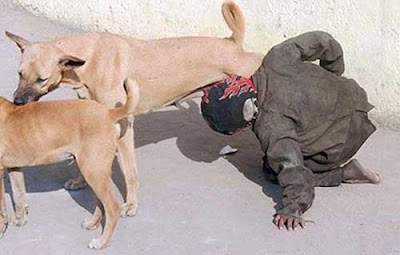
The first story talks about a six year old Indian boy whose family was so poor he had to resort to suckling the milk from a stray dog to stave away starvation.

According to UNICEF, fifty per cent of children under the age of three are malnourished in rural areas of Jharkhand
The second article talked about a fight amongst neighbours in the Hamptons, one of the wealthiest areas of America. A billionaire megalomaniac called Ira Rennert has annoyed his neighbours by flying his huge helicopter over their houses. A millionaire neighbour has described his behaviour like “throwing their garbage on the other side of the tracks for us poor folks to live with.”
Rennert’s 100,000 sq ft house on the Hamptons
Little boys drink milk from stray dogs, while millionaires fight over who has the biggest toys.
This is the world we live in.
This is the type of world the wealthiest among us wish to preserve in perpetuity.
It’s just sickening.
Lets’s face it. Cancer is shit. It makes its appearance at a random time in many people’s lives, turning normal lives into chaos, destroying families, cutting people off in their prime. It is no respecter of religion, IQ, gentility, accent or nationality. It just happens, and the result is devastation. No one is immune. Doctors, Pharmaceutical executives, Health gurus, Herbalists; all have suffered from it. The most powerful people in the world, the great executives, presidents and ministers: cancer sufferers and victims come from their ranks too.
It is the great problem of our age. Nobody yet has cracked all its codes. Progress towards cures have been painfully slow. The drugs used can have terrible side effects. Treatment can be drawn out, painful and dreadfully uncertain. People continue to die – in their millions. Its existence and intractability has motivated many a young person to pursue a career trying to do something about it. Theirs is a thankless, frustrating, yet honourable, life.
If you are there for people, giving freely of your time, offering words of kindness, love and encouragement, easing the burden however small, then I salute you. It’s these acts of humanity that inspire us all.
If, however, you declare that you have a cure, when it flies in the face of common knowledge; if you put peoples lives in your hands, manipulating their hopes with your sweet empty words; if you drain them of money while adopting the mantle of bruised martyr then the word ‘scumbag’ is yours to keep. You are truly beneath contempt.
Cancer is shit. It is too serious for words. Modern treatment is like a frontline battle in a war we continue to lose. Sufferers need patience, care and compassion, not some fly-by-night magic potion bereft of substance. Pretending that you have a cure and building a career off this pretence is practically the worst deceit imaginable. My wishes for such people? May your roads all contain potholes. May the wind punch you in the face. May you die roaring.