Archives for posts with tag: scepticism

Blackrock_CastleWhen we look back in history, it can seem self-evident that previous generations were poorer in almost every way imaginable. To us, they had fewer material resources, a benighted mindset, poorer social structures, rudimentary health systems and a throwaway attitude towards human life. Yet, such a way of looking at the past may be deeply biased.

It may well be an illusion to think of our times as objectively “better” than in the past. Instead, we might only be considering how the past complies with the current zeitgeist. The further back in time we go, the less familiar things become. If we were to apply a percentage to how things comply with the present, then starting at 100% (now), we see this percentage reducing the further back in time we went.

No matter what period people are born into, it’s likely that they would apply the same bias. Whether they lived in the 1920’s, or the Middle Ages, or during the Roman Empire, they would always start at 100%. Their sense of the past would be framed completely by their present, possibly making them believe they were living in the most perfect of ages, irrespective of how bad these same ages might seem to us now.

Such an outlook means we must look at history not as objectively imperfect, but rather relatively different compared to the world we live in today. In the values we measure highly today, the past is unlikely to match up well. However, other measures, of lesser importance to us today, might have been deeply prized in another time. Where a time in the past is 100 – X percent like this world, this missing X becomes hugely interesting. It defines something that we would struggle to appreciate now, but nevertheless would have been crucial to the lives of people of those times, and vitally important if we wish to properly understand historical contexts.

Examples of that missing X could be music, folklore, poetry, humour or religious practice, all now lost to the sands of time. It could be skills and handiwork, no longer practised. It could be the toys and games played, the foods and the sports, of which we know little. All of this possibly lead to lives worth living for those times. When we hear older people bemoaning how older times were better, perhaps we hear echoes of this missing X.

The missing X applies not just to time, but to space too. Foreign cultures may not be poorer to our minds, as they are different. To understand it properly would require living there. To make a spot assumption that our culture is somehow better (or for them to assume it for themselves) is dangerous territory indeed.

All this is not to say that the values of our time are worthless and immaterial. Issues such as feminism, LGBT rights, racism, slavery, child-cruelty, empiricism, medicine and science have made this world a better place and, I would argue, objectively so. However we still need to be mindful of a creeping bias that turns the past into a caricature of itself. Making this mistake blinds us to what might really have been going on. At best, it leads to an imperfect view of our past. At worst, it deepens prejudice and intolerance.
Normally, in the political sphere, the business meeting or on the Internet, there is nothing like a good debate to flush out the issues and get people thinking more deeply about their views. It helps us make up our mind on subjects we might not know a lot about.

Debate has its limitations, however. Some people are better than others at performing it. Irrespective of the merits or strengths of the arguments, good debaters will make themselves appear sympathetic to the audience. They will use pathos and evoke emotion. They will use humour and make use of clever soundbites where possible. There is an element of conjuring in the best debaters: little rhetorical tricks that we in the audience may not be aware of, but can do wonders to get people onside.

There is also a sense that the best ideas from each side can lead to a better position overall. Seeking a middle ground is a viable position for a disinterested viewer to take. The argument can be made that if both views are being represented, then they are somehow equal, and that there are important points to be gained from both sides.

When it comes to scientific issues, public debates don’t work quite so well. First of all, no matter how good a debater you are, it has no effect on the underlying science. A skilled creationist debater can argue until the cows come home that God created the Universe in 6 days. He can use every rhetorical device and trick in the book to persuade his audience, but it doesn’t make evolution and a 4.5 billion year old Earth any less true. So too with gravity,  or any number of well established scientific theories. These theories were not developed in the courtroom, or by TV debates, or by pressure groups, or forums on the Internet. There was no appeal to the public to decide their veracity. They came about in the lab, through field work, experimentation, data analysis and published papers. Sure, there would have been debates – many of them – but these debates are technical and professional ones, focused on the quality of the evidence and the methods used. Such arguments rarely play well in front of a TV audience.

Secondly, once scientific theories are established, there is no middle ground. Just as 1 plus 1 is always 2, that too is usually the case in science. Reality works in particular ways. Gravity, electromagnetism, nuclear physics and biochemistry all operate on strict physical laws that don’t change just because someone doesn’t like them. A good thing it is too, as our computers, the cars we travel on, and the boilers for our hot water would not work if it were not the case.

You can’t just come along and equate your opinion or belief, no matter how deeply held, with a well established scientific principle, unless you have serious evidence to back it up. There is no sense that creationism is partly true. No sense that the successive dilutions advocated by homeopathy are of any practical use. Why? Because their advocates have not brought any useful evidence to the table, properly supporting their beliefs, while at the same time accounting for everything else that the existing scientific theories tell us. To take the middle ground in such cases, you are comparing apples, not with other apples, but with a copy of a facsimile of what once used to be an orange but now could be a giraffe, or anything you are having yourself. A scientific theory can only be modified or upended by better scientific evidence, not by a change in public opinion.

Equating pseudo-scientific opinion with well established science is known as “false balance”. It’s widely practiced in the media, where the he-said / she-said debating format is in wide use. A frequent outcome is that a casual listener can come away believing in nonsense, merely because the rhetoric on the nonsensical side of the argument was more persuasive than the expert view.

False balance is everywhere. Creationists in America have tried every trick in the book to inject their particular brand of stupidity into the US education system. There have been incessant efforts to put alternative medicine on a par with actual medicine, despite a long-standing failure to establish scientific plausibility, or to prove their modalities work better than placebo. Climate change deniers are active in the public sphere, using techniques borrowed from creationists and tobacco companies to cast doubt on the research. In Ireland, anti-fluoridation groups are seeking to change public health policy, despite numerous research studies giving fluoridation a green light at low dosages. All of these groups use public debate and public pressure as proxies instead of proper scientific research – because the science does not support their position.

Many prominent scientists are reluctant to engage in debates of this nature because it gives the other side a recognition that they don’t deserve, and offers the possibility of losing a debate because their rhetorical skill might not be as good as the other person’s. These are genuine concerns, however it’s a problem because public pressure and public debate can, and does, move the needle. It is possible for laws to be changed despite the best efforts of scientists. Legislators are rarely scientifically educated themselves. Simply avoiding debate gives all kinds of pressure groups a carte blanche to force through the most wrong-headed legislation possible.

I am minded of Christopher Hitchens, who never shirked any debates, even when his opponent’s points were extreme, terrifyingly offensive and in no sense based on reality. He recognised that how we learn things is based on science, but how we move forward is by public debate. We need both the sense of discovery and the ability to persuade. We need good communicators who can counter the propagandists from the other side while making a forceful case for science in public policy.

The following video is an oldie but a goodie. Dara O’Briain outlines the problem of false balance better than I ever could.

I did a radio interview a few weeks ago, and in it, I discussed homeopathy, acupuncture, salt therapy and chiropractic. Needless to say, the interview was followed by a range of alternative practitioners all calling in to defend their methods. The interviewer also read out a number of texts and emails, all pretty much saying the same thing: that I was just a closed-minded begrudger who should be a bit less dismissive about things he doesn’t understand.

Image

“Thinking” by ores2k (CC Licenced)

It’s a common belief that sceptical people are somehow lacking in imagination and empathy. According to some, when we look at the world, we moan and groan at the stupidity we see around us. Somehow, most other people are lesser beings, and while we cast doubt and criticise, they are out in the world getting on with their lives. What a miserable, negative lot we are!

The thing is, I don’t see it like that at all. As a person, I’m not terribly negative about things, and most other sceptical people I know have similar attitudes. Indeed, what I see around me, when I visit sceptical conferences and organise my own get-togethers, are wildly interesting people. Among the sceptical community, you will find writers and musicians; painters, comedians and poets. You will find fantasists, willing to consider life far into the future and worlds yet to be discovered. You will meet people with great talents, and those with huge burdens to bear. There is a passion to our discourse, some sadness, and many, many laughs. The sceptical community is just like any community on the planet, as varied and fascinating as a patchwork quilt.

So, what makes us different? If there is something that distinguishes us from others, it is this: we are driven by a curiosity about how the world really works. From this, we believe that the best way to understand it is to consider the evidence that exists for it. If you are asking us to accept something as true, we will ask how well it is supported. If it has good backup, it will be discussed, considered, explored and toyed with for the possibilities that it may offer. If it has little or no support, then acceptance will be withheld, until such time, if ever, that better evidence comes to light. Over time, you develop a sense of whether an idea is worthwhile or not: a “baloney detector kit”, as it were, helping you sort the good ideas from the bad ones.

A glance at my bookshelf reveals books about the origins of life, the story of Galileo, the scramble for Africa, Richard Feynman, the Ice Age, the Crusades, the stories of civilisation, great epidemics and the life and times of an executioner in 17th Century Nuremberg – hardly the library of a cynical begrudger. It would pain me greatly if I was ever to be parted from them. I am possessed with a desire to know and understand what I can, and yet not be fooled in the process. To me, scepticism is part of the process of gathering knowledge. Without it, knowledge is meaningless, as you cannot distinguish the worthwhile ideas from the chaff.

Scepticism is a state of mind. It doesn’t mean I get angry every time I see something I disagree with, or that I’m always writing angry letters to newspapers complaining about the latest fad. Most of the time, it simply allows me to be discriminating in what I wish to spend time on. There are only so many battles you can fight.

That doesn’t imply that there are no issues to discuss. Scepticism gives me a perspective on which to look at the world, and from this viewpoint, I see charlatans – psychics, faith healers and cancer quacks – exploiting peoples hopes and vulnerabilities with non-existent cures. I see anti-vaccination groups scaring parents, thus bringing rare diseases back amongst our children. I see cult religions warping people’s lives when they could have been doing so much else. I see political think-tanks questioning the science on climate change, thus condemning future generations to a potentially dreadful future. These are issues that affect us all. My concerns are human concerns, focused on the best of what life has to offer us, and rejecting the worst. I’m just coming at it from a slightly different angle.

Ultimately, I think scepticism is a hopeful stance. I believe that we humans have the capability to extend our survival as a species and to make all our lives better during our short stay on the planet. We can solve many of the problems that beset us, but it will require hard work, trial, error and great insight. In the end, it’s less about ideology and more about the role of science, technology, education and a good dose of common human decency, in addressing the many challenges that we face, now and in the future.

So, it’s not all about begrudgery and negativity. Quite the opposite – scepticism is about intellectual honesty, unquenchable curiosity and truly great ideas. It is accessible to all, both young and old. As a perspective, it is valuable and satisfying, both emotionally and mentally. It is a viewpoint shared by many of the world’s greatest thinkers, scientists and innovators. If only our political classes would consider it more seriously! We sceptics still have quite a job to do to convince people that our stance is important and worthwhile, but in the end I am hopeful. After all, we have an important ally on our side: reality.

Homeopathy Overdose by Richard Craig (CC Licenced)

Homeopathy Overdose by Richard Craig (CC Licenced)

“What’s the Harm”? It’s another question that often comes up from supporters of Complementary and Alternative Medicine (CAM). Is it not the case that most people attending alternative practitioners can expect to happily live long, chaotic and unexpected lives just as much as the next person?

Yes, but. There’s always a “but”. In fact, there are quite a few “buts”.

Let’s tackle the extreme cases first. There are many cases of people foregoing proper medical care in favour of CAM, thus prolonging pain and suffering for longer than is strictly necessary. In the worst situations, this can be life-threatening. There are many examples of people foregoing medical care for ineffective practices, much to their detriment. So, if you are really sick, go to a doctor. That also applies to your kids.

Other cases exist where semi-medical interventions are being performed, using acupuncture needles without gloves, performing chiropractic manipulation near the neck region, using actual medicines in homeopathic treatments, adding heavy metals to Ayurvedic treatments, triggering asthma attacks during salt therapy. While rare, such treatments have lead to medical complications because, by their nature, they border on real medical intervention, with all its attendant risks.

And then there’s just stupid, avoidable stuff that could have huge negative consequences if the practitioner gets it wrong. Ear Candling, I’m looking at you.

These are the easy ones. But, let’s say it’s not acute or life threatening, and the intervention appears totally safe. There’s no harm then, right?

I looked at the phenomenon of “It Worked For Me” in a previous entry, where I examined what might be going on for people who reported marked improvements in their condition after having CAM treatment. What this implies is, while people often report improvement, there is no actual improvement taking place. They may temporarily report improvement, but only until the condition reappears again sometime later.

If it doesn’t work, it might require another visit. Then another visit. Then another. Or multiple visits to different therapists in search of a cure. The problem may eventually get better, but that may have nothing much to do with the treatment. It’s just your body getting better naturally, as it would have done anyway, without any CAM intervention whatsoever. That’s a lot of money spent on nothing.

Many people take regular visits to alternative therapists, any time they feel poorly, or tired, or in pain. Given that most alternative treatments have been shown to work no better than placebo, it’s all a very effective way of spending a big portion of your income on something that could have been better spent on a holiday, or a new car, or saving for college, or whatever.

It’s also a great way of spreading nonsense. Some CAM practitioners feel themselves to be in competition with proper doctors, and so are not unfamiliar with spreading negative propaganda about the so-called “allopathic” medical profession. It’s not to say that the health service is perfect, but neither is it the bogeyman they often make it out to be. At the worst, the propaganda engenders a disproportionate sense of distrust in science-based medicine. Completely preventable diseases have been making a comeback because anti-vaccine nonsense continues to be perpetuated by some CAM practitioners and consequently, their clients. Children are referred to dangerous quacks because of a conviction by some that doctors are part of a conspiracy to hide cures from the general public.  So, while there appears to be no harm to you, you may be putting others at risk, simply by passing on bad advice.

Another way harm is spread is simply by perpetuating false hope. Sadly, there are some conditions and diseases where cures still evade us. People can be driven to their wits’ end, trying to find a cure or a treatment that will work. While doctors are expected to be honest with their patients in such cases, the CAM profession has far less qualms, and so clients are sent on distressing wild goose chases when perhaps they should be moving on towards more palliative measures. These are difficult, heartbreaking situations, but one thing is clear: nobody should be capitalising from such tribulations.

A question you might be asking is this: don’t medical treatments sometimes cause harm? Yes, but medicine usually looks beyond placebo into actual interventions, the bulk of whom have a great deal of evidence to back them up. These interventions can be harmful, but this is balanced against an improved outcome for the patient. Most alternative therapies are placebo at the best of times, so if little improvement can be expected, then neither should there be much harm in the intervention.

So, while active harm is rare, there are more indirect kinds of harm. Harm can be caused through inaction, or through spreading misleading information to others, or through the perpetuation of false hope. We shouldn’t look at alternative medicine as having no downsides. In the end, it’s never the best when people are forced to seek out solutions that don’t exist.

More thoughts on this issue from Science Based Medicine.

WhatsTheHarm.net – a database of alternative therapies going wrong.

Acupuncture Needle, CC Licenced via Acid Pix

Acupuncture Needle, CC Licenced via Acid Pix

“It Worked For Me” : these are the four words I always expect to hear when I get into a discussion on Alternative Medicine. In many ways, it’s very difficult to argue against. If you are not particularly careful in replying, you can come across as highly insensitive. How dare you assume that you know their circumstances better than themselves! Are you accusing them of lying? Furthermore, there is almost always a readymade refutation should you challenge any aspects of the assertion. It happened, you were not there, I was.

“It Worked For Me” is a minefield, and yet it needs to be tackled.

In the case of most alternative therapies, it’s implausible in the extreme for the putative cure to have been the cause of the recovery. Scientific studies have established, far beyond reasonable doubt, that homeopathic pills contain no active ingredient. These pills, by themselves, are utterly useless. Further studies have established that Chiropractic back manipulation is of no use beyond providing temporary relief to lower back pain in some cases. Other studies have demonstrated that Acupuncture, the insertion of needles in the skin, does little from a medical perspective. The list goes on and on. Whatever they say is working, it’s obviously not the particular treatments themselves.

And yet, many people swear by them. They had back pain, they went to an aromatherapist, and the pain disappeared. They felt very unwell, they went to a naturopath, and felt much better. Some people have reported the end of chronic pain and illness from going to alternative practitioners. They have reported the clearing up of allergies, the ending of depression, fatigue, lots of things.

So what is happening? Clearly, it’s difficult, without full information, to comment on any individual case, but here are some of the things that may be happening:

1) The Placebo Effect. The Placebo Effect relates to the tendency of people to report improvement after all manner of interventions, medical or none. Significant study has been done on this, and, while measurable improvement (beyond what would happen without intervention) is almost never seen, the effect refers to a strong tendency to make people feel better in themselves. It’s triggered by lots of things: the dosage, the nature of the dosage, the ambiance of the consulting room, the attitude and friendliness of the therapist, and much else. We all feel better from having spoken to someone who listens and helps us talk more easily. The Placebo Effect is particularly strong when it comes to non-specific symptoms, such as pain, fatigue, low mood and general feelings of un-wellness. It has less of an effect for specific, clear symptoms, such as cuts and infections.

2) Regression to the Mean. This refers to the natural tendency of the body to get better. Given enough time, back pain tends to get better by itself, sleep cycles are re-established, and allergies clear up, at least for a while. Just because a therapy was invoked before the recovery happened, doesn’t mean it caused or accelerated the recovery. It may have happened quite naturally, and there is no way of knowing this without careful analysis.

3) False Memory. Our memory of an event is actively re-created every time we recall it, so by necessity, many details of what actually happened tend to get lost, particularly the aspects that do not resonate with the main story. So it might be forgotten that the person was on antibiotics at the same time as visiting a homeopath, or that the recovery didn’t happen quite as fast as they remember. Even worse, the memory tends to become even more fixed with the telling as the weeks and years go by.

4) Belief contamination. We tend to view the world based on our inherent beliefs. Ghost hunters see and hear ghosts everywhere. Right-wingers tend to see left-wing conspiracies everywhere, and vice-versa. So too with people with an invested belief in their chosen form of alternative therapy. They will reach for signs of it working, even when the evidence is very slim.

5) Cognitive Dissonance. Once we have established a story about ourselves, we hate admitting we might be wrong about it. So when challenged on any aspects, our brains tend to go into overdrive to defend our position. This can have the effect of further changing our memory of it, bolstering the false memories even further.

6) Subjectivity. People don’t normally establish criteria for success beforehand, then judge the outcome based on these pre-existing criteria. Instead, there is a tendency to retro-fit a meaning after the event, which gives them much greater latitude to define what success means. The bar can be set as low as the person wishes.

7) Maslow’s Hammer, or “if the only tool you have is a hammer, it is tempting to treat everything as if it were a nail”. This is where people do not understand the limitations of their thinking. If we know of only one major way that a problem can be solved, we are unlikely to conceive of other alternatives to solving the problem. So, lack of knowledge of alternative modalities limits us to conceiving just one answer to the problems we have.


None of this, by the way, imputes deliberate action or foul play on the person making the claim. It’s just the way our minds work. When it comes to how our brain interprets the information we get from our environment, we are truly a funny lot.

If confronted with a personal anecdote and asked to explain it, it is far better to avoid engaging in a particular diagnosis, as you are unlikely to win that battle. It is possible, however, to engage in a hypothetical situation, on why we should be sceptical of personal testimonies. You could also imagine yourself experiencing a magic cure, then testing yourself on how you might have interpreted it incorrectly.

In the end, we are all too easy to fool. Convincing ourselves that a discredited modality works is the easy bit. Trying to establish that we might actually have got it wrong is much more difficult. “It Worked For Me”, as a reason for believing in a treatment, is simply not good enough.

epsos

Wooden Sculpture (CC image via EpSos.de)

Why is science important?

Some people think science is all about wild-haired, bespectacled geeks in lab coats, holding beakers and marvelling at their latest fantastic breakthroughs. Then there are the people who believe it to be some sort of church, where immutable truths are held in sacred reverence. Many consider it to be just a type of opinion, prone to change its mind with the same regularity as teenage fashion. In the worst case, it is condemned as an enterprise of pure evil, determined to foist dangerous chemicals, foods and drugs on a compliant public. All of these are lazy, small minded caricatures of what science is.

Put simply, science is about trial and error. Scientists test ideas against reality; dumping the failed ideas and retaining the successful ideas for further scrutiny. Ideas that survive multiple, repeated testing gain greater validity. Over time, the best ideas become part of the consensus of knowledge that helps us understand the world and Universe we live in. While all this knowledge is provisional, and subject to change with further evidence and testing, many of the best ideas are doggedly persistent, retaining their power and validity after many decades, and even centuries, of close examination. Gravitation and Evolution by Natural Selection are two of the more notable examples.

This process of trial and error is familiar to us all. Computer programmers, debugging thousands of lines of code, understand it only too well. Businesses test competitive strategies, rejecting ones that don’t add to the bottom line. Plumbers, bricklayers and carpenters rely on the fruits of hundreds of years of reality testing, every time they build a house. We eat mushrooms, salad leaves and shellfish, safe in the knowledge that someone, some time in the past, tried them, liked them, didn’t die of poisoning, and told others what they had just eaten. Science is all this, and more. Over the years, it has become very sophisticated in how it can tease out the best approaches from a vast array of flawed ideas.

Science is important because it tells us how things work. Often, it can explain why they work. So, when it comes to explaining something like why vaccines are today used against measles, the trained eye can explain it not only from longitudinal studies on the effectiveness and safety of vaccines, but also though an understanding of the mechanisms of the human immune system and the measles virus itself. Even if there is a lot more to discover, as in the cases of autism and cancer, science can provide a sense of what is known so far and what is yet to be discovered.

Science is furthermore important because it also tell us what doesn’t work and the reason why this might be so. So when crystal healers tout their garnets and quartzes as cures for depression, or when homeopaths claim that their sugar pills have medicinal properties, we can reliably challenge their assertions. Pseudo-scientific (“false scientific”) claims like this fly in the face of physics, biology and everything we know about physiology and mental health.

One wonderful thing about science is the many surprising insights that have been made about the nature of the world around us. Discoveries such as DNA, quantum mechanics, electromagnetism and relativity – to name but a few – have revolutionised our understanding of the world while driving massive improvements in technology and the world economy. We need to keep in mind that without science, such discoveries would never have been made.

Science can also provide the most useful hints toward future discoveries, cures and treatments. The knowledge already built up leads to interesting pathways deserving of further research, and from this, real breakthroughs may arise. Without such a starting point, we are unlikely to make much progress in fields such as cancer control, neurological disorders, climate change and the many other problems of our times. To propose and promote solutions in such areas while remaining ignorant of existing knowledge about the problem is foolish in the extreme.

There is an integrity to science. Despite many different political systems around the world, there is no “Islamic science”, or “Eastern science” – it’s just science. The same methods are taught in science classes everywhere there is a commitment to good education. And despite many attempts by politicians and charlatans to interfere with the scientific process for their own ends, it stands firm, even if this means loss of funding and favour. This is particularly the case in the environmental debates of the present time.

For these and other reasons, science is worth promoting and defending. Many groups seem intent to promote anti-scientific agendas, or, more usually, cherry picking the bits of science they like, while rejecting outright the bits that don’t conform to their ideologies. It’s difficult to be blasé when confronted with such opposition. A lessening of the value of science, in our classrooms and public spaces, is ultimately a rejection of what we have learned as a species. It debases a process of inquiry that has served us so well in the past and should continue to do so in the future.

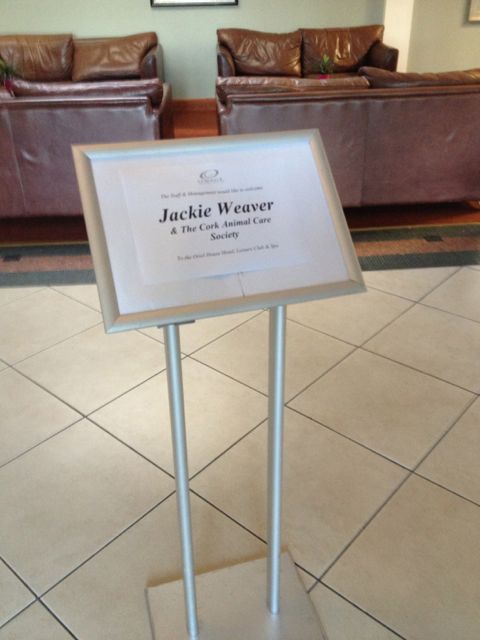
weaverLast night, I visited a talk in Ballincollig given by “animal psychic” Jackie Weaver. Weaver had been invited along by the Cork Animal Care Society, a charitable organisation that looks after stray and feral animals in the Cork area.

I’ve never been to a psychic show before, but through my interest in scepticism, I have heard a lot about them over the past few years. I had heard about all the tricks and techniques used by psychics, so I was slightly curious about how it worked in practice.

Weaver is an “animal psychic”: she claims to communicate directly with animals and understand their language. I wondered if they communicate to her in English, but she told us during the show that they have figured out some sort of universal language, using the metaphor of the ear doing the translating for us, or something. She didn’t tell us how she had learned this language.

Weaver herself was understated, bubbly and soft spoken. She came across as an empathic person who immediately made a connection with audience members, many of whom were strong animal lovers. The audience of around 100 people was composed mainly of women, with just a handful of men present.

The talk started with her going through her life story. She told us she always felt she had psychic abilities, and that she had embarked on her career as an animal psychic after a particularly traumatic onset of cancer some years ago. She got into animal readings, the word spread, and it went from there. Peppered through her talk were references to celebrities whom she now counted among her friends. She made the claim that, given the high profile of these people and what they had to lose if they were wrong, they couldn’t possibly accept her if they thought she was talking nonsense. This is at variance with what I know of celebrity culture.

She dropped a few anecdotes about how she had gotten into the minds of problem animals – how a dog told her that being dropped from a short height as a puppy had caused it to behave strangely, and how another dog was refusing to take heart medication because it thought it was used to make it urinate. There were inevitable swipes and sceptics and scientific vets, who clearly didn’t appreciate these mental abilities.

Weaver requested us to close our eyes, and imagine we were going on a walk through a field and into a house. She suggested we meet someone or something significant in that house, and then later asked audience members who or what they had experienced.  There were a few misses. A man responded that he had experienced nothing, followed immediately by another woman who said exactly the same. She moved on quickly.

She was then given a photograph of a dog, and she started putting forward Barnum statements like how it loves its ears ruffled. While the owner nodded vigorously about many of the readings, Weaver did not pick up that the dog had a major hip problem, nor that it was nearly euthanised as a pup. In the course of the conversation, we learned that its owner was into healing, and a suggestion was given a number of times that the dog would benefit from homeopathics. For a dog that is clearly in pain, this might not be the best advice to give the owner.

We then went on to animals that had “passed to the spirit realm”. Weaver explained that death is a bit like travelling to Australia (presumably without the funnel web spiders and the endless episodes of Neighbours). She did another reading for an audience member based on minimal information. Again the statements were bland and generic, and would apply to most pets. The bereaved owner was much more willing to give details of her dog which made it easy for Weaver to add further soft statements about the animal.

And then it was over. All in all, terrifically underwhelming. No amazing insights, incredible denouements or shockingly accurate observations. It was all very fluffy. One thing I did pick up from her was a sense of defensiveness, that there are many who don’t believe her, including many of the local Cork media outlets. People are already quite sceptical of psychics, but when you are an animal psychic, the doubt increases by another degree. How she mentally manages to deflect this criticism is impressive, and is a case study in itself, I think.

I had the privilege of speaking at the First Friday’s at the Castle in CIT Blackrock Castle this weekend. My talk was “Hoaxes and Hysteria in Astronomy”, where I took a sceptical look at Astrology, UFO’s and the Moon Landing “Hoax” conspiracy theory.

I first spoke about astrology. To understand why astrology is wrong, you need to understand how it originated, and how astronomical discoveries since the 1500’s have completely overturned the basis of the belief system. It also gave me the opportunity to present Phil Plait’s frequently posted diagram:

Then I gave a potted history of UFO’s and our culture’s fascination with all things extraterrestrial. Part of it featured Orson Welles’ infamous radio broadcast that panicked half of America in 1938. Here is the first piece of the radio show. Even now, over 70 years later, it still works as a monumental piece of broadcasting.

Orson Welles later described why he did it:


While a great many people claim to have seen UFO’s, there has never been any hard evidence provided. UFO reports have been plagued by problems of mistaken identity, delusion and hoaxes. One of the best hoaxes was crop circles: initiated by two drinking buddies in the south of England.

I then spoke about the widespread perception that the moon landings of the late 1960’s and early 1970’s were a hoax and that NASA staged a cover-up of monumental proportions. There have been many rebuttals, most comprehensively done by the Mythbusters team.

Personally, I love Michell and Webb’s take on it.

At the end of the talk, I got around to my Baloney Detector Kit:

That last one, the “lone mavericks” suffering for their ideas, is particularly true. There have been far, far more wrong-headed lone mavericks” in history than the tiny number of people who have eventually been proven right.

Finally, if you have managed to read through to the end, here are some useful links should you wish to know more.

  1. BadAstronomy.com : Phil Plait waxes lyrical about his wonderment of the universe, while regularly debunking the widespread misinformation.
  2. Snopes.com : If you hear a strange tale or you get an email that sounds fishy, check this website out. It will give you some food for thought.
  3. Skepdic.com : The Skeptic’s Dictionary is a tremendous resource for people who want to understand the scientific view of modern delusions and weirdness.
  4. Randi.org : The James Randi Educational Foundation has been fighting baloney for years. There are plenty of resources there for budding sceptics.
  5. Skeptoid.com : Brian Dunning has created a comprehensive list of ten-minute podcasts debunking all sorts of strange ideas. You name it, it’s probably there.

We run regular “Skeptics in the Castle” meetings in Blackrock Castle, where experts are invited to talk about the reality behind modern misconceptions, fads and strange beliefs. Check out our website corkskeptics.org. We are also on Facebook and Twitter.

Few people outside Ireland know of Mary Raftery, but they should.

To appreciate the kind of person she was, you need to appreciate what Irish society was like just a few decades ago. Most things of importance in Ireland were controlled by the Catholic Church. Because of their power and influence, nothing happened in the country without the imprimatur of the bishops. They had ways of making their views known. What displeased them quickly came to an end. Priests were seen as minor nobility: to be revered, not to be crossed, no matter what their personal qualities and vices. The Church had their backs. So long as you followed the system, you could get on with your life.

And what of those who didn’t fit? The Church had solutions for them, too. They ran Industrial Schools to deal with poor and unruly children. They ran slave laundries to deal with unmarried mothers. Within these walls, they beat troublemakers into submission. For others, they had more effective means of gaining the upper hand, practically guaranteeing that they would never speak up for the shame of it.

Much of this took place behind closed gates and closed doors. Most people never heard of it. If you heard something, you were far better off staying quiet. Life would be easier for you. From the highest statesmen to the keenest of media investigators, the monster that lay at the heart of the Catholic Church in Ireland lay hidden for decades; all the while growing, gathering tentacles, feeding off its most vulnerable, corrupting those who came in contact with it.

This was the country in which Mary Raftery began her career in investigative journalism. Things weren’t right. A heroin epidemic was raging in Dublin. Mary began to inquire into its causes. Her inquiries lead to broken people, their dreams destroyed long before they ever took drugs. Ireland had a horrible secret, and it was behind a lock that would require several years of dogged determination to open. Mary helped to unpick that lock.

The 1990’s were not great years for the Catholic Church in Ireland. Bishops and priests were discovered to have had children in secret. Damaging books were being written. Pederasts in clerical garb were being exposed. It was possible to look upon these incidents as aberrations and the protagonists as bad apples. Easily excused and dismissed. It would take something much bigger to rock the sensibilities of official Ireland.

In 1999, Mary Raftery’s RTE documentary series, “States of Fear”, did just that. It exposed a widespread system of institutional abuse, through which thousands of children were processed, for over half a century. The system functioned through deprivation, starvation, overwork and violence: both physical and sexual. What this documentary had in abundance was evidence. After her programme, it wasn’t so easy to make excuses.

Mary went on to produce more documentaries that set out the scale of the problem. “Cardinal Secrets” (2002) showed how senior bishops “managed” the crisis, often compounding the horror and injury for victims. More recently, “Behind the Walls” (2011) shone a light into the Government run psychiatric hospitals. At one time, Ireland lead the world in terms of the number of people detained in mental institutions.

For those still in denial, the subsequent years have been torrid indeed. The scale of the problem has been revealed to be enormous and manifest. A succession of official reports have backed up, with compound interest, the original allegations. The rot within the Catholic Church has been laid bare. We now live in an Ireland that looks at the past and our past masters, and says “never again”.

We knew Mary Raftery from her regular media appearances and for her great faculty to put words to the intense anger we all felt when the latest stories came to light. She was not someone to be trifled with in a debate, as apologists found quickly to their cost. She came across as brave and ruthless in the face of grave injustice. Mary epitomised a new type of morality, based on compassion, truth and justice. She was a role model for a new, more secular generation. Mary Raftery was a sceptic, a rationalist and a humanist. Her name and her work deserves widespread recognition.

Mary Raftery died last week at the age of 54, after a battle with ovarian cancer.

Today I came across a website dedicated to a young Irishwoman who has been fighting cancer throughout 2011. Hannah Bradley was diagnosed with brain cancer earlier this year, and since then she has been in and out of hospital, undergoing surgery and radiotherapy in an effort to keep the tumour at bay. It has truly been a terrible time for everyone involved.

Honestly, I cannot imagine how I would react if I were in such a position. When treatment options are limited, people are motivated to help as much as they can. There is clearly a strong desire to keep her alive, to not lose hope, and for this they must be commended. 

On Hannah’s website, the desired course of action is the clinic of Dr. Stanislaw Burzynski in Houston, Texas. Burzynski advertises treatments involving “antineoplastons”. These are molecules, so the claim goes, that attack cancerous cells, leaving healthy cells alone. Unfortunately, there is no proper scientific evidence that these treatments work, and Burzynski has not shared the data with the wider medical community in order for the treatments to be validated. Furthermore, his treatments have not been approved by US regulators. Burzynski is getting around this by presenting the treatments as experimental. This would possibly be ok, except for the surprisingly and stupendously high cost of such an experimental approach. The bottom line is that his clinic exists on the fringes of the medical world. Instead of working with scientists and oncologists to prove for once and for all whether his course of treatment is scientifically valid, he has rejected it all in favour of direct approaches to patients and the use of slick marketing and testimonials. Burzynski presents himself as the lone genius who has challenged the might of the medical establishment. This would be fine if he had properly controlled, peer reviewed evidence, but so far, he has not been able to provide this. The burden of proof clearly rests on his shoulders.

Over the past few weeks, challenges to Burzynski’s methods have been met by a barrage of legal threats from an individual who appears to be associated in some way with the clinic, including a personalised attack on a 17 year old blogger that beggars belief. This is not the right way to meet such challenges. The right way would be to provide the facts, and to let these facts speak for themselves.   

Hannah’s friends have clearly decided that Dr. Burzynski holds the keys to her recovery. Data is emerging throughout the Internet each day that this is not the case. I understand that Hannah’s team will feel that they have invested themselves on a course of action – that perhaps it is too late to change course – but for Hannah’s sake, they need to take this new information into account. It will make for very uncomfortable reading and there will be a natural tendency to rationalise it away as the product of some very mean and nasty individuals. The people who are presenting this information are not bad people. Many of them work closely with cancer sufferers, and many of them will have lost family and close friends to cancer. If Team Hannah were to reach out to some of these critics, I expect they would be listened to sympathetically and provided with second and third opinions. The question “what would you do?” can always be asked.

I know that the medical establishment can sometimes appear cold and arrogant. I know that there are limits to what is known and that doctors can sometimes give patients a message that they never want to hear. It is heartbreaking to have someone say “We can’t do any more”. The natural inclination is to say that they are not trying hard enough. Sometimes, perhaps they aren’t. But, no matter how inadequate doctors may seem, there is a world of a difference – a universe of a difference – between medical science and outright quackery. 

Cancer is shit. Real shit. It’s the plague of our times. Some day, hopefully, our children or grand children might look back on the world today and ask how we managed through it at all. The hard, thankless work of medical researchers will continue to push the frontiers forward. They have already accomplished wonders, but much more needs to be done. Given time, there will be enormous advances. Unfortunately for some, time is running out.

I wish Hannah the very best. I hope she can get through this nightmare of a year and emerge with this awful thing in remission. If her doctors can still help her, I hope they are doing everything within their powers to give her the best possible chances. I don’t know from her blog if the cancer has metastasised, whether chemotherapy has been tried or even if it is effective against such a cancer. If options within the medical literature are still available, then I expect they have already been seriously considered by all concerned. If options no longer seem to exist then yes, it’s heartbreaking. Being there, at such a time, possibly trumps doing something. I wish her the very best.

References

a) The False Hope of the Burzynski Clinic (Andy Lewis)

b) Stanislaw Burzynski: Bad medicine, a bad movie, and bad P.R. (David Gorski)

c) Antineoplastons (Skeptical Health)

d) Burzynski The Movie: Hitting you over the head with pseudoscience (Orac)