Every so often I am obliged to go to a Catholic Mass ceremony. This is something I try strenuously to avoid, but sometimes I have little choice. Such are the complex demands of middle parenthood.

Little has changed in the ceremony in the quarter century since I forsook the weekly ritual. What has changed are the congregations. On this occasion, the pews were full, but populated in the main by parents like me – uncertain about what they should be doing and registering a timid protest by not attending communion with their children. If it were not for the nature of the ceremony, the attendance would have been a great deal smaller and greyer.

The priest, a young curate from a part of the country where “th’s” are banned, didn’t bother to alter his style in the midst of this gathering of heathens. Instead, his sermon was all about the nihilism of secularism and a call for us to return to the religion of our youth lest we fall prey to decadence. He blamed atheism for hardship, a diagnosis equivalent to not flossing or washing between one’s toes – satisfactory to some, but ultimately irrelevant.

As I said, not much has changed. If anything, some priests are getting more hardline as the collection plates dry up. Despite plenty of evidence to the contrary, they still believe they hold the monopoly on ethical behaviour and are fearful of the loss of pomp and privilege. There is still an unwillingness to engage into a dialogue with the real world. It’s all a bit sad, and while I believe that ethics is as important now as it ever was, it seems the Catholic Church is getting less qualified each year to inform us on ethical behaviour.

In the meantime, here is a delightful video from Stephen Fry on humanism and happiness. Judge for yourself what is a better role to live by.
.

We Irish don’t look at St Patrick’s Day in quite the same way as other countries. While St. Patricks Day is a welcome break and a chance to prepare for spring, we tend to look at the kitch and global celebration of Irishness with mild embarrassment, as if someone invited us to a party in our honour, but sent it to the wrong people, and we went along with it anyway, rather than spoil it for them.

What is Irishness anyway? Perhaps, when Ireland was a mono-cultural society, defined along rigid sectarian lines, there might have been a case to be made – commemorating a history of oppression and struggle against sometimes massive odds. Nowadays this story holds none of the same resonance.

Ireland today is a relatively modern country and home to a broad range people from all over the world. Our religious identity is disappearing. We are quite well integrated into the wider European community and thus more likely to share most of the values and aspirations of our continental neighbours. Our health and education systems are chaotic and under-funded, but functional. Our political leaders are salesmen. Sport is a national obsession, as is the price of property. A bracing combination of engaging scenery and bad weather keeps us grounded. All thing considered, we don’t particularly stand out, and that’s ok with us.

But, to consider the pomp around St Patrick’s Day, you would think we are wildly special, different by a long shot from all other people on the planet.

Alcohol consumption might be a factor, but we’re certainly not the only nation with a love of drinking. In fact, if our empty pubs and middle-age health obsessions are anything to go by, drinking is rapidly on the wane here.

Arts, music, literature and poetry, yes, perhaps; but it seems this too is overblown. Our artistic heritage is often more complicated, in any case, than it appears at first glance – owing a lot, in many cases, to other nationalities, conveniently forgotten in our self-made myths.

Maybe it’s the love of the craic, the raconteur, the devil may care attitude, the life and soul of the party, or whatever you are having yourself, but it seems that these are more universal values than we care to accept.

It’s all very hazy. We’ve moved from a patriotic love of Ireland and its dominant religion to this nebulous concept of “Irishness”, and we don’t really know any more what it means.

Here’s what I think it should mean. Rather than focusing on one small culturally ambiguous island in the Atlantic, St. Patrick’s Day should be all about displacement. It should be a global celebration of emigration, immigration and movement away from home, both forced and unforced. In a world where mobility is expected and often mandated, it’s good to have a day when we can think about where we came from, and the journeys we have made to get to where we are. This is true, both for us as individuals and our wider historic backgrounds. The Irish, a nation with form in this area, are just as good ambassadors as anyone else.

So there it is: if you live somewhere that is far away from the homeland of your childhood, or even if you feel a connection to somewhere other than your current home, whether that be China, Gabon, Vietnam or Co. Offaly, then happy St. Patrick’s Day. This day is for you.

Yesterday, Cork County Council recommended by a “huge majority” to stop the use of fluoride compounds in public water supplies. Under pressure from the council, the Minister for Agriculture, Simon Coveney, has agreed to appoint a group of international experts to review the fluoridation of Ireland’s drinking water.

Water fluoridation was introduced in Ireland in the 1960’s to reduce dental cavities, after other countries had reported significant success in their own fluoridation programmes. Fluoride compound ingestion does have side-effects, so the issue has always been about establishing the correct dosage for safe use. Currently, the recommended dosage in Ireland is 0.8 ppm, which is substantially lower than the US Environmental Protection Agency’s maximum safe dosage of 4 ppm. The only established side effect of fluoridation at low levels is dental fluorosis – a temporary discolouration or mottling or teeth that is mainly observed in children. To date, and despite extensive study across the globe, no major health organisation has been able to establish a link between fluoridation and any other health impacts. The conclusion is that, so long as the levels are below international safe guidelines, it’s safe to drink the water.

That’s not the conclusion our esteemed councillors appear to have reached. From listening to their soundbites, you would be lead to believe that we are in the middle of a major public health disaster.

 “Some of the countries we are exporting food to are now calling into question the use of fluoride in our food products and this would be very detrimental to the food industry.”

Cllr Adrian Healy, FG

 “It contravenes the EU Convention on Human Rights. Nearly all countries in the EU have stopped it.”

Cllr Christopher O’Sullivan, FF

This is “Dr. Strangelove” territory.

The inspiration for all this scaremongering is a highly organised campaign group in West Cork, running under “The Girl Against Fluoride” (TGAF) banner. They are running an energetic and effective campaign, with a large support base. They have successfully grabbed the ear of anyone who will listen, including plenty of local politicians.

However, running a slick campaign and determining public health policy based on the best scientific facts are two totally different things. TGAF cherry picks data from wherever they can find it, linking current levels water fluoridation to thyroid problems, lowered IQ, cardiovascular problems, osteoporosis, cancer and kidney disease. If only the peer reviewed literature supported them! For example, a Harvard study quoted by them on lowered IQ is based on excessive amounts of fluoride in China, and not on the minimal amounts in Irish water supplies.

As if to lend credibility to their campaign, TGAF are supportive of notorious quacks such as Joseph Mercola and Stanislaw Burzynski, of which much else could be written. If the science is against them, then clearly their opponents are on the take, stooges of Big Fluora, or sheeple who have not yet woken up to the truth. The message is that scientists and public health advisors are working against the people and that they know better – classic conspiracy thinking. If they reach their goal of making Irish water fluoride free, one wonders what their next target will be? Childhood vaccines, perhaps? Antibiotics, maybe?

If public health experts conclude that water fluoridation is no longer required in Ireland based on the success of other measures, then I have no problem with this. The problem here is how the fluoride debate is being pushed – primarily via scaremongering and bluster – from an organisation that prefers emotion and fear over rational analysis.

The developments in Cork County Council yesterday indicate that anti-scientific and conspiratorial thinking is making strong inroads into public debate and that all you need to overturn good public health policy is a highly motivated campaign group. This is not a good portent for the future.

—–

For more on this I recommend you read David Robert Grimes’s excellent blog post on the same subject.  Also, please look at Gerry Byrne’s “Inside the mind of an anti-fluoridationist”


Another week travelling, this time in the opposite direction. Over the last three weeks, I’ve been in three equally sized corners of the world. I still miss Shanghai.

I’m in Silicon Valley: an endless suburbia straddling San Francisco Bay, and home to some of the brightest technical minds on the planet. Photographic opportunities are somewhat limited, but there are some wonderful gems, not far from the hustle and bustle.

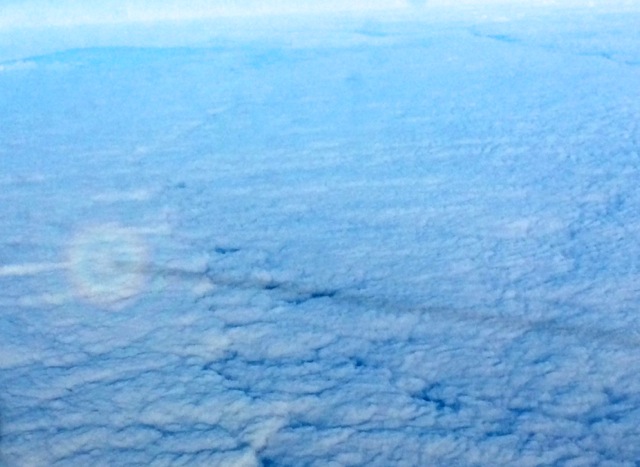
I saw a few curious things on my flight over from London. While travelling past Iceland, I noticed a dark line of shadow imprinted on the clouds far below. It took me a few seconds to realise that it was caused by our own plane’s vapour trail – a shadow cast from far above. What was even more interesting was that the head of the shadow – where the plane should be – was surrounded by a small rainbow. It’s called a “glory” – an optical phenomenon caused by the reflected rays’ passage through tiny water droplets.

Plane Shadow 1

Plane Shadow 2

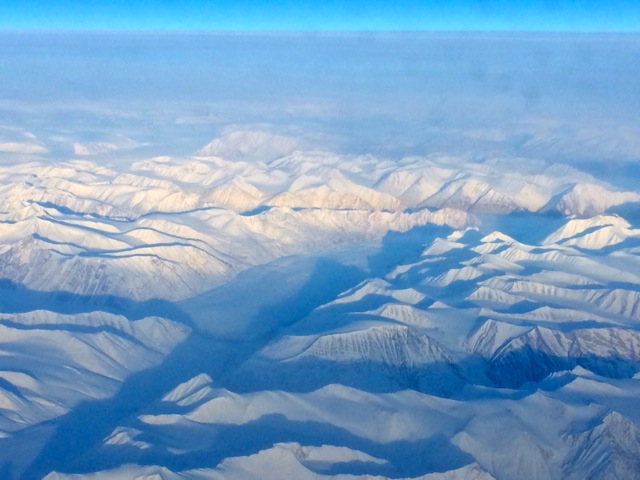
Greenland was uncharacteristically bereft of cloud, so I could see clearly the high snowy mountains of the coastline. Deep in the valleys, I could see massive glaciers grind their way to the sea. As the plane headed inland, these glaciers began to engulf the mountain tops, until the mountains themselves disappeared under the enormous ice-cap.

Greenland Ice Cap 1 Greenland Ice Cap 2

We arrived into San Francisco early, and with time to kill, we headed towards the Pacific Coast Highway, one of my favourite spots in Northern California. Thick sea fog was assaulting the coast, lending a certain dullness to the scenery. We wound our way South from Pacifica to Santa Cruz, past driftwood strewn beaches and high cliffs. It’s a relaxing part of the world.

I’m staying right beside the Shanghai Tower, which is frighteningly high, believe me. It’s 650 metres tall – the second highest skyscraper in the world. You get a crick in your neck just looking up at it.

This video was just posted on the Internet by two Russian guys who climbed to the top. Then, as if that wasn’t terrifying enough, clambered out to the end of the crane at its apex. Health and Safety folks around the world would get sick just thinking about it.

If you have the stomach to watch the video, did you see the skyscraper far below it? The one that looks like a bottle opener? That’s the Shanghai World Financial Centre, “only” the sixth tallest skyscraper in the world. I’m staying on the 83rd floor and as the photos from my window will testify, it’s already pretty high.

IMG_7084 IMG_7085

The trip to Shanghai comes to an end tomorrow. It’s been a wonderful experience and very different to how I expected it might be. I’m craving to see more of the country from this one whistlestop visit.

Don’t worry – there is no “Day 3” post. Yesterday was not eventful for me. Just work, a nondescript meal at a restaurant near the hotel and then bed.

I woke early and made my way across the Huangpu river to The Bund, the old financial area of Shanghai. Barges ploughed their way past the skyscrapers of Pudong as kites floated silently in the air. The morning was misty and dull, but not too cold.

I then walked up to Nanjing Road, one of Shanghai’s biggest shopping areas. From what I hear it’s usually crowded with people, but this morning only a few brave souls walked the street. Having watched some elderly people practice T’ai Chi, I flagged a taxi back to the hotel.

Our meal this evening was hot-pot. Each diner is given a pot of water and vegetables, then presented with small portions of meat, mushrooms, noodles, prawns and fish cakes to cook and eat. It was delicious and a lot of fun. We then walked to a local market with small alleyways and lots of interesting, good quality items on sale. Shanghai is an expensive city, although I suspect some local knowledge would come in handy in this city.

IMG_7063

Some other things I took in: taxi passenger doors only open on the right-hand side, so it’s always a case of first-in, last out when getting in the back. The driving isn’t great – we’ve had more than one close shave over the last few days. None of the drivers know English, so a card with the destination address in Chinese is an ideal accessory when travelling.

I’m learning a small amount of Mandarin Chinese. Yes and No sound a bit rude to Anglophones, so I should have no problem remembering them. Other than that, it’s a very difficult language to learn. The way you say something is at least as important as what you say.

And, no, I’m not improving with my chopstick prowess. It gets worse when anyone is looking at me, and worse still if they start commenting about how bad I am.

It snowed today, a rare event for a city that shares the same latitude as Jerusalem and Austin.

I took a short time-lapse video this morning with the sun poking through the clouds; the light playing games with the February dullness.

This evening, we ate in the Langyifang Restaurant. It’s situated in a gigantic modern mall close to the hotels. We sampled a large mix of local foods, mostly similar to what might be found back home.

Foodpic 1

My impression of the city so far is much less of a culture shock than I would have expected. Shanghai is brash, modern and unquestionably upmarket. Most items on display cost the same as what might be paid in Europe. Many of the big brands are here, including Haagen Dazs, KFC and TGI Fridays. Clearly, if we want an authentic Chinese experience, we are in the wrong place.

One of my colleagues, an American, has mastered Mandarin Chinese, both oral and written. My Chinese colleagues tell me it is word perfect without much of a trace of an accent. Knowing how to read the Chinese characters is especially impressive, as this is a much bigger challenge for Chinese children compared to western kids. Mastery involves familiarity with several thousand symbols, many of which vary in meaning depending on the context in which they are written. On top of being masters in Chinese, many of my colleges speak English perfectly. Truly, I feel humbled here.

This morning I arrived in Shanghai – by some reckonings the world’s largest city. My travels began early the previous morning, with dangerous gusts around Cork Airport making hard work of our take-off.  After a short stop-over in Heathrow, a Boeing 777 took us across the Russian Steppes and Mongolia, touching down in Shanghai at 9.30 am Sunday morning. It’s my first time in China and only one of my first times in Asia proper.

Flying in, the area under the flight path reminded me of the Netherlands, with its cloudy weather, reclaimed land, wind turbines and man-made canals. It’s all brand new, with many roads, bridges and buildings under construction. The airport is shiny and enormous – the terminal building itself seems to stretch to infinity in both directions. A motorway brings you straight into the city centre and driving in you get an appreciation of the huge number of people living in Shanghai. Large apartment blocks cover the landscape as far as the eye can see. It’s an impressive sight.

Shanghai Motorway 1

Click photos to enlarge

A number of huge skyscrapers dominate the cityscape, the largest of which, the Shanghai Tower, is being built at the moment. It will top out at 630 metres, making it the second tallest skyscraper in the world. Construction is due to complete in 2015.

After a brief rest in the hotel, we took a taxi to Yuyuan Bazaar and Gardens. The garden itself is delightful – full of nooks and crannies, steps going nowhere and tiny footbridges. The pools are full of colourful koi carp. A pity it’s too early to see the trees in blossom.

The bazaar was a bombardment of sounds, smells and sights. Everywhere there were people – lots of families and children. Despite the fact that we didn’t have a clue where we were or what we were doing, somehow we managed to visit the Temple of the City Gods, do some tea-tasting and see the lanterns light up as the Chinese New Year ceremonies come to a close. We even got our photos taken by some teenagers, clearly impressed to have come across quaint looking foreigners.

Yu Bazaar 1


20140202-232307.jpg

I’ve just arrived home after a wonderful day in the Aviva Stadium. The boys and I watched a thrilling game between Ireland and Scotland. After an indifferent first half, Ireland let fly and romped home in style in the second half – 28 points to 6.

I loved every minute of it. There’s a real style to the game that makes it thrilling to watch. It was only my first time in the Aviva and my second time at a rugby international. We had a great vantage point behind the Southern goal-posts. Even though the Aviva holds well over 40,000 people, it seems very small and intimate. The play seems close and personal.

I have to admit, though, I know very little about rugby. I understand tries and conversions, I think I understand line-outs and I get it that you can’t pass the ball forwards, but otherwise it’s all a bit of a mystery to me. And those names! Props and Out-halfs and Hookers, Jive Wookies and Rear-Flank Ball Breakers (ok, I made the last two up): I know they must mean something, but I’m completely at a loss to what it might be.

And all these south-city types, talking about the plays. Jesus, it’s like a foreign language. I mean, look at this from the IRFU today:

5 mins – Rory Best combines with Heaslip in the lineout. First decent bit of possession for Ireland. A double hit on Luke Marshall leads to a ruck in midfield and Ireland are pinged for ‘sealing off’.

I mean, what the hell are they talking about? Combine harvesters, satanism, drinking games, table-tennis and window repair would be my best guess.

Here’s another comment from the IRFU blog later in the game:

27 mins – O’Mahony gets up to disrupt the lineout, it is back on the Irish side and Conor Murray goes the aerial route. Possession back to Scotland though and they counter from inside their own half.

Did O’Mahony suddenly become Scottish for a while and start flying, or something? Was I watching Quidditch, perhaps, and didn’t realise?

Ok, one last one:

54 mins – Marshall is used for a crash ball run. Ireland bring play out to the left with good carries from Heaslip and Best. Sexton leads a wraparound move that ends with Rob Kearney being brought down.

A Crash Ball Run? Wasn’t that some sort of Hollywood movie in the 70’s? And what is a wraparound move? Sounds sexy. No wonder Kearney was down on his knees.

I have to admit it. These guys (and probably 99% of the spectators, fuck ’em) saw a completely different game to me. While I was going Ooh as one of the green fellows was hit by a blue fellow, everyone else was going “Smart pinging on the pong frame by O’Driscoll there. Will he ruck to make the 10 metre line scrum?” or some equally nonsensical bullshit like that.

No matter what the sport has ever been, I have always failed utterly in understanding the language that goes with them. Even though I come from a hurling tradition, my train of thought never deviated much from “guy with stick hits ball to other guy with stick”. Rugby, however, is in a class of its own.

As far as I am concerned, they are making it up as they go along. I prefer to believe that none of them know what they are talking about and that it’s all the ref’s fault anyway.

In any case, it was a huge amount of fun and a great day out. Just don’t ask me to explain it. Please. Just don’t.

Let’s face it. The Catholic Church has a homophobia problem. Despite all the evidence that’s out there showing that it is as much part of a person’s makeup as the colour of their eyes, many people within the church can’t reconcile themselves to a the fact that a homosexuality is a normal part of the diverse tapestry of humanity. They find all kinds of excuses why homosexual people should not be entitled to the same expectations of happiness and reward as other ‘normal’ folks. Somehow, according to some, it’s just not right.

It’s a big problem. You see, because of their inability to accept homosexuals fully into the fold, and in some cases their outright hostility to the idea of equal rights for homosexuals, other, less restrained folks, have decided that they have approval to discriminate against their own gay communities to a far greater extent, secure in the knowledge that they won’t hear much opposition from any powerful religious leaders.

By giving homophobia a cover and a degree of respectability, they have provided an intellectual underpinning to the assault, imprisonment and killing of homosexuals in Russia, in Nigeria, in Ghana, in Uganda and other countries. In their insistence on keeping homosexuals at arms length, they are fuelling violent bigots across the globe. This fire of bigotry gets stronger by the month – having already reached alarming levels in some of the aforementioned countries.

I am not saying that the Catholic Church is directly responsible for this, but there are great violations of human rights happening right now. Instead of coming to the aid of the downtrodden, they have prevented themselves from taking any sort of leadership position. Indeed, by their silence and opposition to the cause of gay rights, they are making matters worse, not better. It’s a negation of everything they claim to be about.

It’s not just the Roman Catholic Church, of course. The greater Christian church, including Protestantism and Eastern Orthodox, not to mention Islam, is blighted by homophobia, often to a much greater extent. No major religion, to my knowledge, has come to the defence of the LGBT community. None of them have revised their thinking sufficiently to shout ‘stop’. Instead, the task has been largely left to secular groups.

A sea change is urgently required. Some of the bigger churches need to alter their stances. They need to stop giving succour and support to the bigots and those who provide them with ready arguments. They need to start campaigning against discrimination and bigotry based on sexual orientation. The leadership needs to come from the top, if they are not to repeat the mistakes of the past.