Archives for category: worth a look

Over the past week I was away in Chicago. I had a fairly quiet time there, so during that period I was able to catch up on some reading.

The Tipping PointFirst of all, I finished reading “The Tipping Point” by Malcolm Gladwell. This is a great read – very interesting stuff. His central thesis is that social changes (business trends, fads, crime rates and other memes) tend to behave in a manner somewhat similar to epidemics – often there is little progress followed by a sudden exponential jump – the idea catches fire, as it were.

According to Gladwell, three factors are needed – the right people, the right messages and the right environment. What makes the book exceptionally interesting are the case studies used: everything from crimes on the New York subway to Sesame Street to the sales of footwear. It’s packed full of interesting tales: the bit on the 150 rule was fascinating. Essentially the idea behind this is that no social or business unit should be bigger than 150 people. Go beyond this number and you lose control. The manufacturers of GoreTex are cited as a good example of this. They build a new factory and restructure once the population of any of their units goes beyond the 150 mark. Radical stuff indeed.

If I had any reservations it is with the first area – finding those elusive “right people” who will seed the epidemic, as it were. These right people, known as Connectors, Mavens and Salespeople, are required to guarantee success. While I accept that there are people around with such exceptional skills, I wonder how common they are in practice. There is something super-human about it which doesn’t quite ring true. It all seems a little too simple – too packaged. A well working team would seem to me to work just as well, if not better.

The book Freakonomics challenges his assertion that small changes, on the margin, resulted in a sudden drop in the New York crime rate. It’s a debate that will go on for a while, I imagine.

So, I now know a bit more about “stickiness”,the dynamics of cigarette smoking, Paul Revere’s ride and the influence of peers. It’s an enjoyable read and highly “sticky” in itself, but nevertheless I have a few misgivings.

My next review is coming up soon.
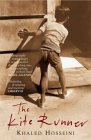
This is a wonderful read. It’s got everything – friendship, betrayal, shame, honour, bravery, hatred, grief and redemption – the whole gamut of human experience.

The Kite RunnerThe story revolves around the central character’s two most important relationships – his father and his best friend, set against the backdrop of the troubles in Afghanistan. Saying any more about the plot might lessen your enjoyment of the book, so I will refrain from doing so!

Parts of the book are painful to read. It’s not a story for those who want an easy time from their novels. The author does not spare his readers from the more disturbing aspects of human life particularly in the context of war and unheaval – the casual cruelty, the killing of innocence, the sickness of fanaticism.

However, for readers looking for depth and complexity in their characters, you cannot easily find a better example. Although a grotesque villain is brought to life in the novel in the guise of Assef, betrayal and cowardice are present in the book’s central figures. In fact, it’s this betrayal and cowardice that forms a central theme in the book, making it such a fascinating read.

A strong emotional bond with Afghanistan is painted in the book. Afghan people are portrayed as proud, generous, talkative but sometimes hypocritical and stubborn. I noted strong parallels with the Irish way of life, or at least a way of life that used to exist in Ireland, but now, perhaps, is in rapid decline.

When all is said, there is a gripping story to tell here. The denouements in the text are wonderful – I frequently found myself gasping as the plot twisted, sometimes in the most surprising of ways.

I absolutely loved the book and would gladly recommend others to read it.

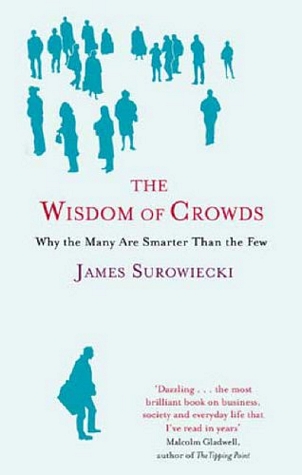
The Wisdom of Crowds is an enlightening book, particularly at the beginning where he spells out his thesis: that, under certain defined conditions, the views of many can often trump the views of one single person, no matter how influential or how much of an expert that person may be.

The Wisdom of Crowds

The book justifies the opinion that forecasting and estimating are better performed by many people from different backgrounds instead of just a single elite. These types of problems, referred to as “cognition” problems, are commonplace – who is going to win the 3.40 at Newmarket, what will our sales be for the next quarter, when will the project be completed, etc.

He then tackles more complex problems, called “coordination” problems and “cooperation” problems, and arrives at a similar conclusion that, left unhindered, crowds of diverse people, acting independently, can arrive at an elegant solution to very complex problems.

In some ways, the book is nothing new. Adam Smith promoted the basic idea over 200 years ago when he talked about the “invisible hand” guiding the market and economists and politicians have been discussing this ever since. Surowiecki asserts that some of the rules of the free market have applications way beyond finance – the inner workings of the Google search engine and the Hollywood Stock Exchange (HSX) are examples that are mentioned.

But, you might be saying, what about stock-market bubbles, group-think, decision by committee, mass-hysteria, riots and all the things that one would attribute negatively to crowds? His view is that crowds work best when a highly diverse group of individuals are able to make independent choices with levels of influence minimised as much as possible. In this way the maximum amount of information can be gleaned from the environment and an aggregation process can then happen which may yield a good answer to the problem at hand. Influence and persuasion are seen as disrupting factors in this process.

If you are looking for a “how to” manual, then the book will be somewhat disappointing. For instance, many business managers face challenges in getting groups to come together to make good decisions. This book provides some tantalising evidence that group decision making is indeed superior, but the reader is left to figure out for themselves how to apply it to their own particular situation.

The book is very readible. It contains a large body of fascinating research material and conveys the conclusions elegantly.

Mars Rover (Courtesy NASA/JPL-Caltech.)

I went to a very interesting lecture last night presented by Leo Enright, the Irish broadcaster and science journalist. He talked to us about the two NASA robot probes, Spirit and Opportunity, that are currently making their way across Mars. Spirit is currently holed up in the Columbia Hills in Gusev Crater, while Opportunity has come up to the edge of the impressive Victoria Crater on the Meridiani Planum.

They both landed there in January 2004, and were originally expected to work for around 3 months. Nearly 3 years later, they are still operational, sending back pictures almost every day. Spirit celebrates its 1,000’th “sol” on Mars today. To celebrate the occasion, a panoramic 360 degree view of the Columbia Hills has been released on the internet.

McMurdo panorama from Spirit Rover (Courtesy NASA/JPL-Caltech.)

The view from the Victoria Crater is, if anything, even more stunning. The crater is about a kilometre wide, and in a few week’s time Opportunity will descend into it. (How it gets itself out is another question entirely).

Opportunity on rim of Victoria Crater (Courtesy NASA/JPL-Caltech.)

Leo demoed a free application known as “Midnight Mars” that downloads the latest photos from the rovers onto your PC each night. Because the rover cameras are about the same height as an adult human, you get the distinct impression you are standing there yourself.

The probes have bolstered the case that Mars was once covered in water and they have provided an insight into the geology and stratigraphy of the planet. Looking at the photographs from Mars, I got the distinct feeling that we know very little about the place. There is a treasure trove of information waiting to be discovered by future robot probes, and maybe some time in the distant future, people themselves.

Update: My question about how Opportunity gets out of Victoria Crater has been answered: it doesn’t. It’s fate is being decided as we speak.