Archives for category: worth a look

Ayaan Hirsi Ali - Infidel

It didn’t take long for me to appreciate that this is a biography like no other. Ayaan Hirsi Ali has had an extraordinary life. Coming from rural Somalia, she has been circumcised, assaulted, betrayed, cursed and threatened with death. She has witnessed famine, family breakdown, forced marriage, misogeny, madness and hardline religious intolerance. A close friends of hers has been assassinated. And yet, despite this she managed to get elected to political office in the Netherlands, with her story playing a central role in the downfall of its government in 2006. She was regarded recently as one of the world’s most influential people.

Ayaan’s story is one of great courage: as a child she was ridiculed as dull and stupid, and yet over time she managed to assert herself: rejecting the spouse chosen by her father and in so doing, leaving Africa for Holland. From there, she saught an education for herself. Over time, she rejected Islam and the deeply held cultural traditions of her people, embracing instead the great freedoms that we in the developed world often take for granted. Despite an ongoing threat against her by extremist groups, she continues to campaign uncompromisingly against Islamic fundamentalism.

The story that she paints from her time in Somalia, Kenya and Saudi Arabia is not pretty. Cultural, traditional and religious factors still hold sway to an extent unimaginable in the West. To many, simplistic edicts from the distant past are far more important than the complex accomodations and hard-won understandings of modern society. Women and children are treated as second-class citizens. The law of Allah holds absolute sway, brooking no opposition, promising a nirvana that fails even the most cursory empirical test.

She casts a critical eye on Muslims in Europe, asking why it is that so many of them have failed to properly integrate into Western society. To her, the future must be one of integration, not multiculturalism. She has no time for those who believe that coexistence without challenge is necessary for European societies. In her opinion, traditionalism is not on an equal footing with modernity: those who stand up for the traditionalists serve only to delay and frustrate the cause of human rights for those whom they purport to represent. It is a compelling argument.

Many sections in the book are heart-rending. It is excruciating to read about how she and her siblings were subjected to the horrors of genital mutilation; how her weary and depressed mother inflicted all her frustrations on her daughters through unrelenting physical abuse; how her father rejected her and cursed her; and how her sister succumbed to the misery of mental illness. All these stories are told with much sadness and little malice. It is clear that her family remain close to her heart, despite everything she has been through.

This is a powerful, uncompromising book that has that rare quality of being difficult to put down.
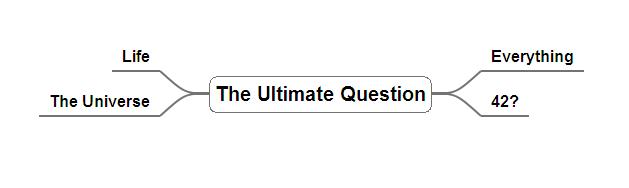
Mind42

I’m a big fan of mind mapping apps: probably because I have a mind that often needs quite a bit of organising. While I was working on my thesis, I always had a copy of Mind Manager close at hand. It was invaluable as it allowed me to make sense of large amounts of research, organising it into useful categories quickly and efficiently. Now that I have since moved on into a new job, I don’t have it any more and I have felt slightly bereft, having to make do for the time being with Microsoft’s One Note.

Mind Manager is an excellent application, particularly if you have presentations or project plans to write on the fly. However, it’s a bit pricey, so the alternative is a free application on the web.

Mind42 allows you to write, save and publish your maps on the web. You can also collaborate with other users, co-writing or reviewing a map as part of a virtual brainstorming session. The mapping tools are rudimentary but nevertheless easy to use and more than adequate for the majority of mapping tasks.

I tried to publish the above mind-map to my blog using the publishing tools, but unfortunately the code provided does not work on WordPress.

This video is incredibily thrilling and utterly frightening at the same time. Enjoy!

(found via Tom Raftery‘s blog)

I’ve been listening to the excellent “Whistleblowers” series on RTE Radio 1. In the past it has featured interviews with Jeffrey Wigand (Brown and Williamson tobacco), Sherron Watkins (Enron) and Craig Murray (British Ambassador to Uzbekistan). Today the subject was Harry Templeton, a Glasgow printer who stood up to Robert Maxwell in the late 1980’s, and got duly shafted for his troubles.

Another story worth listening to is the tale of David Kaczynski, who discovered that his brother, Ted, was the Unabomber.

You need Real Player installed to listen to these programmes.

Some time ago, I wrote about five books for small children that my kids and I absolutely love. I now would like to add another book to this list.

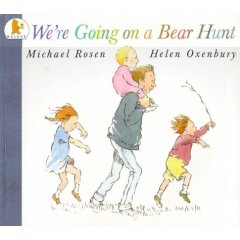
We’re Going on a Bear Hunt (Michael Rosen and Helen Oxenbury)

We’re Going on a Bear Hunt

Oh no! We forgot to shut the door!

The premise of the book is quite simple. A dad brings his three kids into the countryside with the aim of finding a bear. The group are totally unprepared for what lies ahead as they clamber past all sorts of obstacles during their quest. (I can relate very much to the dad in this book). Much to their surprise, they find a bear, and what follows is an exiting race back home with the grizzly on their tail. It’s got everything: repetition, actions, fear and humour. The drawings are superb, particularly as the kids reach the entrance to the cave. I was amazed by how quickly my toddler kids picked up the narrative and were able to recite the whole story verbatim.

Here’s an additional treat: in the following video, Michael Rosen himself plays out the tale. It’s interesting to watch as I use a very different style when reading the story to my kids.

If you know of other small children’s books that really deserve a read, please let me know.

Ooh, ooh, ooh! I just had to do this, even if they don’t actually have a country called Ireland listed… I had to sign myself in as a Brit to do this! Generations of my ancestors are already spinning in their graves no doubt..

Here’s the finished product: what’s yours?

Murphy McCloud

Here’s where you need to go.

(Via Friendly Atheist)

I know, I know – I haven’t lived.

I came across the classic comedy sketch “Dinner for One” in YouTube over the weekend and laughed myself silly. So, if any of you have been hidden below ground for your whole life as I seemingly have, this will be quite a treat.

Part 1

Part 2

Hands up who isn’t familiar with these problems! Real nuggets of wisdom here…

Life After Death by PowerPoint

One of the great things about being a parent is that every evening I get a chance to read night-time stories to young children. These books vary greatly in quality. Many children’s books (particularly the ones with toys and teddy-bears on the cover) are insipid, formulaic, manufactured and quite forgettable . Kids get bored by them just as much as we grown ups do. However there are some books that I still love reading to my younger ones whenever I get a chance.

So, in no particular order, here goes:

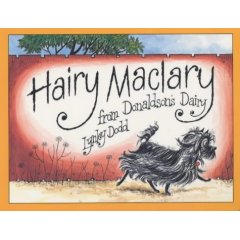
1) Hairy Mclary from Donaldson’s Dairy (Lynley Dodd)

Hairy McLary from Donaldson’s Dairy

“Out of the gate and off for a walk went Hairy Mclary from Donaldson’s Dairy”

This is a terrific little book about a gang of dogs who get more than they bargained for when they all head off for a walk down town. The drawings are superb, the rhythm in the lines is mesmerising and the “MEEEOOOWFFZZZZ” twist in the end has kids jumping with delight. Very soon, even small kids can recite the lines of the book along with you. Superb. (I am indebted to Teuchter for introducing me to this book..)

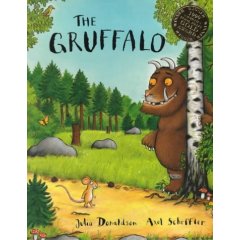
2) The Gruffalo (Julia Donaldson)

The Gruffalo

“Silly old snake, doesn’t he know, there’s no such thing as a Gruffal…”

This extremely well-illustrated book recounts the adventures of a clever little mouse, beset on all sides by predators, and how he manages to outwit them all. The book is written in a gentle, rhythmic verse that is a pleasure to read out loud. Three quite similar stories are recounted before the plot twists and the mouse is confronted with the monster of his nightmares. What happens after this is an act of genius on the part of the mouse. I always shout out the Gruffalo’s lines in a very angry gruff voice – my kids love it.

3) Some Dogs Do (Jez Alborough)

Some Dogs Do

“His paws just lifted off the ground”

This is a rhyming story about a small dog named Sid who discovers one day that he can fly. When he tries to tell his friends in school, nobody will believe him. The miserable pup is comforted by his parents, who let him into a secret. I particularly like the drawings of Sid’s face – the faraway stare – when he is confronted by opposition on all sides. It’s a captivating, delightful tale that the kids want me to read again and again.

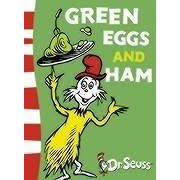
4) Green Eggs and Ham (Dr. Seuss)

Green Eggs and Ham

“That Sam-I-Am, That Sam-I-Am! I do not like that Sam-I-Am”!

No list of good children’s books would be complete without a title from Dr. Seuss. This story tells the tale of a grown-up creature who is pestered by the much smaller and younger Sam into eating a seemingly disgusting meal of green eggs and ham. Despite his protestations, Sam never gives in and finally the adult takes a bite. The whole tale is a reversal of the usual story where an adult is forcing a child to eat something that the kid doesn’t like the look of. Like many of the tales here, the story is recursive, repetitive, rhythmic and rhyming. Soon the child will be reciting the tale along with you.

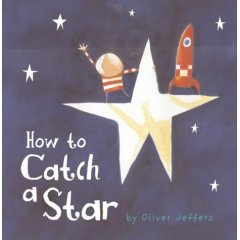
5) How to Catch a Star (Oliver Jeffers)

How to catch a star

“Once there was a boy and the boy loved stars very much”

This story concerns a small boy who wants to catch a star from the sky so that they can be friends and have fun together. He tries reaching for it and climbing trees to get it, but to no avail. Eventually he is drawn to the sea-shore where he finds what he is looking for. This is a wonderfully creative tale that talks volumes about the ways small children see the world. The simple cartoons that complement the story genuinely add to the tale. As an adult you can’t but help feeling for the little boy as he tries to understand a mystery of life.

What makes these books special?

All of these stories are quite similar in that they blend poetry, colour, artistic detail and repetition into a coherent whole. All of the storys take about 3 to 5 minutes to recite. Neither are they “fluffy”: They grapple with quite deep topics concerning relations with adults, friendship, fear, disappointment and making sense of the world. If you are a parent of young kids or are wondering what to give your young niece or nephew for their next birthday, I would wholeheartedly recommend all five titles.

Do you know of any other children’s books that you would add to this list?

Now this book is quite amazing. I had heard about it some weeks ago, so I made a special point of attempting to find it when I went shopping in the US.

The Long Tail - Why the future of business is selling less of moreAnderson’s central thesis is this: with the introduction of the internet and new ways of working we now live in a time of abundance and practically infinite choice. And as a result, the rules completely change. No longer are we constrained to think in terms of “hits” or “blockbusters” or “top selling brands”. We can now buy anything we like, and it’s available for us to do so in just a few seconds of clicking or calling someone. And, what’s more, it’s happening all around us today.

What fascinates me most is how it seems to overturn one of the most powerful “laws” of doing business. A long-standing rule of business is the Pareto Principle, commonly known as the 80:20 Rule. Put simply, it means that, to make money, companies should only concentrate on their highest selling products or services. The slow movers and niche items are too expensive to store, and so they should be ruthlessly excised. The result, if you haven’t already seen it around you, is uniformity, blandness, lowest-common denominators and a staggering lack of choice.

These days are coming to an end.

The Long Tail hypothesis says that the action in the future will be in the lower selling categories. People are increasingly seeking out those things that they want to buy – the niche music tracks or clothes, the arty Spanish films, the British comics from the 1980’s. Whatever you are in to, you can find it quickly and buy it for a cheap price, thanks to Ebay, Google, Amazon and a host of smaller sites and blogs. The Long Tail idea says that hits will decline in importance as interest in niches grows and grows and grows.

So much choice…This is nothing short of a crisis for traditional big media organisations, whose job it has been for a century to sell a consistent message to as many people as possible. Now, with the explosion of new channels of communication, people are turning off their radios and TV sets, reading blogs instead of newspapers, downloading indie music instead of going to the record store, ordering customised T-shirts, footwear and jewelery over the web instead of accepting the limited offerings in the local shop. The message, loud and clear, is “Blandness and Hobson’s choices? No thanks”.

Mega celebrities, big-name TV shows, best-selling newspapers, hit pop bands, blockbuster movies: all are beginning to show significant drops in their market-worth and the trend is getting more pronounced with each year. The world of mass communications is splintering into a million pieces, and no-body seems to be able to put this Humpty Dumpty together again.

Does this mean that the age of the hit is well and truly over? Of course not. Just look at the recent global racism furore on Celebrity Big Brother for instance. However hits will possibly be more random in the future – arising from anywhere, and disappearing back into obscurity once their time in the spotlight has passed. It’s likely that hits will be much harder to achieve, and more limited in their impact. Marketing’s problem will be in getting their message out to a truly fractionalised audience, with no-one consumer quite using the same channels of communication.