Archives for category: stuff

Old Mobile Phone

It’s been over a week without a phone. I’m coping. I’m not sure if others are.

1) No ‘Where Are You’ messages.

People don’t know where I am! Maybe I’ll arrive at the station on time. Maybe not. They have no way of knowing and I have no way of putting them out of their misery. Put it this way: I’m adding drama to their lives.

2) No Podcasts.

Hurrah! I’m a citizen of Ireland again, listening to Morning Ireland, George Hook and Arena. Instead of interesting shows from the UK and the US, it’s back to living in the goldfish bowl that is Irish media. Boy, will I have a backlog to get through when I finally get a new phone.

3) The constant need to update my status on Twitter all the goddamn time has greatly diminished.

So many pithy thoughts lost to posterity. You’re so upset, I can tell.

4) Photographs, of which I have none.

A whole haystack went on fire yesterday morning right beside the house. A transformer exploded near the house a few days earlier. Both incidences were as dramatic as you get in this part of the world. We even had fire engines. And what evidence do I have of these momentous occurrences? Nothing. I’ll show you a picture of the scorchings instead over the coming days. It’ll be almost like witnessing the real thing. Almost.

5) Remembering things is fun.

It’s amazing the extent to which I have left the phone organise my life. Without it, every deadline is a bit of a guess. I’m now reliant on people looking angrily at me. I so wish there was a button I could press to stop people looking like that. A Happy Face Button – there you go now. Who wants to invent that for me?

6) Back to using Voicemail.

Did I tell you I hated voicemail? Back in the halcyon smartphone days, I could safely avoid it for weeks on end. Now, it is one of the only ways I can be contacted. “Press 3, then 5, then 1 to continue. At the tone, enter your passcode then press hash. Sorry, please enter that 10 digit code again. Sorry, invalid response. Please try again later”. The designers of voicemail are as close to pure, unrestrained evil as you will find in the world today.

Life should return to relative normality next week. If not, please don’t try to find me and above all, please, please, don’t leave me a voicemail.
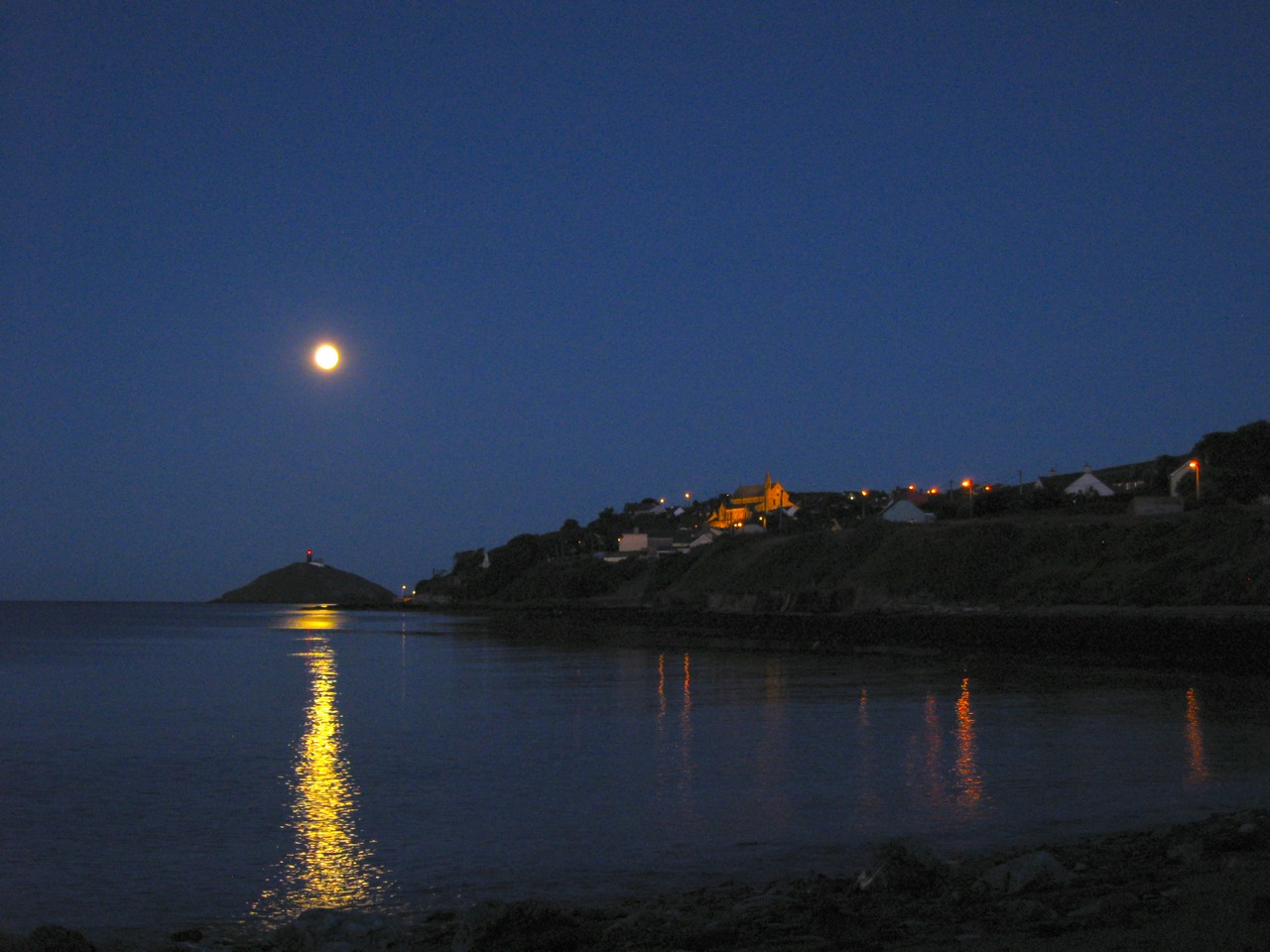
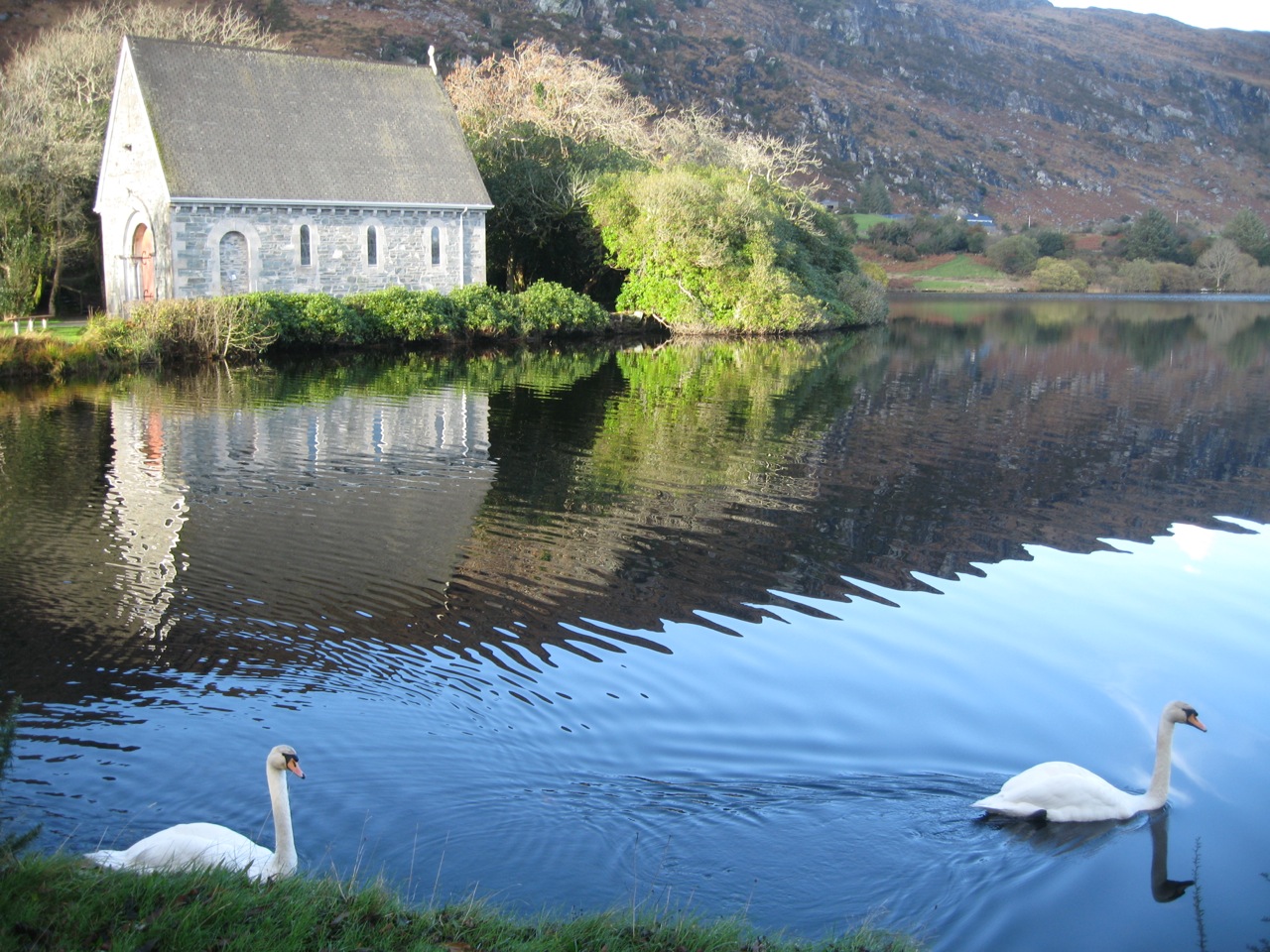
As you might have noticed from the background image, we’ve recently moved home, to a beautiful house, close to the sea by East Cork.

I was raised in the countryside, but after 20 years living in towns and cities, I had completely forgotten what it was like to live in a rural environment. The silence: interrupted only by the cooing of woodpigeons and crows. The stars: the Milky Way glistening, in all its brilliance, from horizon to horizon. Most of all, the beautiful, ever-changing views: from sunrise to sunset, the changes of colour from dull viridian to brilliant emerald; rain showers signalling their arrival as they float like wayward ghosts over distant ridges.

I’m looking forward now to winter, when the seas boil over and mighty winds assault our house, torrents of rain dashing like arrows off the windows. Inside, a fire burning brightly, king of its tiny domain, keeping us all cozily warm.  And the clear nights, dominated by Sirius and Orion to the south – the brilliant, endless scattering of stars. Endless fascinations.

There’s a feeling of freedom here. We’re minutes away from beaches, cliffs and a quiet fishing harbour. We have a choice of walks we can take, along quiet winding boreens. Although the rapidly approaching autumn darkness will hamper our evening forays, it’s a treasure to be enjoyed at the weekends.

So, hopefully, many long and happy years ahead.

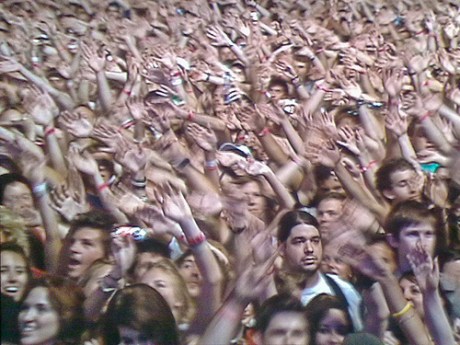
"Killers Crowd" taken by Steve Crane (Creative Commons Licensed)

In each day that goes by, almost 19 million years of human life is lived. If you were to spend twenty four hours in turn with each of the 7 billion people living on the planet, that’s how long it would take. Seven billion days. Nineteen million years.

In that span of time, whole continents can ramble about the globe, thrusting gigantic mountain ranges into the skies. Enormous tracts of land are submerged beneath the waves, while others wither in the heat. New species evolve, thrive and become extinct. Ice ages come and go like the seasons. Bolide impacts from space are a near-certainty, and catastrophes beyond our imagination, such as enormous earthquakes, tsunamis and super-volcanoes are a regular occurrence. The human race has been around for just 1% of this extraordinary time-span.

In one twenty-four hour revolution on our planet, 19 million years of human life will come to pass. You would imagine, given such extraordinary numbers, that almost anything that possibly could happen, and would happen, each and every day. Even if many billion people pass their day without event – watching TV, or taking the dog for a walk – this still leaves plenty of opportunity for far more interesting stories. Each day, every possible situation is being acted out: delight, despair, birth, death, sublime discovery and gruesome horror. These stories will remain largely unknown to us. It is impossible, therefore, to grasp anything but a thin essence of great historical events. The small stories, the petty tragedies and minor victories are doomed to be lost to posterity.

Somewhere in the world each day, one person may experience a one-in-seven-billion co-incidence: an event so extraordinarily improbable that it may seem miraculous. Such is the power of these numbers that strange events are not just expected, they must happen all the time. It’s not providence: it’s statistics.

Our media landscape serves us only a tiny slice of all the stories of the day. Television shows and newspapers often struggle to find news, and as so often happens, a single news story of two celebrities getting married, a sending off in a football match or a politician’s inane comments will dominate the media to the exclusion of everything else. The stories of the other 99.999999% of us, no matter how fascinating, will remain hidden from view.

We are oblivious to this accumulating tide of human history, because for most of us, each day is not much different to the one that went before. We spend our lives in a small corner of the world, perpetually nearby friends, aquaintances and colleagues. We are insulated from the great cacophony of our co-travellers. Knowing that we don’t know that much at all is both humbling and mind-blowing at the same time.

Photo credit: “Killers Crowd” taken by Steve Crane (Creative Commons Licensed)

The train came to a grinding halt just outside Aulendorf. I instinctively thought that someone had pulled the emergency brake. Two attendants ran past with somber looks on their faces; something very serious had taken place.

In Ireland, a canned statement would follow an hour later, about an unavoidable delay “for operational reasons”. But this is Germany. Here, in this railway line between Ulm and Friedrichshafen, we were told what happened almost immediately. Someone had ended his life, throwing himself in front of the train. When the engine came to a halt, his body was some distance behind the carriages, in a state I dare not imagine.

Sitting opposite us was a rather odd man. He was somewhat elderly. A few long whisks of grey beard intermittently jutting out of his wide chin at strange angles. A few times during the journey, he would turn to us and declare “Es regnet” (It’s raining). Most of the time he spoke quietly to himself. Occasionally he would take out a book, seemingly a yearbook of 2009, read a few lines, then replace it back in its bag. While disconcerting, we paid little notice.

When the train stopped, he abruptly became animated, asking us what had happened, as if we had some special insight into the accident that he did not possess. After being told about the suicide, the man asked us if the criminal police would interview all of us. He seemed perturbed by the prospect.

The train attendant quickly became his object of attention. This young woman, clearly upset by the incident herself, was harangued by the man every time she passed by. He wanted to know when the train would go again. He had to have lunch, you see, in Friedrichshafen. Then, he wanted to know if the train back to Ulm would be on time. No comprehension in his eyes that someone had just died.

Emergency workers and police were now making their way down the track to photo the body and determine the circumstances. He started banging on the window. “When do we continue our journey” he would shout. At one stage, an official pointed to his watch, intimating that we would be going in 20 minutes. It wasn’t enough for the man. He got up from his seat and followed the beleaguered train attendant down the carriage. “But I have to eat in Friedrichshafen”, he would say.

The train finally got underway and we finally arrived in Friedrichshafen. Descending from the train, he started shouting at other passengers. “Out of my way” he would yell, at one stage adding an racial expletive to a black man ascending the steps. He barked another order at an elderly woman in crutches at the doorway of the station.

Then he was gone, presumably to eat a rushed lunch, harassing some unfortunate waiter or waitress in the process; oblivious to what had happened or to how other people might perceive him. A strange man indeed.

Any sufficiently advanced technology is indistinguishable from magic.

– Arthur C. Clarke

A few days ago, I watched the Harry Potter finale with my kids in the cinema. After the film, one of my children asked me if I believed in magic; being a sceptical sort of person I admitted I didn’t. Magic is a relatively loosely defined term, but my bottom line is that “supernatural” phenomena have never been conclusively demonstrated or proven. Unless a compelling argument can be made, it appears that all objects in this universe act in accordance with natural laws.

Image by Don Solo (Flickr - CC Licensed)

The wizards and witches in Harry Potter have powers that certainly seem magical to us. They can “apparate” instantaneously from one place to another. They perceive memories from far-off times. They are armed with a variety of spells to disable opponents. Everything seems to have some sort of sentience. The magic in JK Rowling’s world is particularly appealing to us 21st Century folks. It is device based, utilitarian, networked. It mixes the physical universe with the virtual world of the Internet and gaming; strong reasons, in my mind, for the astonishing success of the books and movies.

Perhaps I am being a bit too harsh in not believing in magic, because to a medieval person, or a person who lived in Roman times, we live in truly extraordinary times. To them, we would all be wizards and witches. We can watch events and interact with people in other parts of the world. We move in metal carriages that require no oxen or horses. The greatest of these carriages fly above us and can even sail at incredible speeds above the sky itself. We have at our disposal wonderful materials – plastics, composites, semiconductors – that would be unimaginable by the medieval mind. Simple pills can be taken to cure what would have once been common ailments. We have created weapons of unimaginable strength and brutality. I could go on.

We don’t call this magic. We call it science. We call it engineering. We call it technology. It’s not magic because it is simply the laws of physics, chemistry and (increasingly) biology, applied in interesting ways to different challenges. The tools of the trade are not incantations but experimentation, imagination, analysis, criticism and frequent failure. The magical language is mathematics. Chemistry is our Potions class, Biology replaces Herbology and Computer Science supplants Divination.

Perhaps, in 500 years time, Harry Potter will be more akin to a documentary than to a fictional work. It may be possible to render oneself invisible, to flit in an instant through time and space or to backup one’s consciousness into safer, more robust objects; thereby achieving a kind of immortality. The people of that era would seem breathtakingly magical to us. That’s the wonder of science. The hard work of scientists today will pave the way to the magic of tomorrow.

Oh, and WordPress informs me that this is my 300th post since I began blogging in 2007. How did I ever manage that?

Art credit – Don Solo (Flickr, CC Licensed)

Photo via TheJournal.ieI met a traveller from an antique land
Who said: “Two hundred vast towers of stone
Stand in a deserted town. Near them close at hand,
Half sunk, a torn picture lies, whose clown,
With wrinkled hair and sneer of clueless command
Tell that its painter well those passions read
Which yet survive, stamped on these lifeless things,
The limos that mocked us and the politicians who fled.
And on the pedestal these words appear:
`My name is Anglo, Bank of Banks:
Look on my loans, ye mighty, and despair!’
Nothing beside remains. Round the decay
Of that colossal wreck, boundless and bare,
The lone commercial wastelands stretch far away”.
Poem based on Ozymandias by Percy Bysshe Shelley
Photo via TheJournal.ie

With a lack of proper imagination endemic in certain parts of Kildare, journalistic bollocks is the great global king. Give them a minute and they’re off, spouting shite about Chinese bullfighting flower arrangers, or whatever they can think of before the deadline arrives.

And I loathe reading the bollocks that some journalists spew out, without wit or humour or an ounce of research. Only an abject terror of being “judgmental” prevents people discussing this issue with the frankness it deserves.

So for once, let’s be honest. A journalist that is gratuitously talking through his arsehole is needlessly burdened with many handicaps: for ugly writing and imminent dismissiveness in themselves lead to social isolation, emotional and sexual frustration, pontifical infirmity and often premature bed-wetting.

Some journalists are so lazy that they physically cannot be bothered to think about what they are writing. So either they improvise, using tinfoil helmets, or a towel wrapped tightly around their heads, or they get a chum to sit on it. So now do you wonder why the very, very crap also have very, very few friends? (It may also have something to do with bad insect puns).

The conjoined trinity of women’s lib, bra burning and bad mammies lie at the heart of the bollocks epidemic. The mammies of the 1970’s started listening to that Greer wan and all hell broke loose. Everything has consequences you know.

The Sun was a great thing to discover, but we never imagined it would give us sunburn and the purple dots in your eyes if you stare at it too long. Oxygen was great too when it was invented but it created flatulence and yawning. And the feckin’ Greeks! Who invented those?

Moreover, merely to state the next obvious truth — that mothers are largely responsible for people talking through their arseholes — is to court hysterical denunciations from the virally infected. But we all know that most men are now dead, given that their wives stopped feeding them in the 1970’s and once hyper-busy women with careers started watching rugby and farting at inopportune moments — then their children started talking the most unbelievable shite.

Do you know why a shite-talker wheezes? It’s because their huge arsehole is preventing light from escaping, whereby it crushes the brain. The ultimate humiliation comes when you have to ask your one remaining friend to accompany you to the loo, so you can collect up the contents of the bowl to write your next Indo column.

And most lethal of all is the mental virus that accompanies scatological verbiage. This not merely acquits parents of their own personal responsibility for having made their children into shite-talkers, but it also causes them to hallucinate. When they gaze at the revolting column-inches their children have spewed up, their poor diseased brains only register a future Poet Laureate or Pulitzer Prizewinner.

So the key to the cure of the bollocks-talking illness is the neutralisation of mothers especially. This will almost certainly require a kitchen, a large ball and chain, inflammable corsets and lack of access to cigarette lighters — and needless to say, the author of such a solution can only be a woman, as the men are, after all, dead. Until her hour comes, shite, blather and rambunctious nonsense will always rule.

Inspired by this.

via hollyladd (Flickr) CC Licensed


1) Relate your story

Tell your story with a clear beginning, middle and end. Make the story as compelling as possible. Make the protagonists look really heroic, and your adversaries positively villainous. Exaggerate your main points for the maximum emotional effect. Ignore anything that might contradict your story.

2) Ignore

If someone starts to poke holes in your story, ignore them. They might go away or give up if given no satisfactory answers. Don’t take their calls. Pretend you are at an important meeting, or you are out playing golf. If you have to, them you will respond soon. Don’t bother to.

3) Ridicule

If they persist in attacking your story, laugh at them. Go for the jugular. Tell them they haven’t either the knowledge nor the wit to understand. Impugn their motives. Call them close-minded. Make them out to be in the pay of someone. Threaten them.

4) Obfuscate

If other people are now listening, pretend that’s not what you meant, that you were quoted out of context. Exaggerate minor truths to major importance. Minimise the importance of your major points. Appeal to any authority you can find. Appeal to tradition. Appeal to their emotions. Find anecdotal evidence that fits your argument. Throw as many curveballs at them as you possibly can.

5) Justify

If your argument is now falling apart, start to justify your motives with gusto. Blame your enemies. Blame your friends. Blame the media. Blame the polical establishment. Blame the woeful lack of standards in education. Make yourself out to be the victim of a plot. Bring in the effect on your family wherever possible. Go on a drinking binge. Get caught.

6) Oh yeah. That.

Admit you were wrong.

Say, here’s an idea. Why not not go from 1) to 6) directly? You might earn some self respect while actually learning something.

Last Friday, RTE’s Late Late Show invited Patrick Holford, a “pioneer in the area of health and nutrition” to talk to people about how to beat depression. It’s an interesting choice of expert because Patrick Holford has no academically recognised qualifications in the treatment of depression and has spent much of his career building up his health food and vitamin pill business. He has been the source of much controversy. Holford has claimed that AZT (a drugs cocktail used to combat AIDS) is less effective than Vitamin C and has been pulled up by the advertising standards authority in the UK for making unsubstantiated claims. In a nutshell, he isn’t the type of “expert” you want to be to rolling out when discussing something as serious and damaging as depression.

Using RTE Player I went through some of the claims Holford makes during the interview, and as it happens, many of the claims check out. There are studies around that have shown a beneficial link between fish oils and depression. There are studies that show a positive correlation between Vitamin D and seasonal depression. There are studies that link mood to obesity. Holford conveniently ties these studies into a single thesis: that what we eat is the most significant link in causing and treating depression, when many decades of clinical research would present a very different view. In other words, it’s just a confident sales pitch: read my book, eat the foods I suggest and you will feel better. Maybe it will and maybe it won’t; such is the power of the placebo effect; but in reality it falls far short of a comprehensive solution to the problems of depression.

Depression really is a grind. It differs from bad mood because it is not easy to get rid of and the depths of despair reached people inflicted by it. It can last for days, weeks, months, even years. No magic bullet has yet been found and it appears to differ greatly from person to person. There are lots of probable reasons and many treatments. It is one of the most widespread illnesses in society and is tipped to be the second leading cause of disability by 2020. Many of the most effective weapons against it (antidepressants, psychotherapy, electroconvulsive therapy) remain unpopular and stigmatised, often by the very same groups that promote healthy eating and mineral supplements. In the battle against depression what is most important are treatments that work, not ones we would like to work.

We need a serious discussion about depression in this country, not just a sales pitch by a vitamin pill vendor.

A stray tweet in TAM London a few weeks ago has lead to my setting up, with three other comrades in arms, Cork’s first Skeptics group in the city.

We are busy working on the agenda and details for our first meeting, which will take place in Blackrock Castle on Thursday next, November 25th at 8pm. We have a Twitter account and a Facebook page already, some posters on the way and a website in the works too, where we can post all sorts of stuff and nonsense.

The group is part of the global Skeptics in the Pub movement, where people come together to share stories and to discuss a wide range of topics, from pseudoscience to proper science, medicine to alternative medicine, parapsychology to psychology, and goodness knows what else.

I just want to say that I’m really appreciative of the work everyone is putting in. We have Dylan Evans from UCC lined up to do a speech on Alternative Medicine on Thursday and I’m hoping I can get a few more people to talk to us over the coming months. We hope to meet every month in Blackrock Castle. The Castle has a great café with a full drinks license. We couldn’t have asked for a better location and meeting room.

If you have any ideas or suggestions on what else we can do to get the group off the ground, I’m all ears.