Archives for category: science

As people on Twitter might know, I have a thing about the Space Shuttle. I was my son’s age when the Shuttle first launched itself into space. I gasped with incomprehension when the Challenger exploded. Many times I rushed outside at just the right time to see it fly over. On a few rare occasions, I was one of the first people in Europe to see it just after launch: its jettisoned fuel tank descending below it.

They needed to be retired. The fleet was long past its use-by date. They were using technology from the dawn of the computer age. They were dangerous and ridiculously expensive. The International Space Station has been completed. There are now other ways to send crews and supplies to it. There was no rational reason to extend its lifetime.

Nevertheless, I am sorry to see it go. I would have loved to see a launch first hand, to hear the roar as it rose above the atmosphere in a matter of minutes. No matter what comes next, the Space Shuttle program will be missed, if only because we are reminded, in a very tangible way, that 30 years have now passed us by.

Here is a great video which quickly recounts entire program, its highs and its lows, from 1981 to 2011. Let’s hope that the next few decades will inspire us even more.

It sounds like a tall tale thought up by a seven-year old Mr Gadget fanatic, but it’s true: the good folk in Cork Institute of Technology (CIT) have commissioned a large 32 metre transmitter just north of Midleton, Co. Cork for radio astronomy.

The site was originally developed in the 1980’s as a satellite transmission site for the Irish telecoms agency (now Eircom) to enable international communications. As is typical of the industry, it was already defunct by the mid-1990’s, with optical fibre replacing satellite as the primary medium for global telephony. The site was mothballed and in 2009, it was sold by Eircom to a private company.

The use of the site as a radio telescope is terrific from a number of standpoints. It will help to develop skills in space-science here in Ireland. It will provide fantastic outreach opportunities for kids who might be interested in science as a career. With CIT’s backing, it will create a focus for international research projects. It also has tourism potential for the east Cork region. Win, win, win, win!

I am genuinely delighted for the hardworking team in CIT and Blackrock castle, including Niall, Claire and Alan, Deirdre and Francis, all of whom I have had the pleasure to get to know in the last year. With their involvement and leadership, this is going to be a huge success.

I have a very fond memory of the station, in that it was the very place where I saw the fabulous auroras in October 2003. It’s a memory that I will never forget.

News reporting: Irish Examiner article. Irish Times article.

Last Friday, RTE’s Late Late Show invited Patrick Holford, a “pioneer in the area of health and nutrition” to talk to people about how to beat depression. It’s an interesting choice of expert because Patrick Holford has no academically recognised qualifications in the treatment of depression and has spent much of his career building up his health food and vitamin pill business. He has been the source of much controversy. Holford has claimed that AZT (a drugs cocktail used to combat AIDS) is less effective than Vitamin C and has been pulled up by the advertising standards authority in the UK for making unsubstantiated claims. In a nutshell, he isn’t the type of “expert” you want to be to rolling out when discussing something as serious and damaging as depression.

Using RTE Player I went through some of the claims Holford makes during the interview, and as it happens, many of the claims check out. There are studies around that have shown a beneficial link between fish oils and depression. There are studies that show a positive correlation between Vitamin D and seasonal depression. There are studies that link mood to obesity. Holford conveniently ties these studies into a single thesis: that what we eat is the most significant link in causing and treating depression, when many decades of clinical research would present a very different view. In other words, it’s just a confident sales pitch: read my book, eat the foods I suggest and you will feel better. Maybe it will and maybe it won’t; such is the power of the placebo effect; but in reality it falls far short of a comprehensive solution to the problems of depression.

Depression really is a grind. It differs from bad mood because it is not easy to get rid of and the depths of despair reached people inflicted by it. It can last for days, weeks, months, even years. No magic bullet has yet been found and it appears to differ greatly from person to person. There are lots of probable reasons and many treatments. It is one of the most widespread illnesses in society and is tipped to be the second leading cause of disability by 2020. Many of the most effective weapons against it (antidepressants, psychotherapy, electroconvulsive therapy) remain unpopular and stigmatised, often by the very same groups that promote healthy eating and mineral supplements. In the battle against depression what is most important are treatments that work, not ones we would like to work.

We need a serious discussion about depression in this country, not just a sales pitch by a vitamin pill vendor.

Tonight I am performing cutting-edge science. I am searching for planets revolving around stars some quadrillions of kilometres from here. My equipment? A laptop and an Internet connection. The cost? Just a bit of my time. The possible benefit? Contributing to discovery of entirely new worlds.

On December 16th, a new project – Planet Hunters – was put online. The aim is simple. You are given a whole series of light curves (graphs) from different stars, and your mission – should you choose to accept it – is to identify anything that might indicate a planet crossing in front of its parent star. It’s easy to learn. In a few minutes you can be searching for far-away planets like an expert.

Planet Hunters uses data from a satellite known as Kepler, whose job it is to study hundreds of thousands of stars over an extended period, looking for signs of planets crossing in front of their parent stars. Planets are very dim compared to stars, so they are almost impossible to detect visually. However if they happen to cross in front of a star, the light from that star decreases momentarily. This decrease can be picked up by powerful telescopes and it is these occurrences that Kepler is keeping a lookout for.

That’s where we citizen scientists come in. Many of these small drops in brightness are not easily detectable by computers. Humans are good pattern recognisers, so we can often see anomalies that a computer might not recognise. Searching through the light curves for transiting planets is a bit like finding a needle in a haystack. The planet, the star and the Earth need to line up exactly, so only a small percentage of stars are likely to show anything of interest, even if they have planets revolving around them. If enough stars are sampled however, new planets will certainly be discovered. Some scientists reckon that Kepler will quadruple the number of exoplanets known to us. We currently know of 700 planets revolving around stars other than our sun.

What hit me about searching were the many different types of light curves available. Many stars are relatively uniform, but others show complex variations and rapid fluctuations. The picture below gives you an indication of some of the star patterns I came across today.

So far in my searches I have come across a few patterns that may indicate a planetary transit. The software permits you to tag and highlight possible candidates. The same pattern is shown simultaneously to other users, so that comparisons can be made and observation errors reduced. If many people are tagging the same feature, then it is likely that something interesting is going on. Having us “citizen scientists” involved is of huge benefit to the real scientists,who would otherwise need to sort through a deluge of data.

Here are my 4 best candidates from my searches so far. They may turn out to be nothing of importance, but in any case for a few hours searching it’s been a fascinating introduction to the world of planetary discovery.

Today we were greeted with an announcement, which, if validated, will have profound implications for the search for extraterrestrial life on other planets and moons in the Universe.

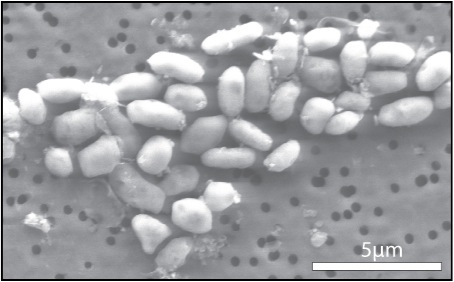
Researchers in the US have discovered a bacterium that uses arsenic instead of phosphorous in its basic biochemistry. To date, all living organisms – from whales to fungi to the simplest micro-organisms – use just six elements in their fundamental chemical make-up: hydrogen, oxygen, carbon, nitrogen, sulphur and phosphorous. Arsenic is chemically similar to phosphorous, but usually when used instead of phosphorous, it can disrupt metabolic pathways causing cell damage and death. This new bacterium, GFAJ-1, has found a way to use the element successfully in arsenic rich environments, proving that life is even more tenacious and adaptive than we could have imagined.

GFAJ-1 is not a totally different life-form. It’s DNA is based on conventional DNA and so it is tied in some way to all other known organisms on this planet. However the door is now opened, just slightly, to the possibility of a “shadow biosphere” – living organisms that are completely different to any known lifeform in this world. Such a discovery would be monumental. It is almost certain to be an area of feverish research in the coming years.

While we are some way off finding life on other planets, the discovery provides us with more evidence that living organisms may exist in worlds very different to our own. Saturn’s moon Titan, for instance, has a carbon rich environment; but its temperature is far lower than any place on Earth. Earth-bound organisms, because of their basic chemistry, would perish in such a world. Creatures with a different biochemistry, however, might find a way to survive on Titan, hence the importance of the announcement today.

The research is likely to be challenged robustly in the coming months and years, but if validated, it will provide new lines of investigation for scientists interested in making the discovery of the century – the finding of truly alien lifeforms.

Today, I brought my kids along to the Discovery 2010 exhibition in Cork’s City Hall. The show is the centrepiece of Science Week in Cork and it features exhibitions from CIT, UCC, Blackrock Castle Observatory, the Tyndall Institute, Lifetime Labs and many more.

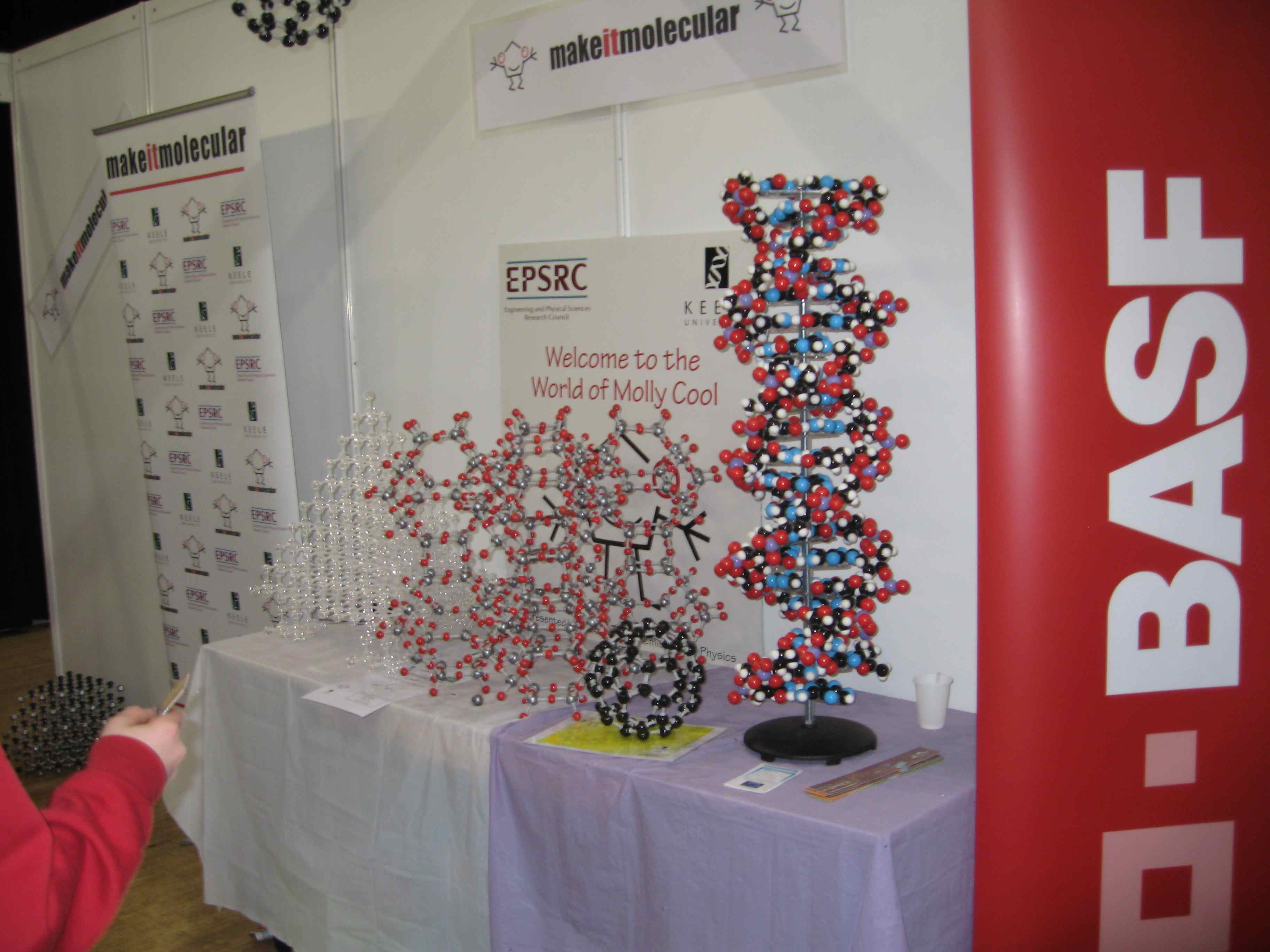
There were tons of interactive displays. The Alimentary Pharmabiotic Centre were showing the kids petri dishes full of bacteria and luminescent microbes from the deep sea. There were Venus flytraps and molecular construction kits in the UCC stall, as well as a strange game that allowed two contestants to challenge each other using mind waves alone. The Tyndall display had a lot of of weird electronics on show, from photoelectronics to nanotechnology to wireless sensors. Pharmachemical Ireland were showing lot of hand-on demonstrations including a great explanation of keyhole surgery. Across the way, the Cork Electronics Industry Association were displaying magnetic levitation (MAGLEV) technologies using flying saucers and rotating spheres.

The Defense Forces and Gardai were there too. The Defense Forces had a highly informative display on land-mines and bomb-disposal. They even a heavy kevlar bomb-protection suit for people to try on for size. The Gardai were handing out high-visibility vests and armbands to all the kids.

Blackrock Castle Observatory were there with the StarDome – a mobile planetarium used as part of their astronomy outreach program. I managed to squeeze myself and the kids in for the last showing of the day. Inside was an informative surround-movie depicting a solar eclipse from the perspective of a base on the Moon. My kids gave it the thumbs up as their favorite exhibit of the show.

I was also highly impressed by some of the demonstrations by the Lifetime Labs people, showing how to make simple batteries out of lemons. They tell me that you would need 500 lemons to light up a small incandescent bulb, so if I notice my kids storing lemons everywhere, I’ll figure out quickly what is going on.

Scattered throughout the show area are many interactive displays. What particularly caught my kids’ attention was a revolving planet model that went beautifully turbulent if you suddenly stopped its motion.

Not only were the displays impressive, some of the people at the show had interesting and inspirational stories to tell. I spoke briefly to Ms Xiao Fang Zhang, who won the European Laurate of Innovation Award for the invention of an air-bubble extractor – extremely important for intravenous infusions of any sort. She is a student of Mechanical Engineering in CIT and is currently studying for her PhD.

The show is well worth bringing the children to. The exhibits are hands-on and geared to what kids are interested in. There is a sense of energy and fun amongst the exhibitors. In brief, the organisers have done a great job and the kids will love it.

TAM London, 16-17th OctoberI spent the weekend in Edgware Road at the TAM London 2010 event.  What a blast! This blog can only give the most cursory summary of the meeting, but I’ll try to pick out some of my highlights.

One of the real highlights for me was the very first speaker, Sue Blackmore. She had an out of body experience in college, leading her to dedicate 20 years of her life to finding conclusive evidence for ESP and paranormal phenomena. Unfortunately, though her work covered everything from Smarties to IRA bombings to Tarot readings, things didn’t turn out quite the way she expected. Her story is one of the most interesting and varied tales I have ever heard. It is a true tale of science, where repeated experimentation lead her to change cherished world views, forcing her to admit that her initial convictions were wrong. If only more people would adopt such an approach in everyday life.

Another highlight was Richard Dawkins. His speech was a tour de force, where he showed that Evolution is capable of providing key insights into such varied disciplines as human anthropology, geology, philosophy, geography, cosmology, politics, mathematics, computer science, engineering, cosmology, linguistics and the history of ideas, to mention a few. Dawkins’ presentation was expansive and poetic, presenting quite a different dimension to Dawkins’ often negative public perception. A pity some of his more strident critics were not there to see his lecture.

Adam Rutherford’s talk on the Alpha Course was delightfully irreverent and funny. He lampooned the methods used by the Alpha Course leaders and questioned their over-reliance on tales such as The Narnia Chronicles and The Lord of the Rings (“it’s boring and slightly racist. It’s a tale about walking’). Rutherford finished his talk flatly stating his revulsion to the Alpha Course’s homophobic views.

Another memorable moment was the talk with James Randi, as he recalled his origins as a skeptic and his battles with Peter Popoff and Yuri Geller. The room went silent as he recounted how Popoff and his wife operated – taking money from the vulnerable while laughing at them in the most vicious way. Randi, the figurehead of the modern skeptical movement, is 82 years old, yet he is still well capable of holding an audience in the palm of his hand.

Just after Randi’s talk two prizes were announced for outstanding achievement in skepticism. Ben Goldacre won one of the prizes, but it was the second winner who brought down the house. The prize was given to Rhys Morgan, 15 years old, who had the temerity to confront and publicly expose the makers of an industrial bleach being flogged off as a “cure” for Crohn’s Disease. There wasn’t a dry eye in the room.

I enjoyed Marcus Chown’s lecture on 10 bonkers things about the Universe. There was a great “pictorial interlude” beforehand and afterwards (I’m a sucker for astronomical images) and Marcus proceeded to bring us on a tour of the cosmos and the arcane world of atoms, black holes and multiverses. Arguably nothing that many in the audience had not heard before, but entertainingly delivered nonetheless and a lecture that should be essential on the outreach circuit.

The second day was also a day where the skeptical movement itself was put under the microscope: what we are about, what we are not about, and the level of “dickishness” appropriate within the movement. The two most powerful contributions were from DJ Grothe and PZ Myers. While their styles might differ, both saw skepticism as a force for good in the world – at the heart of the skeptical movements are shared principles and moral values, a way of looking at the world using science as a tool to winnow the wheat from the chaff, as it were. Grothe warned about zealotry within skepticism, saying that being right is not enough, you have to be good about being right too. PZ phrased this sentiment somewhat differently – “Be the best dick you can be”.

There was far more to this discussion than I could describe here, and similar views were brought up by Stephen Fry in his videotaped interview with Tim Minchin. Fry, with his natural humor, depth and sensitivity, is one of the greatest assets the Skeptical movement has. His response upon being doorstepped by an evangelist preacher got a great laugh: “Tell God to send better people”.

Media matters were also a large part of TAM London, with contributions from Graham Linehan, Cory Doctorow and a panel of commentators including Martin Robbins, Kate Russell and Gia Milinovich. Doctorow talked about copyright reform, comparing the digital media wars to the situation in the fashion industry and the database industry and pointing out that many within “old media” come from industries that once bordered on illegality themselves. “Yesterday’s pirates are always today’s admirals”, as he put it. Linehan talked about the amazing impact of Twitter and took us on a quick tour of some of the web’s nooks and crannies, unwittingly creating a dangerous movement where it looked as if we would suspend the rest of the conference schedule to watch YouTube baby videos on the big screen.

There were wildcards too. Andy Nyman talked about his show Ghost Stories; Karen James talked about the HMS Beagle project; Melinda Gebbie talked about female comic book porn (or is it art? or both?) and Alan Moore brought us on a poetic tour through the town of Northampton. He also gave us his theory of the Big Bang happening in 1927. Moore has broadly left comic book writing behind him in order to focus on underground magazines and new projects.

If I had one criticism, it is the UK-centricity of the event. The event attracted a considerable number of skeptics from all across Europe, yet the discussion at times felt exclusive. Proceeds for the event also were given to promote skepticism in the UK, which is an opportunity lost in my view, at least until TAM events become commonplace across the rest of the continent.

Organisation has greatly improved since the first TAM London event but the venue was still not quite perfect. I felt the auditorium format worked better last year as it made the conference much more intimate. People at the back of the room this year were at a disadvantage. The stage seemed light years away and the video displays were inadequate.

In summary I have to say that TAM London 2010 lived up to expectations. It was a barrage to the senses, a magical mystery tour (in the skeptical sense of that word) and an electrically charged coming together of some of the brightest people I could ever have the fortune to meet. Roll on 2011.
Conor Lenihan, junior minister for Education and Science in the Irish government, must be reeling from the storm he found himself in yesterday. After accepting an invitation to launch a book debunking Evolutionary Theory, he was lampooned and ridiculed with a ferocity I have rarely seen on the Internet. Here are a selection of the comments on Twitter.

“Maybe the author told Conor that it was a book about Job Creationism.”

GSheehy

“Ye Minifter for ye Sciencef of ye Kingdom of Prefter John sendf salutationf&wishef of good health to ye Minifter for Alchemy, Mr Lennyhan.”

– janeruffino

“Conor Lenihan may be late for Wednesday’s book launch as he’ll be trying to rake the moon out of the pond with a hoe.”

Charlieconnelly

And these are just the nice ones.

Lenihan says that he is a friend of the author, that he was attending the book launch in a personal capacity and that doing this for constituents is something public representatives often do. (The author’s website advertised his presence as Junior Minister of Education – this was later changed).

Late last night, the author withdrew his invitation, but you would wonder how the minister is feeling today. If he is feeling wronged, that he was subjected to an attack by the media and the intelligensia, he is missing the point. The reason he got such a strong reaction is because of his cluenessness on this issue. He can no more claim “personal capacity” than if he was attending a UKIP friend’s campaign launch at the launch of the Lisbon referendum. On one hand, we have a government that supports the advancement of science, but on the other hand we have a minister tacitly supporting a book which, no matter which way you cut it, is vehemently anti-science right from page 1. The optics here are terrible. Evolution is one of the strongest theories in science, backed up by over a century of solid evidence, and fundamental to diverse studies such as biology, medicine, genetics and geology. Even someone with a rudimentary understanding of science would understand this. Giving a platform to a man whose only argument is “I am too ignorant to understand it, therefore it cannot be true” is just mind-blowing. Whether he realises it or not, it is very embarrassing for our country’s image abroad, not to mention to him personally.

Maybe, Minister, it’s time you stepped down from your position, took some time to read a few books and not just those with big coloured pictures on them.

It’s beautiful

If you go out on a dark moonless night, you will immediately know what I mean. The Milky Way, stretching its jagged course across the heavens, is quite a sight to behold. The constellations, particularly the winter constellations, have an elegance and familiarity to them. The Moon is also an appealing object, with its ever changing phases and frequent conjunctions with other planets in the sky. Through a small telescope, planetary disks, galaxies, nebulae and open clusters come into view, often startling in their majesty.

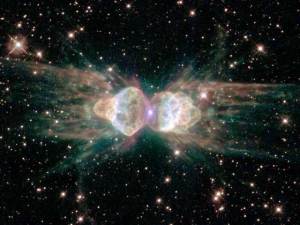
Of course, the beauty of the universe is not limited to what is immediately visible to our eyes. Deep space objects, seen through the largest of telescopes, are candidates for some of the most beautiful things ever seen by human eyes. Who could not fail to be impressed by the wonderful Hubble photos of the Crab and Eagle nebulas, or the views of the outer planets and moons from space probes such as Voyager and Cassini? To see for yourself, each day NASA publishes it’s Astronomy Picture of the Day. Few images ever fail to impress.

It’s extreme.

Nothing can be taken for granted about space. Most of it is unimaginably cold, interspersed occasionally by blisteringly hot stars with coronal temperatures of millions of degrees. Almost everything is racing around at breakneck speed: barreling through space at velocities of hundreds or thousands of kilometers a second relative to us. That’s enough to cause quite an impact if we were to get in their way. All around us catastrophic convulsions are taking place, with vast explosions and unconscionably high energies. This is a Universe of supernovas, neutron stars, magnetars, pulsars and Gamma Ray Bursts – beams of high energy radiation that would eliminate all life on our planet in an instant were our Earth unfortunate enough to stray too close. Black holes exist that can compress the mass of whole stars into volumes a few kilometers wide, creating gravitational fields that nothing, not even light itself, can escape from.

This is the stuff of childhood fantasies. Superpowers. Forcefields. Instantaneous death. The destruction of worlds. It is no wonder that space features so prominently in the minds of the young.

It ignites our curiosity.

Astronomy confronts us with some of the biggest and most challenging problems about the nature of ourselves and the fabric of reality. As a science, it has lead the way in overturning ancient notions of how nature should behave. At one time we believed ourselves to be at the centre of the Universe, with all objects, including the Sun, revolving around the Earth. Astronomers through the ages slowly revealed a different truth. Our star and our home planet are among countless billions in a very ancient Universe. Everything we do ultimately only affects an infinitesimally small piece of real-estate in the cosmos. This discovery, while deeply humbling, is enlightening. It tells us that we will never know everything. Our quest for knowledge is unlimited. We are ants in a cathedral, and what a cathedral it is.

The study of the stars and planets has pushed out the frontiers of knowledge in every direction. It’s contribution to science and mathematics cannot be underestimated. Without astronomy, the modern world as we know it would not exist. Astronomy continues to confound us and guide us right to this day. Gigantic accelerators are busy smashing sub-atomic particles into smithereens to gain greater insights into the nature of matter because objects in space do not always behave the way our current scientific models expect them to. Astronomy has revolutionised our understanding of nature and it will continue to do so.

It tells us about our past.

When you look into space, at any star you care to mention, you are looking into history. You are not seeing the star as it is now, but as it was when the photons of light left its photosphere many years ago. If you can find the Andromeda Galaxy in the sky, you are getting a picture of how it looked two million years ago, long before humans ever roamed our planet. The largest telescopes can see back billions of years ago, to galaxies in their infancy, still in the process of being formed.

History is about ourselves, how we got here, why things are how they are. Astronomy opens history even further by explaining the origins of our planet, our sun, our galaxy – even providing insights into our Universe and how it all started some 13 odd billion years ago.

Astronomy is fascinating even when applied to our own modest human story. We have had an intense relationship with the stars and planets for thousands of years. It guided the ancient cycles of sowing and harvesting. It provided the raw material for belief systems, rituals and religions. It contributed to our language. It assisted with navigation and discovery. In living memory, we have witnessed men walking on the Moon and robot probes being flung out of the solar system – events likely to be celebrated for millennia to come. Our relationship with the stars has shaped the culture of today.

It’s our future.

Astronomy is important to our future, from the short term to the distant long term. Over the coming decades, private companies will take over much of the heavy lifting formerly associated with government agencies such as NASA and ESA. This will create new jobs and new wealth. Bigger telescopes and better equipment will provide insights into reality that will stretch our technological capabilities. Over the coming centuries perhaps we will explore and colonise deep space for ourselves, using technologies yet undreamt of. In the end, billions of years from now, our sun will expand, frying everything on this planet before diminishing in size itself, its fuel spent, its job done.

Perhaps there is a large asteroid or comet out there in space with our name on it. Perhaps our planet will eventually turn against us, forcing us to find a new home. Perhaps we will find a way to cross the enormous gulfs separating us from other stars in our galaxy. All of these possibilities lead us to the conclusion that the stars will feature prominently in the future of the human race.

Astronomy is available to all, from the small child with his toy rocketship, to the octogenarian peering through her telescope at a crater on the Moon. Few endeavours are so wide in scope, so rich in detail, or so marvelous in implication. I invite you to join in.

This blog entry was written to accompany my podcast for the September 5, 2010 broadcast of the 365 Days of Astronomy. The podcast can be listened to here.

One of the high points of my stay in Germany recently was a visit I made to Nördlingen on the border between the provinces of Bavaria and Baden-Württemberg in southern Germany. It’s a beautiful place. It is enclosed by a defensive wall that dates back to the 14th Century – there are only three towns in Germany with this claim to fame. All the buildings are full of character. The town was the site of two battles during the Thirty Years War and were it not for the cars and the shops, you could easily imagine yourself in another time, another era.

But beautiful and all though the town is, this is not the reason I went there. It’s Nordlingen’s surroundings that interested me the most. The town is located in a region known as the Ries: a round, flat plain with an approximate diameter of around 23 km (15 miles).  This area is quite different to the surrounding countryside as the following scale model clearly indicates.

For many centuries, the prevailing idea about how this geological feature came to be was that it was an ancient volcanic caldera. The trouble was that much of the boulders and debris surrounding the  region were of non-volcanic origin. Many ideas were presented as to how this material got there, but it’s didn’t fully add up. The origins of the Ries remained controversial until fifty years ago.

Enter Eugene “Gene” Shoemaker. Gene was an astronomer and he had a few questions. When he looked at the Moon he saw a landscape quite different to the Earth. Everywhere on the Moon he saw craters. Big craters, small craters, enormous craters. Why then was the Earth practically devoid of them? Was it credible that the Moon could be subject to the slings and arrows of outrageous impacts while its larger sister, our planetary home, missed them all? He was convinced that the evidence for impact craters must exist on Earth, but where were they all? Gene had a good idea what kind of material would be created when a large object hit the Earth. It was just a matter of finding it.

Gene found the answer in Nordlingen. During a visit to the town in 1960 he became fascinated by the stones of St Georg’s Church in the centre of the town. He immediately realised that the church walls contained coesite, a material only created as a result of a massive meteorite impact. The rock had been mined locally from the Ries. This lead to a simple, stark conclusion. The Ries had been formed as a result of a gigantic meteor impact. “It was the first big impact crater on the Earth that we could prove was an impact crater, and that just changed the whole ballgame”, said Shoemaker.
Here is what we know. 15 million years ago, two large objects, one measuring up to 1km in diameter, crashed into southern Germany. The large object hit Nordlingen. Hitting the ground at a speed of 45,000 km per hour, it punched a hole 4km deep into Earth’s crust, vaporising on impact. The surrounding rocks were compressed to a quarter of their size by the impact and they responded with an explosion measuring 18,000 megatonnes of TNT, hundreds of times larger than the greatest nuclear bomb ever detonated on this planet. An enormous shock wave killed all living things for a hundred kilometers in every direction with devastating effects felt much further afield. A mushroom cloud 30km high was generated. Much of this cloud, composed of melted rock from deep within the crust, subsequently fell back to earth, covering the crater and the region around the Ries with a material known today as Suevite. The church of St Georg in Nordlingen is built from this material.
A massive amount of bedrock was ejected ballistically, forming rocks known as Bunte Breccia. The deepest rocks landed close to the impact zone while rocks close to the surface were hurled over great distances. Some limestone blocks have been found 70km from the crater while glassy rocks known as Moldavites have been discovered 400km away in the Czech Republic.
The 1km deep hole left by the impact became a lake and life returned to the Ries. Over time the lake itself became clogged with sediment and subsequent glaciations flattened out the region into the wide plain we see today.
A particularly good place to see the crater expanse is the Daniel, the steeple of the aforementioned St. Georg’s Church. From a height of 80 metres you can see in all directions the flat, fertile countryside with the hills forming the outer crater in the far distance.
A smaller meteorite simultaneously hit the region of Steinheim am Albuch, 40km away from Nordlingen. While the resulting crater was much smaller – just 3km in diameter – a distinct central uplift remains. Steinheim is a village well worth visiting. There is an excellent little museum in the hamlet of Sontheim im Stubenthal and plenty of well marked trails with wonderful views of the crater.
Addresses
Nordlingen:
Rieskrater Museum
Hintere Gerbergasse 3
86720 Nördlingen, Deutschland
09081 273822-0
Steinheim
Meteorkratermuseum
Hochfeldweg 5
89555 Steinheim, Deutschland