Archives for category: reviews

Nick Hornby is one of a small number of novelists whose books I thoroughly enjoy reading. He posesses a unique ability to extract humanity and humour out of some of the most difficult situations and to create recognisable, real life characters that the reader warms to, irrespective of what they have done.

A Long Way Down - Nick Hornby

This book, a sort of Breakfast Club for the suicidally depressed, is no exception. I was sucked into the storyline pretty much from the start, despite its weighty subject. Four people with nothing in common, apart from a desire to end their lives, find themselves on the top floor of a well-known jumping off point in South London. Instead of queuing up on the ledge in single file they descend via the stairwell and embark on a series of madcap escapades involving tabloid headlines, an angel visitation conspiracy, a holiday in Tenerife and a riotous meeting in Starbucks.

Each section in the book is written from the viewpoint of one of the main characters. You step inside their heads, as it were. The “star” of the book is Martin Sharp, a former chat-show host very much down on his luck, particularly after having slept with a fifteen-year old girl and ending up in prison as a result. He finds his match in Jess, an eighteen year old foul-mouthed rebel who has alienated herself from everyone around her as she speaks without bothering to inform her brain first. Then there’s Maureen, a middle-aged carer who has lost 20 years of her life nursing her seriously disabled son. Finally there’s JJ, a washed-up American musician, who resorts to lying when asked to explain why he wanted to jump because his reason seems so banal compared to everyone else’s. I got the impression that the author had the greatest degree of sympathy for this character.

The continuous jump into each other’s thoughts is utterly convincing and often quite funny. In Maureen’s sections, all the swear-words are blanked out: for a short while I thought this was an American thing, owing to the fact that I bought the book in Chicago… Swearing by others in the group is often followed by “sorry, Maureen”. The degree of personal insult each person in the group has to endure is cringingly hilarious at times. In the end however, a bond of sorts forms amongst them, and each of them finds out a bit more about themselves.

So, yes, I would recommend this book. It’s full of warm, funny moments with a set of wonderfully complicated characters. It’s not so much a book about suicide as it is about keeping going.

And if this book is ever to be made into a movie, I’d love to see Colin Firth playing the role of Martin Sharp..
I’ve been reading my daughter the tale of Rumplestiltskin over the last day or so. Man, it’s wild! For anyone not familiar with the story, here it is in a nutshell.

A miller foolishly tells a king that his daughter can turn straw into gold.

The king gets interested, siezes the girl, locks her in a room full of straw and tells her upon pain of death, that all the straw needs to be turned into gold before dawn the next day.

An elf appears and for a small fee, offers to do the job. Offer is accepted and hey presto – the straw is converted into gold by the elf.

The king is impressed, but rather than let the poor girl go, he brings her to an even bigger room full of straw, and the nightmare for the girl continues for another few days, with the rooms getting bigger and bigger each time. Every time, the elf saves the day, but the poor girl is eventually obliged to promise her first-born child to him in return for a room full of gold.

Get, this: the girl then marries the king. It’s her reward no less.

She has a baby, the elf comes back looking for the kid, she refuses. The elf then proposes that if she can discover his name in 3 days, she can keep the kid. At the last minute she finds out that his name is Rumplestiltskin (a messenger hears him sing his name as he dances around his house), and when she tells him his name, the angry elf puts his foot through the floor before he leaves and is never seen again.

Now who exactly is the bad guy here? That king is a complete psychopath! I mean, imagine marrying someone who has just threatened to kill you if you can’t do something that should be impossible to do! And, like, what the hell is Rumplestiltskin doing, loudly singing his name outside when so much is at stake? Idiot.

So what was the moral of this tale? “The bigger the bastard you are, the greater the rewards”? “All men are bastards”? “Keep your father away from the drink, because he might say something really stupid”? Possibly all these are lessons to be gained from the story, but should we really be telling our kids this? 🙂

Still though, it makes a welcome change from “Prince Charming”…

I had a very good night last night. Leslie Dowdall and Mike Hanrahan, two of Ireland’s best singer/songwriters and formerly of In Tua Nua and Stockton’s Wing, were playing a gig in McDaid’s Pub in Midleton. It was a great gig – a real feast of music! There were about 30 people present, so it was cosy, relaxed and intimate. Boy, does Leslie know how to sing! It was captivating stuff. I was not familiar with many of the songs, but “Wonderful Thing” and “Beautiful Affair” brought back good memories. They also played a few Annie Lennox and Nick Cave songs along with their own work such as the very touching “Garden of Roses”.

Nights like these, when you don’t really know what to expect, are often the best.

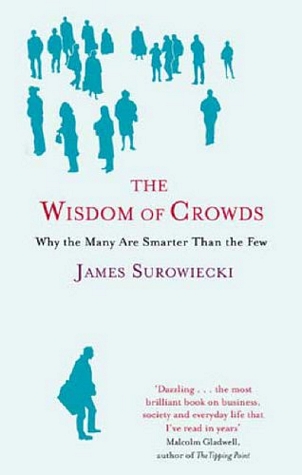
The Wisdom of Crowds is an enlightening book, particularly at the beginning where he spells out his thesis: that, under certain defined conditions, the views of many can often trump the views of one single person, no matter how influential or how much of an expert that person may be.

The Wisdom of Crowds

The book justifies the opinion that forecasting and estimating are better performed by many people from different backgrounds instead of just a single elite. These types of problems, referred to as “cognition” problems, are commonplace – who is going to win the 3.40 at Newmarket, what will our sales be for the next quarter, when will the project be completed, etc.

He then tackles more complex problems, called “coordination” problems and “cooperation” problems, and arrives at a similar conclusion that, left unhindered, crowds of diverse people, acting independently, can arrive at an elegant solution to very complex problems.

In some ways, the book is nothing new. Adam Smith promoted the basic idea over 200 years ago when he talked about the “invisible hand” guiding the market and economists and politicians have been discussing this ever since. Surowiecki asserts that some of the rules of the free market have applications way beyond finance – the inner workings of the Google search engine and the Hollywood Stock Exchange (HSX) are examples that are mentioned.

But, you might be saying, what about stock-market bubbles, group-think, decision by committee, mass-hysteria, riots and all the things that one would attribute negatively to crowds? His view is that crowds work best when a highly diverse group of individuals are able to make independent choices with levels of influence minimised as much as possible. In this way the maximum amount of information can be gleaned from the environment and an aggregation process can then happen which may yield a good answer to the problem at hand. Influence and persuasion are seen as disrupting factors in this process.

If you are looking for a “how to” manual, then the book will be somewhat disappointing. For instance, many business managers face challenges in getting groups to come together to make good decisions. This book provides some tantalising evidence that group decision making is indeed superior, but the reader is left to figure out for themselves how to apply it to their own particular situation.

The book is very readible. It contains a large body of fascinating research material and conveys the conclusions elegantly.