Archives for category: opinions

Storytelling may be the most important means of verbal communication that we have. Stories were the standard form of imparting knowledge from generation to generation for millennia. To this day, some of the best forms of entertainment: movies, novels, plays; are ones that tell a story. Children learn stories at an early age by their parents. We were born to narrate, and to be narrated to.

via youngdoo (Flickr / CC Licensed)

A key aspect of good stories is their coherence. Everything in the story contributes to the message the author wishes to impart. A case is built up, line upon line, until a solid, inevitable conclusion is reached. The aim of the storyteller is to build up evidence that convinces the reader; there should be no loose ends. Incongruence is disparaged. To tell a good story is to make it flow like water from source to sea. Coherence is the power of good storytelling.

In life, we tell stories all the time. We use the tools of the narrator to make our message heard, to compete for jobs, to seek enrichment. The best storytellers find tales that contribute to their narratives. If there is a jarring note, they try to write it out of the plot. There are many techniques to do this. Our stories create coherence, direction and conviction in a otherwise chaotic world.

Via Local Studies NSW (Flickr, CC Licensed)

Stories package life into digestible bites, but we all know that life is not so simple. Stories, by their very nature, are distortions of reality. They place greater weight on some incidents, facts, people, findings and opinions; while minimising the importance of other aspects of a situation. They gloss over complexities in the interest of maintaining attention. Two people can create totally different stories from exactly the same event. If we want to understand real events, we need to treat individual stories with great caution.

Stories are often central to the world-views of people. At the heart of all great political movements, religions, fads and management theories are narratives – ways of looking at the world that emphasise certain aspects while dismissing contradictory information. The filters are so great that people go to the grave convinced of their certainty, even when all the evidence points in the opposite direction.

We should be thankful that we possess narrative thinking, as it is our greatest communication tool. At the same time, we should mindful of its many weaknesses. There are occasions in life where simple narratives are not enough. There are situations where the distortion field erected by narration needs to be pulled down, so that we can understand reality as it is, faults, blemishes and all.

via TED.com

Fortunately, there is a mode of thinking that recognises the failures of the narrative. It accepts challenges head-on. It seeks to understand the biases that plague our patterns of thought. Through testing and experimentation, it matches our premises to reality. This type of thinking does not come naturally to us. We have only engaged with it, seriously and systematically, over the last 400 years. In that time, it has proven itself over and over again; allowing us to see things as they are, rather than how we think they should be. We have a name for this type of thinking.

We call it science.

Image by Jerry ツ

Yesterday, a man called around to the door to do a job. As soon as he had set foot inside the doorway, he started talking. And talking. And talking. He spoke about the government, the police, the criminals, the immigrants, the travellers. He gave us his views on how the law should be changed to benefit the victims and not the criminals. If we thought things were bad now, he said, just wait. They were going to get a lot worse.

It must have gone on for ten minutes. With him just inside the door. No pause in conversation. No chance for us to get a word in edgeways. No realisation that, instead of looking at him, we were staring on the middle distance.

By the time he had finished his work, the world had been set to rights. This would probably have involved the incarceration and expulsion of large sections of the Irish, and non-Irish, population.

Do these people realise they boring the pants off other people? Do they realise how offensive they are being? Do they not pick up on the hints? The lack of feedback, the glazed eyes, the silences that follow their diatribes? Don’t they realise that, if nobody seems interested in what they are talking about, that the correct course of action is to stop? Just to take a breath and listen to what others have to say?

May all of you have a bore free day today.

(Image “Boring” by Jerry ツ Flickr / CC Licensed)

via Long Island Rose, CC Licensed.

We live at a point in history where government policies, exacerbated by economic collapse, have created a dangerously wide gulf between the rich and the poor. Unprecedented indebtedness, unemployment and a widespread perception that government only works to protect the powerful, has brought people onto the streets. The most visible manifestation of this is the Occupy movement, where protesters have taken to camping in financial districts around the world to highlight the problems that rampant market deregulation has caused to ordinary people.

I can see three ways this is going to go.

Perhaps, the whole thing will fizzle out. Economic circumstances might improve; the powerful may close ranks and crush the movement using all the resources of law; people might just get disillusioned and give up. Five years from now, it may well be as if it never happened. In this scenario, the extraordinarily wealthy see no change to their earning potential while vast numbers of the impoverished continue to eke out whatever . Investment bankers and the corporate elite may continue to obtain remarkable salaries and privileges, while the less fortunate find their prospects and benefits eroded.

A second scenario is revolution. This happens where the instruments of state security are not strong enough to withstand public anger. History has shown that, where governments refuse to listen to their people, then eventually the whole political system can break down through riots and widespread violence. This is essentially what occurred in North Africa and the wider Middle East over the last year. The problem here is what comes next. Where there is a political vacuum, all sorts of ideological groups may rush in to take control. Not a pretty picture if you are looking for rational solutions and stability.

Then there is the third scenario: governments listen to the protesters, identify the root causes of the problems, and do something to address it. The core concern of the Occupy protests would be resolved by changes in policy: more equitable taxation, a widening of the safety nets, better and more comprehensive regulation, bolstering the representation of voters and lessening the influence of lobby groups. Such a scenario does not mean the end of business, it does not mean the end of innovation and entrepreneurship, it certainly does not mean socialism, but it does allow for people to air their grievances and to feel that they are being listened to. In the long run, it makes for a healthier society. What is needed are governments with enough teeth to implement badly needed reforms in the face of very well funded vested interests.

Ironically, this last option may actually not be such a good thing for our little island. One of the drivers behind the inequality in the US has been the headlong rush by global companies to outsource labour to cheaper parts of the world with more favourable corporate taxation policies. Should the critical point be reached where these protests translate into changes in government policy, this trend may well go into reverse. Large numbers of unemployed people in the US may force companies to source their labour back from within their home country, and there could be aggressive moves to repatriate taxes earned from abroad. Given our dependence on foreign investment in Ireland, this might be a very bitter pill to swallow.

Our politicians need to take close heed of what is happening, particularly with regard to events unfolding in the US. The Occupy movement, or at least what it represents, may well change the nature of global business and foreign affairs in the coming years. A swing to the left may pose challenges to Ireland, so it is something we need to start preparing for now.

Photo: “Occupy Wall Street: Day 14“, Long Island Rose, CC Licensed.

Photo by hugovk. CC Licensed.

A service station was prosecuted yesterday for “under-measuring” the amount of petrol and diesel going into cars. It was the first ever successful prosecution for this behaviour. The punishment? A fine of 14,000 euro.

For a long time, I have wondered if the amount of petrol going into my car was really the quantity represented in those rapidly whizzing numbers on the pump’s display. The answer, in many cases, may well be “probably not”.

Why wouldn’t petrol station owners mess around with their pumps if the fines are so trivial? Why wouldn’t this be a major problem in the state if yesterday saw the first ever successful prosecution? The message seems to have been to do whatever you like – you will get away with it.

The National Standards Agency inspected 8,000 petrol stations last year, giving out over 2,000 warnings to owners who had their pumps calibrated incorrectly. Two thousand warnings! Just how much money did this translate to? Did the errors go both ways, or just one way? I would love to see the results of a statistical analysis checking if the errors are random, or if they are biased in any way. Such a study would clearly indicate if widespread fraud was taking place.

If I were to walk into a shop and accidentally walk out of it carrying an ice-cream I had not bought, I might well end up in court. Upon conviction I would have a criminal record. It’s a crime to defraud people out of money. The same standard should apply to business owners.

Owners of petrol stations should be criminally liable for the accuracy of their petrol pumps. If their equipment is not working correctly, it should be their primary concern to fix it immediately. If, following a first inspection, favourable errors are discovered, fines should follow, relating directly to the amount of money the pumps may have taken from customers. Subsequent favourable discoveries should be referred to the DPP. Anything else is a travesty.

(Photo “Competing” by hugovk / Flickr / CC Licensed)

Ireland has been victim to a succession of increasingly violent gang related thuggery in the past 20 years. The crimes committed by these characters, from Martin Cahill, to the Westies, to Marlo Hyland, have been abominable in the extreme. What comes across is a kind of fecklessness: people who simply don’t care about anyone, so long as they can they can load themselves up on drugs and money. This pattern of nihilism is not exclusive to Ireland. The blood baths currently taking place in Mexico put Ireland into the minor leagues.

Religious leaders commonly portray such excesses as being caused by godlessness. These people, they say, have rejected God. They imply that widespread rejection of God will make such anarchy commonplace. It’s a frighteningly effective message, perhaps serving to bolster religious faith despite all the past and ongoing revelations of religious indiscretion.

Let’s put to bed the most glaring and idiotic canard straight away: that godlessness equals immorality, and even criminality. Millions of people around the world live good, honest, normal lives without requiring the services of any god whatsoever. Atheists and agnostics have contributed to the betterment of life, campaigned for the poor and sick, railed against injustice and have pushed forwards the frontiers of knowledge – just like many religious people, in fact. The children of non-religious parents grow up in similar environments to kids in religious families and go on to lead lives with just as much promise. There is no evidence that relatively godless and secular societies, such as Norway, the Netherlands or the UK, are on the brink of collapse or have any interest in throwing out common decency or the rule of law.

A second generalisation is that religious people are more ethical than atheists. The facts suggest that this is far from the case. You only need to look at the work of priests, pastors and bishops in the numerous child-abuse scandals around the world to realise that many religious people, whose theological credentials are impeccable, have a lot to answer for. Religious differences have sparked many a war, and many prominent, god-fearing religious people have been found wanting when the details of their lives are uncovered.

Neither does religion provide people with a “get out of jail free” card. The religion of prison occupants tends to match the wider society where they come from (US – predominantly Christian, Middle East – predominantly Muslim), so if religion is stopping people from committing crimes, it does not appear to be working very well.

Now, some more difficult questions. Are gangs predominantly atheistic, and does this contribute to their criminality? Without knowing the true stats, it is unlikely that many notorious criminals are regular mass-goers, or that they care much for any of the trappings of religion. There may well be a correlation between gang criminality and godlessness. But that is not what is being asserted by many pastors and priests. What they are saying is that their godlessness causes their criminality, a very different question. Is the motivation for criminal acts a defiance against God? Or could it be due to more worldly factors, such as their upbringing, education, access to opportunities, peer pressure and personality? It seems that the right people to answer this questions are trained sociologists, not those who are willing to provide pat answers that simply reinforce their prejudices.

Another question is whether criminals who have found God are better people. There are many cases of violent criminals repenting while in prison. One could readily accept that “finding God” in such circumstances has made a positive improvement in these people’s lives. So too, however, does believing in Allah help Muslim prisoners, while Chinese prisoners become better people by studying the words of Confucius. The circumstances of redemption seem to strongly associated with the culture and location of the redeemed person. Maybe, it’s not so much the nature of the god-figure that’s important at all. What may be far more significant is finding a focus, educating oneself, having a chance to reflect on one’s life, becoming part of a community and the assistance of an authority figure or friend who is willing to go the distance with you. The reasons people turn their lives around may be far more attributable to common human approaches than to a deity whom we wish to attribute the turnaround to.

Religious preachers frighten their congregations into believing that godlessness equates to nihilism and the corruption of society, when the reality is totally different. Religious people and non-religious people alike share the same concerns and worries about criminality. The solutions to crime are grounded in common sense, not divine intervention. It’s time this “godlessness” excuse was thrown out, once and for all.


I’m currently going through the painful process of finding a place for my eldest son in secondary school next year. Competition for places is high, so it’s not unusual to find that many schools have an enrolment policy, which helps them decide who gets an offer and who doesn’t. One consideration is whether you live near the school. Another consideration is whether you have a sibling already in the school. Performance in entrance tests and interviews may be considered. In one school we visited, a key criterion appeared to be the extent to which parents wanted their child in the school, i.e., how much they were willing to pester the school management to get their kid a place.

All well and good, but many schools have another card up their sleeve. When you have ticked the suitability boxes on almost everything, your child might still be rejected. He might simply be part of the wrong religion.

Let’s cut to the chase. Children are getting accepted into schools, not on merit, not on ability, but on the overriding need to have the right formulation of strange ideas in their head. Hell, it’s not even their head – it’s expected to be in the heads of their parents. You couldn’t think of a worse reason for a kid to be rejected if you tried.

As far as I know, there is no such thing as Catholic maths, or Protestant geography, or Buddhist science. Schooling is schooling, and, apart from religion classes themselves, your religion should bear no relationship to what is taught in the classroom.

Religion offers people an opportunity to discriminate. Imagine you had to bring your family abroad, to Pakistan, say, and the only school for your daughter was an Islamic school. Part of each day involved learning parts of the Koran off by heart. If you were not Muslim, you would probably be unhappy having her learn it, no matter how well disposed to the school you were. Yet, we don’t see anything wrong with the children of non-affiliated parents being expected to conform to a similar system right here in our own country. Even if the child is exempted from these classes, a line is being drawn quite explicitly between her and other students.

I also wonder whether the “ethos” and “values” cards are overplayed. Religion does not play a part in most workplaces and yet most people seem to be able to show respect for each other. Common humanity: courtesy, manners and compassion, is not the preserve of any one religion or philosophy, as we soon find when we meet people with vastly different upbringings.

The fact that religion can be used as grounds for selection, in such a crucial area of life as education, is a monstrous failure by the Irish State. Religion has no role in the definition of who can be an Irish citizen. Article 44 of the Irish Constitution specifically states that the State shall not discriminate on religious lines. Surely this extends to schools, paid as they are out of taxpayer money?

Here’s my suggestion. It should be made illegal for schools in receipt of public money, to discriminate against children and parents on religious grounds. Ireland urgently needs a level playing field.

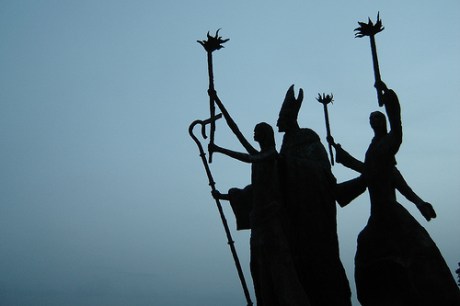
"La Rogativa" (Trevor Huxham)

Two church leaders, Archbishop Michael Neary and Bishop Patrick Rooke, strongly attacked secularism in Tuesday’s Mayo News. They called secularism a cult, and defined it as a philosophy defined by selfishness and greed. It was seen as the “common enemy” – the implication being that secularism was responsible, among other things, for the Celtic Tiger debacle.

These comments completely miss what secularism is about. The basis behind secularism is an acknowledgement that in a free society, people believe all kinds of things and are entitled to believe all kinds of things. It notes, therefore, that it is not the job of government to dictate beliefs to anyone, or to promote a particular set of beliefs above others. Public society should operate on a neutral setting with regard to belief systems, in order to provide a flat playing pitch to everyone. We expect that our schools, our hospitals, our local and national governments, and all offices underwritten by the tax payer, do not discriminate or unduly benefit people, simply on the basis of a particular belief system.

What is self-serving, greedy or cultish about that?

Core to secularism is freedom of speech, and however the churches might object, this includes the freedom to criticise religious beliefs – to expose them to public scrutiny and debate. Despite what it may seem to clerics unused to such questioning, this is the complete opposite of how a cult works – there is no control, no censure, no subjects that are out of bounds. There is no central authority figure. Secularism is called a cult by the clerical establishment because their beliefs are challenged, criticised and occasionally ridiculed.

What happened to Ireland’s economy during the 2000’s was lamentable, but I cannot see how it can be linked to secularism. It’s a safe bet that many of the property developers, regulators, speculators and bankers involved in the boom were practicing Catholics, coming, by and large, from a generation that had much a stronger Catholic influence than we do today. Implying that “they were really closet secularists” is simply a feeble attempt to redefine, for the sake of convenience, what “secularism” and “Catholicism” actually mean.

So I say to these men, grow up. You are living in a society where many different beliefs, and none, coexist. You live in a society where the entitlement and power given to you and your followers is eroding; where people are free to challenge you and to criticise your views, no matter how sacred you think they are; and where greed crosses all mindsets, all cultural boundaries, including your own, yet you see fit to conveniently blame it all on secularism, with no basis whatsoever.

Photo: “La Rogativa”, Trevor Huxham, 2007, (CC Licenced).

Yesterday, I joined a bandwagon, protesting the imminent execution of Troy Davis.

Just because there was a bandwagon doesn’t make the cause right. But it doesn’t make it wrong either.

I don’t know whether Troy Davis was innocent. All I know is that there was significant evidence that the prosecution case was highly suspect. This, on its own, should have been reason enough to commute the death sentence. Reasonable Doubt. Burden of Proof on the prosecution. That kind of thing.

I know that there were victims in this case. A police officer’s family was left bereft in tragic circumstances. If there is a risk that the wrong man was killed in response to this gruesome act, how does this help the family of the police officer?

I know that another man was put to death in Texas on the same night. How does this matter? The issue is not that guilty people are often executed by the US justice system. The issue is that potentially innocent people can be executed and that no one in power thinks that this might be a huge problem.

If Troy Davis were to be conclusively found guilty, it would not stop my repulsion at this execution. He deserved, at the very least, a retrial.

The system failed Troy Davis last night. How many others has it failed? How many others will it fail in the future?

So, the date of May 21, 2011 came and went rather uneventfully, as was to be expected.

The 21st of May had been heralded for some time as “the Day of Judgement” by a tiny, but well financed Christian doomsday cult in California. The figure at the centre of the doomsday prediction was an eccentric civil engineer called Harold Camping. He had confidently predicted that the world would come to an end on May 21, allowing “no possibility” for failure. It was numerology bullshit at its finest and it should have been given no credence nor attention. Such trashy predictions have happened many times before, after all.

Instead, the opposite happened. It became a media and Internet sensation – very possibly the biggest reported doomsday story the world has ever witnessed. I couldn’t watch the news, nor look at my favourite blogs, nor read my timeline on Twitter without someone, somewhere talking about it.

The vast, vast majority of people exposed to this story laughed it off, right from the outset. From what I can see, It was never taken that seriously even by the most fervent of evangelical Christians. But, for whatever reason, it captured the world’s imagination.

Perhaps the certainty of the supporters was the problem, as attested in the accompanying video below. Perhaps it was that they had spent so much money and effort getting their message out there. In any case, they became the laughing stock of the world. Many of them must now be deeply ashamed of themselves. Some of them must be in great trouble if they made financial commitments on the back of this ridiculous story.

Some of them may be able to laugh it off or rationalise it away. There have been many studies into how true believers get through failed predictions such as these. Many of them come up with excuses such as God letting them off the hook, or there being a problem with the calculations etc. Soon, we are bound to see a rash of articles and documentaries on how the followers of Harold Camping adjust to life, now that they find themselves still here.

But inevitably there will be some people who cannot cope with the news. I think this story has the potential to do great damage to many of these people whose only real fault was to set aside their critical thinking abilities and follow an impossible dream.  The results are withdrawal, depression, mental breakdown, and possibly suicide in some cases. These are the private tragedies that we will never hear about, the legacy of which will be felt by families and friends many years after the world’s cameras have turned away from this particular story.

We all can laugh, but it really is a case study in how unfettered belief can be enormously destructive. I feel no schadenfreude this morning.

I saw a Twitter message today that got me thinking. The tweet went along the lines of that if your kid wanted to be a politician you must do everything in your power to dissuade them. You should bribe them out of it if necessary. I can understand where the writer is coming from. Politics is a rough world. It’s a place where lofty ideals often tarnish and shatter in the rough and tumble of power games, bargaining and compromise. The bruising experience of politics leaves many people disillusioned and cynical. It shouldn’t be like this, but it is.

Nevertheless we must pause to consider where we are. We have schools. We have hospitals. We have fire stations and a police force. We eat food and drink water that, most of the time, won’t make us sick. We have rights. We can go to court to protect those rights. We have the right of assembly, press freedom and an electoral system where the powerful have to submit themselves to the wrath of the people who put them there every few years.

We have abolished slavery. We no longer have capital punishment or corporal punishment. Torture, child labour and animal abuse are proscribed.  The voices of women, children, homosexuals, immigrants, atheists, the poor and other marginalised people can no longer be ignored. The society we have today is in many, many respects better than the world our grandparents and their grandparents were born into.

And who, in the end, made it happen? Politicians.

It was politicians who gave people their rights to be heard. It was politicians who argued for child welfare and against slavery. It was politicians who faced tyrannies down and protected our democratic freedoms. It was politicians who wrote the reforms, signed the laws and brought and end to wars. Our society is what it is today because of the work of politicians from our past.

Not all politicians are perfect. Some, indeed, have set back the march of progress and greater freedoms. Many others have little to show for their years of service other than a fat bank account. Yet, some politicians have made a positive difference and those differences have created the society that we have today. The story presented is not an altogether gloomy one.

Now, don’t get me wrong. Society is far from perfect. We still have crime, war, bad health, unnecessary suffering, discrimination, hatred, environmental damage and unconscionable injustice. We have problems in our country that are crying out to be solved. These problems require people of vision. They require people who can look beyond the grubby compromises and roadblocks. They require people who are willing to dedicate their lives to an ideal, mindful that failure awaits at every turn.

In politics, it is not years that make the difference, but decades. We need a cadre of people who are willing to dedicate their lives for a vision. Despite our concerns and our cynicism, we should encourage the most motivated of the upcoming generation to become politicians.