Archives for category: Ireland

Croke Park

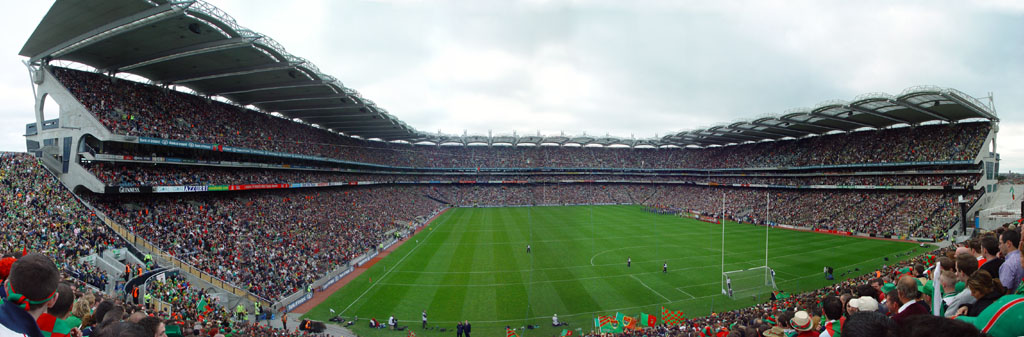
Some of you may know that Ireland has two unique field games – hurling and gaelic football. Both games have massive followings and they draw a fanatical attendance from all over the country during the summertime each year. The two games are by far the biggest sports in Ireland. The games are strictly amateur, and much of the attendance money gained has gone into developing the games and the sporting infrastructure around the island. The greatest achievement from decades of investment is a huge stadium in Dublin called Croke Park. It’s truly enormous. It’s the fourth largest stadium in Europe and it has a capacity of over 80,000.

For decades however, Croke Park has been strictly off-limits to the “foreign” games of rugby and soccer. No major international sporting event featuring these two games has ever happened there. The reason for this is wrapped up with the history of modern Ireland and the foundation of the Irish state.

The Gaelic Athletic Association, or GAA, is the ruling body for hurling and gaelic football. They have always been passionately devoted to promoting all things Irish (particularly Catholic Irish), and this view was hardened during the the War of Independence when in 1920, British Auxiliaries opened fire on a crowd of supporters during a match in Croke Park, killing 13 people. For a long time afterwards, no foreign games were permitted in any GAA ground in the country including, of course, Croke Park*. What’s more, members of the GAA were not even allowed to attend any games of rugby, cricket or soccer. Even though this particular restriction was repealed in the 1970’s, the ban on the use of Croke Park for “foreign games” persisted into the 21st century. Although there has always been a lingering sense of anti-Britishness within the GAA, the prevailing view among supporters of the ban was that the other sporting organisations (i.e. the FAI and the IRFU) had done nothing to deserve access to it – that they were riding on the GAA’s coat-tails, in effect.

All this changed in 2005, after a very passionate and drawn out public debate. The GAA finally agreed to open Croke Park temporarily while Landsdowne Road, the home of rugby and football on Dublin’s south-side, was being refurbished.

Tomorrow, Croke Park hosts its first ever international rugby game – Ireland versus France. It’s a sell-out (and some GAA supporters think it’s a sell-out in another way too), with an attendance that will be more than double that of any home rugby international ever played in the country.

A week or so from now, Ireland will play England in Croke Park. The Union Jack will be hoisted there, and God Save the Queen will ring out from within the stadium grounds.

It’s a bit of history alright.

* with the exception of American Football, Athletics and Australian Rules. Go figure.

Our Toastmasters club ran a poetry and prose evening tonight and for the first time ever, I recited some of my poems in public. I got a particularly good reception to my poem He lies there still. We had about 12 contributors tonight. A few guests spoke, including two visitors who have never been to a Toastmasters meeting before. One guest even told us that she wanted to join the club through the medium of poetry!

For me, the comment of the night was “I couldn’t write poetry. Poetry is far too profound. Nobody should ever underestimate the depths of my shallowness”.

The club has been thriving this year. We have signed up our 7th new member (more than the previous 3 years combined) and all our meetings have been varied and interesting. We made a key decision last year to move to a new venue. We moved from the formal surroundings of the local hotel to the more intimate setting of a pub and this has played a part in making the club more accessible to ordinary people.

I’m really enjoying it this year. Compared to this time last year, it’s like a different world.

I hate writing letters. I hate the effort involved in buying stamps and envelopes (they are never around when I need them), finding out peoples addresses, folding, licking, affixing, finding a suitable post box and dropping off the letter. When I discovered email many years ago, my heart momentarily lept with joy that all this might become a thing of the past, only to gradually realise that letters have not yet gone the way of the camera film or the black and white telly. The lead-up to Christmas does my head in for that reason alone! (Bah, humbug).

It gets worse. In the town in Ireland where I live, the local post-office opens late, closes for an hour-and-a-half at lunchtime and closes early too. Long queues are de-rigeur, with the officials hiding behind a thick barrier of bullet-proof glass. You can’t buy stamps over the counter at any shop in the town, and there is no letter box on the outside of the post-office. If you want to deliver a letter you have to find a public letter box. If it’s a parcel you have to get it weighed in a post-office first unless you have the luxury of a franking machine on your premises. It’s a crap service and we put up with it because they have a monopoly in this country. Nothing much has changed in thirty years. It’s a third-world service in a first-world country.

Why oh why do we still need to affix stamps to our letters in this day and age? Why can’t the postmen and postwomen collect letters from our houses instead of us having to traipse all the way to the bloody post-office to send them?

Here’s what I would love to see from a modern postal service. You write a letter, pop it into an envelope, write on the address or just give a name and post-code. (For familiar addressees, maybe all you need to do is to write their name). You then put this into a mailbox outside your door – the same one as where the letters are delivered – and the postal service does the rest. They stamp each envelope with an electronic barcode and then debit an account that you have set up with the post-office previously. You have many different ways of paying, from a pay-as-you-go option to a flat fee, all paid via direct debit or online or even a good old fashioned cheque, a bit like how mobile phone accounts work. The letters and parcels are delivered efficiently and quickly, and you can do all this without the need for stamps or even opening your front door. Maybe for a small extra fee, they would drop some replacement envelopes into your mailbox every so often so you don’t even have to buy these either?

Is this rocket-science? I don’t think so. Could it be done without too much effort? I think it could. Do I think An Post will do anything like this in my lifetime? Ha! Don’t make me laugh.

I originate from this part of the world. On the south side of the river is Waterford, a small Irish city with a very old and venerable history. On the north side, where I come from, is County Kilkenny. As you can see, one side of the city is relatively well developed, the other side not so much. It’s something of an urban planning nightmare – a city caught between two local authorities who, to put it mildly, are not great admirers of each other.

I was was watching a TV documentary last night that focused in on this particular issue. Waterford badly needs to expand its boundaries and as a result it would like to take over a large tract of South Kilkenny, mainly in my home parish of Slieverue.

The proposal has met with huge opposition from the residents and politicians of South Kilkenny. In 2005, about 10,000 people objected to the plans, but the pressure continues. The issue is very much one of what we Irish might call Tír Grá – love of the homeland. Kilkenny people could never see themselves as Waterford people. We support different GAA teams (hurling being something akin to a religion in Kilkenny), we have strong ties to other Kilkenny communities, and we’re even part of a different province to Waterford.

Nevertheless, there is a contradiction of sorts: Most South Kilkenny people work in Waterford, shop in Waterford and socialise in Waterford. (In truth, because the maternity hospitals are in Waterford, most South Kilkenny people were probably born in Waterford too – but let’s not go there). Waterford, in a sense, is the reason why they live in South Kilkenny in the first place. So, despite loving Kilkenny and wanting to remain part of Kilkenny, from an economic perspective Waterford is the centre of the world for most people in South Kilkenny. Kilkenny County Council has done little to develop the area of South Kilkenny, and the Dublin road is one of the worst in the state. You have to drive on it to believe how bad it is. Most South Kilkenny people owe Kilkenny County Council nothing, and despite people wanting to stay part of Kilkenny, they would be happy enough to benefit from Waterford Council services.

An Irish Solution to an Irish Problem

Isn’t the answer here obvious? Why can’t Waterford City Council accept that the ancient counties of Waterford and Kilkenny are what they are and best left alone, but that other solutions to the problem are possible? For instance, why not set up a Waterford Metropolitan Authority or some other quango to administer the entire region? Cork, for instance, has two local authorities: the City Council and the County Council – you don’t see people getting too upset when their boundaries are changed (actually Waterford south of the river has such an arrangement too). Powerful super-authorities are not new either: the National Roads Authority is one such example, and a successful one too, I might add. A super-authority would neatly bypass the issues associated with land attachment, concentrating instead on day-to-day administrative and developmental issues. All that would be required would be a bit of restructuring, a name change here, a rewriting of some documents there and a strong declaration stating that the areas of South Kilkenny under WMA control are still part of the ancient county of Kilkenny. Robert, as they say, would be your uncle. Ok, it’s probably a bit more complex than this, but you get the jist.

The remaining issue is more a legalistic one to be fought out between the two councils, and it concerns just one thing really: Moolah. Councils get revenue in the form of rates from local businesses and currently Kilkenny County Council receives income from the small number of businesses that exist in the South Kilkenny, revenue that presumably would go to Waterford once the super-authority was set up. And how do you solve issues like this? Anyone? Yes. With moolah. Find a price, negotiate, pay them off. Everyone is happy.

Similar inter-county issues exist elsewhere in the country and, I’m sure, throughout the world. Limerick City straddles the county of Clare and Athlone (in County Westmeath) abuts County Roscommon. The City of Derry is bordered on three of its four sides by the County of Donegal, which not only is another county, it’s in another state altogether! Can we not learn a bit more about how best to deal with such problems and move on?

Another photograph from the weekend. This one is from Inch Beach in East Cork – one of my regular haunts.

Irish country Road by the sea

Over the last few days we have had a continuous barrage of gale-force and storm force winds. Curiously, the weather was meant to be dreadful today but it didn’t turn out like that in Cork at least. It was actually quite a pleasant day..

In any case I still had to get down to the sea to take a few photos. I don’t know about you, but there is nothing like the sea during a storm.

East Cork Storm 4

East Cork Storm 2

East Cork Storm 1

I had a very good night last night. Leslie Dowdall and Mike Hanrahan, two of Ireland’s best singer/songwriters and formerly of In Tua Nua and Stockton’s Wing, were playing a gig in McDaid’s Pub in Midleton. It was a great gig – a real feast of music! There were about 30 people present, so it was cosy, relaxed and intimate. Boy, does Leslie know how to sing! It was captivating stuff. I was not familiar with many of the songs, but “Wonderful Thing” and “Beautiful Affair” brought back good memories. They also played a few Annie Lennox and Nick Cave songs along with their own work such as the very touching “Garden of Roses”.

Nights like these, when you don’t really know what to expect, are often the best.

This weekend was an eventful and pleasent one.

I met a friend of mine from years back in O’Hare, and it so happened that he was sitting right in front of me on the flight. Other than that it was a typical flight – about 90 minutes of sleep and the usual clammy, drained feeling when I finally arrived into Shannon.

I was exhausted (as usual) when I arrived home after driving back from Shannon. I really, really should stop doing this: I’m flying to direct to Dublin from now on. After a 3 hour nap, I headed out to Roches Point, the lighthouse at the eastern entrance to Cork Harbour. It was wonderful. There were some fantastic rock structures out there and the seas were raging. The “harbour effect” was quite dramatic – I could virtually draw a line across the harbour mouth where the waters suddenly became calm. Further on in my travels, I came across a pristine beach that has a stunning cave and cliff backdrop. No photos unfortunately. I’ll definitely be back, though.

Today I took all four kids on a trip up to the Nire Valley in Co. Waterford (once again, no photos 😦 ) . We ambled a short distance to a place where a small river cuts deeply into the valley. Nobody there but ourselves. Flocks of ravens could be seen fighting the air currents. My eldest was thrilled when we came across a megalithic standing stone on our return journey. After looking carefully at the stone, I noticed that the symbol of the cross was incribed in the rock.

I then took a meandering trip to Ardmore, Co. Waterford, the site of one of Ireland’s best preserved round towers (a defensive structure used by monks during Viking times). We found a terrific playground there quite close to the beach, and I pretended to be a big bad monster while the kids tried to defend their playground castle from me. We spent the time there shrieking with joy. It was great fun.

They were exhausted when we got home. One thing though – my eldest son tried to put on a DVD movie (thinking I wouldn’t notice) and when the Universal Pictures intro started – the one with the world turning – my two youngest boys (age 2) started shouting “Earth!!!” and one of them pointed to a small country on the globe and said “Ireland!!!”

He was quite right.

This interview caught my attention on the radio this morning: Richard Dawkins was pitted against David Quinn, a leading Irish Catholic writer. Dawkins has just written a new book called the “God Delusion” (definitely on my reading list).

It didn’t seem however as if Dawkins was terribly prepared for Quinn’s onslaught.

The main arguments coming from Quinn were that physical matter was evidence of God; that atheists could not explain free will (which was also evidence of God); and that atheists were just as responsible for fundamentalism and violence as religious people.

On the question of the existence of matter, just because scientists don’t know everything about the world, it doesn’t mean that “God” is immediately the answer. Quinn, quite unashamedly, invoked a false dilemma, and Dawkins didn’t pick him up on it.

Dawkins completely avoided the question of free will – which was curious because Quinn’s argument seems to be that atheists believe that we humans are completely controlled by our genes, and that we are therefore somehow mechanical in nature. I think he needs to read up on quantum theory, complexity theory, and the unpredictability and emergent effects that arise out of systems as complex as the human brain. It’s not necessary, in my mind, to invoke outside agencies to bring about decisions of free will – the billions of neurons in our brain are well able to yield complex and unpredictable effects when working in concert with each other. Another point about free will is that it appears to me to be a theological concept mainly – it’s never discussed by scientists terribly much. Maybe talking about free will is the equivalent to talking about the colour of the Angel Gabriel’s wings – i.e. a rather meaningless discussion in the first place. In any case, I was a bit surprised that Dawkins steered completely around the question, saying he wasn’t interested in talking about it. In doing so he dug a hole for himself that Quinn was quite happy to shove him in during the final seconds of the interview.

The last piece, on the subject of atheistic morality, Quinn made some good points – particularly regarding atheists who cherry-pick the worst that religion has to offer without balancing this against it’s more benign effects. However, Quinn tried to lump atheists in with some of the worst 20th Century dictators and their followers. He implied that, because atheists do not believe in God, that they often believe in some other weird or cruel world theory that is even more invalid. Shouldn’t a true atheist should be skeptical of everything unless there is proper evidence for it? So, just as an atheist would have problems with Islam or Christiantity, so too should he have problems with eugenics or extreme nationalism or Communist utopianism.

Maybe Dawkins was somewhat unprepared for Quinn’s rather aggressive stance, but he didn’t manage to get his point across very well in the short time allotted. I would have loved to have heard a longer debate on the subject.

It starts from about 8 minutes into the program, and you need Real Player to listen to it.

This photo says it all, really.

Teamwork Ireland 2006