A new cinema is opening in my home-town today, and one movie I really want to see is the Al Gore documentary “An Inconvenient Truth“. I’m sure I’ve got a fairly good idea of the content already without knowing much about it: things are looking bad, here’s one piece of evidence, here’s another, here’s another (oh no), here’s another (enough already), here’s another (oh please, please), here’s another (aah – where’s the razor blades?), here’s what we are doing about it at the moment (not very much), here’s what the major powers are doing about it (climate change, what climate change?), here’s what it all means if we continue to ignore it (death, and doom and destruction and lots of awful yucky things), and finally the inevitable “here’s what we can all do about it”.
Now it’s the last bit that intrigues me the most. What can we do about something like this?
The stock answer is simple. We all get together and co-operate to make things better. Simple in principle. Devilishly complicated in practice.
When I was a kid, the priest at Mass would exhort us to be better people – to reach out to poor people who were less well off than us. They used to plead to people about making changes in their lives to create a more just society. And do you think people listened? Did they heck…
Arguments and exhortations to change are just not very effective. Treaties and agreements are often short term in nature, breaking down when the circumstances change. There are around 200 countries in the world, and do you think they can agree on anything? Not particularly. The Kyoto protocol, itself a badly watered down compromise, is already practically irrelevant. Indeed, even the Universal Declaration on Human Rights, a common-sense corner-stone of how people should be treated, is blissfully ignored by many governments around the world. The same is the case with the Geneva Convention on prisoners of war, along with many other international agreements that are gathering dust as a result of governmental inaction. It’s not just governments who do not co-operate to make things better. On an individual level, SUV sales have never been so brisk, obesity levels are going through the roof, and none of the major tobacco companies have yet gone bankrupt. It’s the price we pay for having high levels of freedom. We co-operate when we see a personal (often short-term) advantage in doing so, otherwise we are perfectly free to opt out.
Long term agreements to co-operate are ineffective because they often go against very fundamental dynamics in our society. Free co-operation is difficult to achieve, because all you need is one defector to upset the apple-cart. The desire to compete for personal gain and to protect what is ours practically define us as humans. Co-operation often makes sense within this context, but when circumstances change and the effect of co-operation becomes self-defeating, the parties to the agreement quickly start looking for a way out.
The only way long-term co-operation seems to work is when it is imposed from a higher authority. The higher authority says “this is how you must behave”, and if you defect, the higher authority imposes strict penalties against you. To meet the challenge of global change in this context, it seems to me you would need a single world government, and a pretty dictatorial one at that. I’m not sure if too many people would be very happy with this. I certainly wouldn’t be.
Is there an alternative to this? Whatever the answer, it needs to comply with social dynamic models – how humans as a group behave in a relatively free environment. Otherwise, it’s probably a failure from the start. For a solution to be effective in the long term, it needs to be economically valid as well as environmentally valid. Economics will always win if there is a conflict. I think there is an alternative, an incomplete and potentially unjust one, but nevertheless quite an effective one.
Human nature is not that prone to major change, but there is one thing in society that changes at breakneck speed. Because of it, each generation often experiences very different and often improved circumstances, compared to the preceding one. The phenomenon is technology: our ability to bend the natural environment to do our bidding – arguably one of the few core competences that sets us apart from other animals in this world.
Technology is an interesting phenomenon in this context because it changes rapidly, it changes the world rapidly, and most particularly because it fits in with human social dynamics. It thrives in conditions of competition and collaboration and it meets a very basic need within us all – the need to make things better. The advances in computing, genetic engineering, space-science, communications, food-science, medicine and materials science are bewildering and beyond the ken of even the greatest 1930’s science fiction writer. We have achieved massive quality of life improvements in our society in just a few generations by letting the tinkerers free to build on ideas from their peers and fore-runners. Why not see how this impressive intellectual capability could be applied against the greatest threat we face to our existence?
Of course, technology has both good and bad aspects to it. It could be argued that the climate change problem itself is a result of technology in the first place. If we had not discovered the industrial potential of coal and oil, things might be very different today. But, if it has caused the problem, then it’s probably a good starting point for finding some solutions too. Technology already has had a huge effect in changing the environment for the better. We have lower emissions from cars and planes, much more efficient fuel consumption, lower levels of industrial pollution, and many alternatives to oil are already available. Compare, for example, the huge coal-burning industries of the start of the century to the much more efficient modern factories of today.
I’m not saying that we should support technology as a solution to our problems because it is the ideal answer, but because it is probably the most effective answer. Technology has a potential to improve societies that can afford it, while ignoring those that are too poor to do anything about it. It also can make very small numbers of people fabulously wealthy, while huge inequalities exist around the world. It’s not perfect, but what it does have the potential to do is to achieve change rapidly. Technology, combined with a degree of governance, can help to quell some of the excesses.
Where governments and powerful organisations fit in is in helping to create the context within which research into these technologies can be fostered. In normal circumstances, this should have happened already, but the current US administration, in its refusal to accept the dire warnings of the IPCC, has put back the effort by a decade. Vital years have now been wasted that could have been productively spent researching and testing technological solutions and alternatives. The reason I single out the US is because of its position of prominence in world economic thinking. When the US commits itself to a goal, other countries swiftly follow suit, particularly if they sense an opportunity to make money.
So, to meet the challenge of rising sea levels and desertification and all the bad things that are predicted, we need to start thinking about economically valid solutions to the problems we face. I think that these solutions can be found, not through ineffective exhortations to cooperate, but through an environment that gives technologists the resources and freedoms to address the problems of the future.
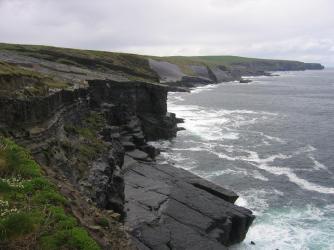
 Today wasn’t exactly the type of day to be putting on boots and getting outside. It had been bucketing down for most of the day. I was keen on going for a walk by the coast, but when I saw the rain pouring down on the balcony I decided that I would need to leave it for another day. But then I got a call from a friend of mine. He was interested in going on a walk, and without a second thought I decided we would do it, rain or no rain.
 My friend was the first person I have ever taken out on a walk on the coast. He has done hillwalking a few times before, but this was different. I’m not sure if he was expecting it to be so challenging. Certain algaes and seaweeds can make boulders very slippery indeed, especially in bad weather.
 Water flooding into a narrow inlet.
 Sea fishing on the rocks
 Moonscape: a boulder field



 Passive Impressions